Meaning at a glance
Cushion cut engagement ring styling is about matching the stone’s visible face and setting profile to finger width and personal taste; evaluate finger coverage by comparing the stone’s carat face or millimeter width to finger width, choose shank and setting to balance comfort and optical size, follow gem-care guidance for treated or fragile stones, and consult a qualified jeweler or gem lab to verify cut proportions, treatments, or authenticity.
What 'cushion cut engagement ring styling' means (definitions and decision criteria)
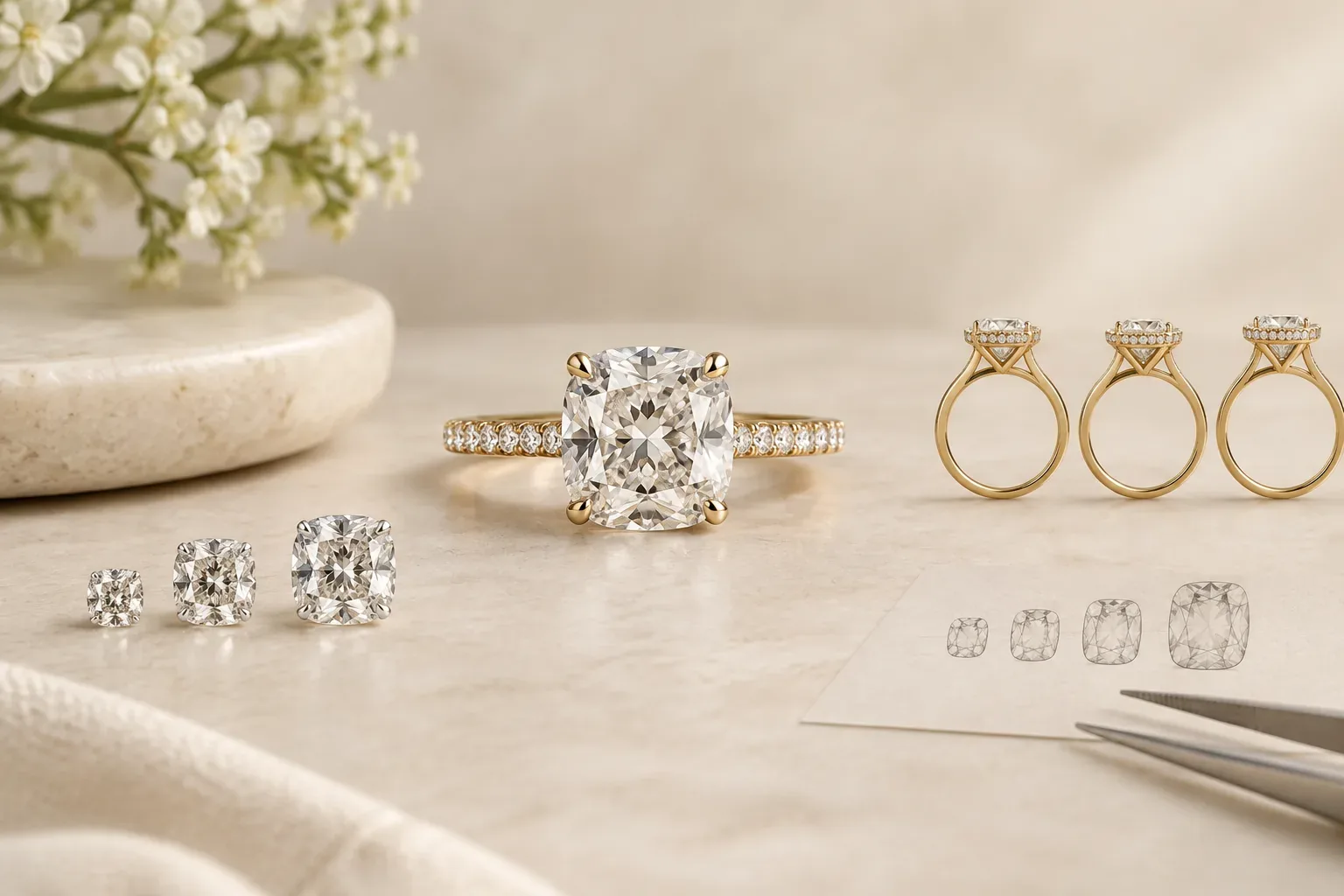
When shoppers search for "cushion cut engagement ring styling" they are looking for practical decisions: how large the stone should appear on the finger, which setting types change perceived size, how to keep the ring comfortable and durable daily, and what trade-offs those choices create. Styling therefore involves four linked choices: the stone face dimensions that determine visible coverage, the setting that magnifies or protects the stone, the shank or band width that balances the face, and finish or accent choices (halos, side stones, open galleries) that alter optical size and wearability.
Useful decision criteria are: compare the stone’s millimeter dimensions to your finger width; decide whether you prioritize low profile (comfort), maximum visible size (presence), or protection (durability); select a setting that complements hand shape and lifestyle; and ensure the metal and mounting suit the stone’s hardness and treatments. These are practical trade-offs rather than universal rules—preferences differ by wearer and occasion.
Historical evidence and cultural associations
There is limited documented historical evidence that ties the cushion cut specifically to a single culture or era as a symbolic motif. Contemporary industry reporting indicates that current popularity is driven more by present-day styling trends, craftsmanship, and consumer preference than by long-standing cultural meaning. For example, Jewelers Mutual describes 2026 demand centering on fluid forms, versatility and modern styling approaches rather than on fixed historical symbolism.
Search and market analyses from trade and digital publishers similarly show modern consumer interest in particular shapes and optical effects rather than evidence of a continuous cultural symbolism attached to cushion cuts across historic periods. Imaginaire Digital’s recent visibility data shows strong consumer search demand for engagement rings and specific shapes, which reflects fashion and search behavior more than formal historical associations.
Documented historical meanings vs modern personal interpretations
Documented historical meanings explicitly tied to cushion-shaped stones are scarce in the major industry references used here; where historians or jewelers have attached meanings to shapes, those meanings often vary by time and place and are not consistently recorded in the trade literature cited above. Because published industry sources emphasize modern styling and consumer preference, any symbolic meaning for cushion cuts tends to be a modern, personal or marketing-driven interpretation rather than a widely documented cultural tradition.
Modern wearers and designers often read personal or contemporary symbolism into cushion cuts—calling them "vintage" or "romantic" for their rounded-square silhouette or praising their soft brilliance—but these are contemporary stylistic labels and personal associations rather than documented historical facts.
How the cushion cut and its motifs appear in jewelry
In practical jewelry terms, the cushion cut appears across a range of settings: solitaire mounts that emphasize face-up size, halo settings that increase perceived coverage, three-stone designs where the center is flanked by trapezoids or rounds, and vintage-inspired mounts with millgrain and filigree. The cut’s shape adapts well to both low-profile bezels and high-prong settings, and designers use halos or side stones to change how much of the finger the ring visually covers.
Industry trend reporting notes a broader move toward versatile and gender-neutral styling, colored gemstones, and modern stacking that affects how cushion cuts are shown and worn. Jewelers Mutual recommends considering versatility—rings that pair well with bands or stack comfortably—to reflect 2026 consumer preferences for flexible styling.
Finger coverage and proportion: practical evaluation and trade-offs
Start by measuring the finger’s width where the ring will sit. The visible coverage is the stone’s face-up width (in millimeters) compared to that measurement. If a stone’s face spans most of the finger width it creates a bold, dominant look; if it covers a smaller fraction it reads as delicate. There are no universal numbers that work for every hand—comfort, personal taste and lifestyle are decisive—but visually comparing sample stones or photos on similar finger widths helps choose proportion.
Consider shank width and profile together with the cushion face. A thin shank next to a large cushion face emphasizes the stone but can feel less stable and be more prone to bending. A wider shank balances a larger face and improves durability but can make the ring feel heavier and reduce the visual contrast between band and stone. A low-profile setting reduces snagging but lowers apparent size; a halo or cathedral setting raises optical size but may catch on fabric more easily.
Trade-offs to weigh: prioritize low profile and a protective bezel or double prongs if the wearer uses hands for manual work. Prioritize halo and high prong settings to amplify presence if daily wear is more formal. For active lifestyles, choose secure prongs, a bezel, or lower table proportions to protect the stone and settings.
Selection and gifting guidance (practical and respectful)
When selecting or gifting a cushion cut engagement ring, make choices that prioritize the wearer’s comfort and daily activities over a presumed ‘‘ideal’’ look. If you are unsure of finger size, use a temporary sizing measure or buy from a seller with a clear return/resize policy. If the gift is a surprise, select a setting and shank style that are easy to resize or exchange.
Respect personal taste: ask indirect questions about preferred metal, profile, and whether the wearer prefers a subtle or statement piece. Where preferences are unknown, a mid-sized face and a versatile design—moderate shank width, optional halo, and a secure mounting—give flexibility and are more likely to pair well with future wedding bands or stackable rings. Choose reputable sellers who provide written disclosures about the stone’s origin, treatments, and any guarantees.
Care advice, treatments and verification limits
Gem treatment, disclosure and durability issues affect long-term care and what you should verify before purchase. The Gemological Institute of America explains that treatments, detectability and durability vary by gemstone and that written disclosure is essential. Ask the seller whether the stone is natural, lab-created, treated, or an imitation and request documentation.
The Federal Trade Commission advises consumers to insist on clear distinctions among natural, lab-created, treated and imitation materials and to get written seller disclosures. If you need authoritative verification of a stone’s origin, treatments, or cut proportions, only a qualified jeweler with appropriate instruments or a recognized gemological laboratory can provide reliable testing and reports. Visual inspection and sales descriptions alone cannot confirm many treatment processes or precise cut metrics.
When to consult a jeweler or a gemological laboratory
Consult a qualified jeweler when you need precise finger sizing, specialized setting alterations, or assessment of mounting integrity. For questions about authenticity, undisclosed treatments, or a formal grading of cut, color, clarity and carat, seek a gemological laboratory report. The FTC recommends relying on written disclosures for purchase negotiations and using independent verification when material origin or treatments matter to value or care.
A professional assessment is also important for insurance valuations and for choosing an appropriate setting for a treated or fragile gemstone. Keep in mind that some attributes—such as subtle heat treatments or clarity-enhancement fillings—may require laboratory instruments to detect and documentary proof to disclose.
Final styling checklist
Before you buy: compare the stone’s face-up millimeter dimensions to the wearer’s finger width, choose setting and shank widths that balance comfort and visual proportion, prioritize secure mountings for daily wear, request written disclosures about treatments and origin, and confirm the seller’s resizing and return policies.
When in doubt, consult a qualified jeweler for fit and a gemological laboratory for treatment and origin verification. Fashion and symbolism are largely personal choices; documented historical symbolism specific to cushion cuts is limited and modern styling and craftsmanship drive current choices.
Frequently asked questions
How do I judge whether a cushion cut will look proportional on a specific finger?
Compare the stone’s millimeter face width to the finger width where the ring will sit. If the face covers most of the finger it will read as bold; if it covers a smaller fraction it will appear delicate. Try photos or mockups on a similar finger width, or ask a jeweler to show the stone on sizing mandrels or finger dummies for an accurate visual test.
Does a halo make a cushion cut look bigger?
Yes, a halo of smaller stones around a cushion center increases perceived face-up size and brightness. The trade-off is additional maintenance (more tiny stones to check) and potentially more snagging if the halo raises the profile.
What can I verify myself and what requires a lab or qualified jeweler?
You can verify finger fit, metal type (by seller labeling and visual inspection), and general construction yourself. Verifying origin (natural vs lab-created), undisclosed treatments, or precise cut proportions requires laboratory testing or a qualified jeweler with gem-testing instruments. The FTC recommends written disclosures and independent verification when origin or treatments affect value or care.
How should I care for a cushion cut engagement ring daily?
Care depends on the gemstone and any treatments it has. Follow the seller’s care guidance, avoid harsh chemicals, remove the ring for heavy manual tasks, and have prongs and settings checked periodically by a jeweler. For details on treatments and special care, consult the Gemological Institute of America guidance and follow any manufacturer or seller recommendations.
If the wearer is active, which setting choices reduce risk of damage?
Low-profile settings, bezels or secure prongs, wider shanks, and protective galleries reduce the risk of catching or knocks. These choices decrease apparent size somewhat, so balance protection with desired presence when selecting the ring.
Sources and further reading
- Imaginaire Digital — Imaginaire Digital
- Jewelers Mutual — Jewelers Mutual
- Gemological Institute of America — Gemological Institute of America
- Federal Trade Commission — Federal Trade Commission