Meaning at a glance
This guide answers how to pair a cushion cut engagement ring with wedding bands by defining decision criteria (shape profile, gap strategy, metal choice), explaining practical trade-offs (comfort, security, ease of resizing, appearance), giving safe care and verification guidance, and clarifying what needs a qualified jeweler or gemological laboratory to confirm.
Quick answer
Pair a cushion cut engagement ring with a wedding band by prioritizing three decisions: choose a band profile that matches the engagement ring's crown and shank to minimize visible gaps, decide whether you want a flush/contoured band or a contrasting straight band, and select a metal based on wear, tone and intended contrast. Trade-offs include comfort and the ability to resize versus the seamless look of a contoured guard; some gemstone treatments and origin claims require disclosure and specialist testing to verify. For consumer-facing claims about treatments or origin, rely on sellers' written disclosures and, when needed, confirmation from a qualified jeweler or a gemological laboratory.
Historical evidence and what the reviewed sources say
In preparing this guide I reviewed the approved industry and consumer sources; none provide a documented, culture-specific history of pairing cushion cut engagement rings with wedding bands. The trade reporting I examined emphasizes contemporary demand and style trends rather than historical pairings: Imaginaire Digital reports 2026 UK search demand patterns for engagement rings and related styles, and Jewelers Mutual highlights modern preferences for fluid forms, stacking and gender-neutral styling. These sources do not record a particular historical ritual or discrete cultural period that prescribes a specific cushion-cut/wedding-band combination.
Because the available evidence from these sources focuses on present-day trends and consumer questions, any historically framed claims about specific cultures, eras or ritual pairings of cushion cuts with wedding bands would be outside the supported material for this article. Where historical meanings or traditional motifs are important to you, treat them as modern interpretations unless you can consult primary historical research or museum catalogs that explicitly document those associations.
Documented historical meanings versus modern personal interpretation
The reviewed sources used for this guide do not establish a documented, cross-cultural symbolic meaning unique to the cushion cut. Historical meanings for ring shapes and motifs are often reconstructed from period jewelry catalogs and museum collections, but those references are not part of the approved evidence here.
Modern interpretations—what a couple chooses to mean by a cushion cut and its pairing—are valid personal meanings. Contemporary trade reporting (Jewelers Mutual and Imaginaire Digital) shows that shoppers now prioritize versatility, stacking, and the visual language of ‘fluid forms.’ Those modern priorities shape how people choose bands: to emphasize continuity, contrast, or wearability. Distinguish clearly between verified historical facts (none provided here for cushion-cut pairings) and these present-day stylistic interpretations.
How the cushion cut and related motifs appear in jewelry
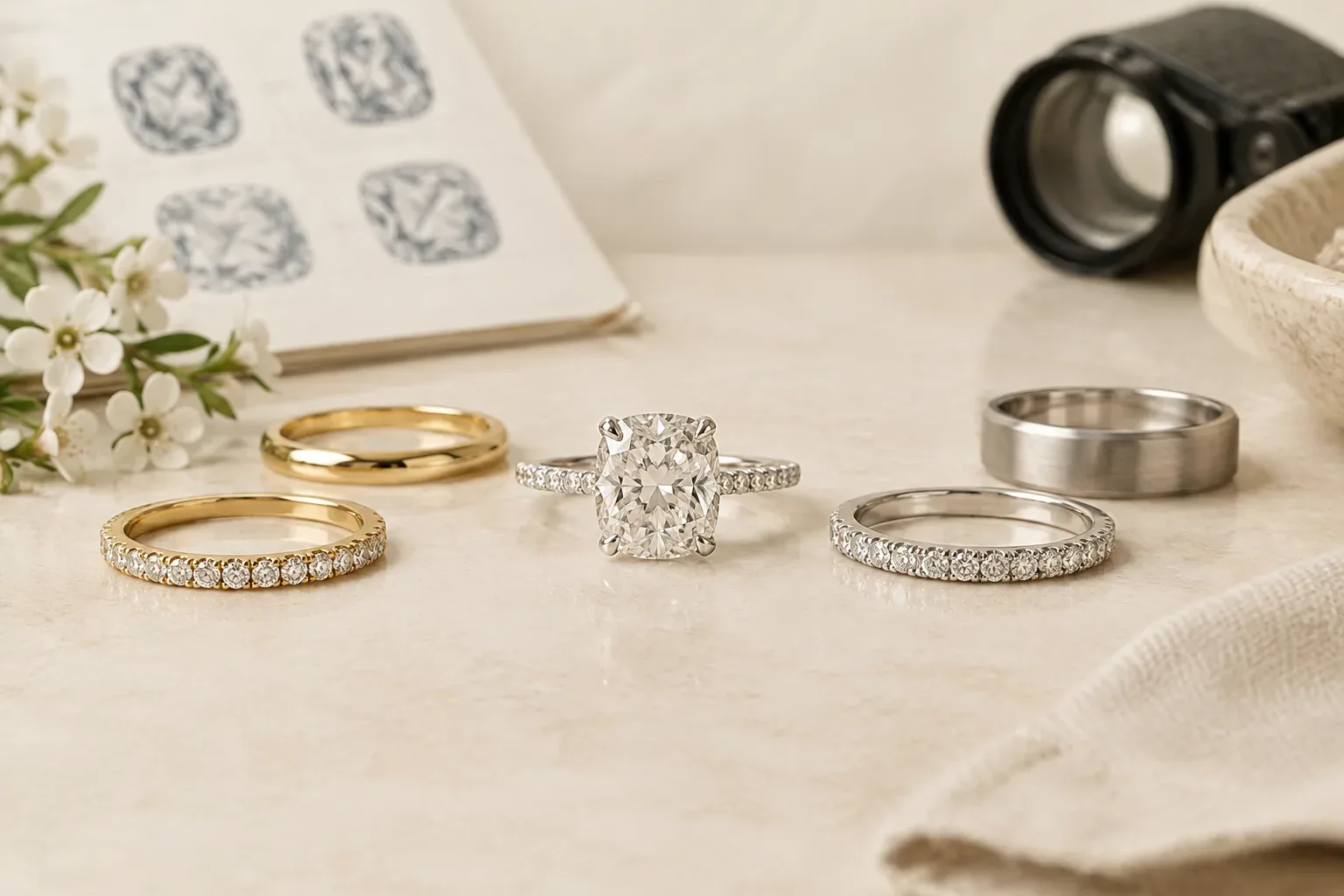
The cushion cut is commonly described as a square or slightly rectangular outline with rounded corners and larger facets that emphasize fire. In jewelry design that outline affects how a wedding band sits: straight bands leave narrow gaps at the rounded corners, while contoured or notched bands follow the profile and close the gap.
Common pairing motifs include halos (a ring of smaller stones surrounding the center stone), milgrain edges, and shared-prong or channel-set pavé bands. Halos emphasize the cushion’s silhouette and can visually bridge a gap, while contoured guards are cut to the cushion’s curve to sit flush. Designers also use spacer rings or full/half-eternity bands to either frame the center stone or add continuous sparkle; choice of motif affects comfort, maintenance and the likelihood of gaps.
Shape and gap strategies: decisions and trade-offs
Decision 1 — Match the profile or not: A matching band that mirrors the engagement ring’s shank profile (flat, domed, knife-edge) gives a cohesive look and reduces shifting. A mismatched straight band can create negative space that draws attention to the cushion’s outline but may need a spacer or guard for daily wear.
Decision 2 — Contoured band versus straight band: Contoured bands are cut to follow the engagement ring’s crown and close the gap, offering a seamless appearance with less lateral motion. The trade-off is reduced flexibility for future resizing and sometimes a more complex repair. Straight bands are simpler and often easier to resize or replace, but you accept a visible gap unless you use a separate ring guard.
Decision 3 — Width and profile: Wider bands can hide small fit imperfections and balance a larger cushion center stone, but they may reduce comfort on smaller fingers. Narrow bands are lighter and easier to stack but can look disproportionate beside a substantial cushion cut.
Decision 4 — Settings and prong types: Cushion cuts often use four or six prongs; lower-profile settings sit closer to the band and reduce gaps while taller cathedral or elevated settings may require a contoured guard.
Metal choices and visual effects
Platinum and white gold produce a cooler, silvery look that often pairs with diamonds to emphasize brilliance. Platinum is more durable and hypoallergenic but pricier; white gold requires periodic re-plating (rhodium) to retain a bright finish. For contemporary styling and durability considerations, Jewelers Mutual’s reporting notes a trend toward craftsmanship and versatile finishes that work across gendered styles.
Yellow gold and rose gold bring warmer tones that contrast with white stones and emphasize vintage or romantic styling. Mixing metals (for example, a white-gold engagement ring with a rose-gold band) is a current stylistic choice and can create an intentional contrast, but expect different wear patterns and maintenance needs over time.
Functionally, choose a metal that matches the engagement ring when you want a seamless set and choose contrast when you want the band to read as a separate design element. Consider skin sensitivity, long-term maintenance and budget when choosing metal.
Gemstones, treatments, disclosures, and what needs specialist verification
If the center stone is a diamond or colored gemstone, the Gemological Institute of America explains that treatments, their detectability and durability are important consumer questions. The Federal Trade Commission emphasizes that sellers should disclose whether a gemstone is natural, lab-created, treated or an imitation and that consumers need written information.
What consumers can verify without a lab: visible craftsmanship, overall symmetry, how two rings sit together when worn, basic metal hallmarks and the seller’s written disclosures about origin or treatments. What requires a qualified jeweler or gemological laboratory: definitive determinations about whether a stone is natural or lab-grown, identification of many treatments, precise grading (carat weight, color and clarity grades), and origin claims for some colored gemstones. For any purchase where those attributes matter to you, obtain written disclosures from the seller and, if necessary, a laboratory report.
Practical and respectful selection or gifting guidance
Start by considering lifestyle and daily wear: active hands, jobs that involve manual work, or frequent travel favor lower-profile settings and durable metals. Try the engagement ring and candidate bands together to judge comfort, stack height and how the gap looks at multiple finger angles.
Respect the recipient’s aesthetic and symbolic preferences. If the engagement ring was selected by a partner, ask explicit questions about whether a matched set is desired, whether mixed metals are acceptable, and whether the wearer prioritizes seamless looks or stackable versatility. If purchasing as a gift, include a clear return or resizing window and written disclosures so the recipient can seek a jeweler’s verification if desired.
Budget and future proofing: a contoured, custom-made guard gives the most seamless look but can cost more and complicate resizing. If you want flexibility, choose a straight band or a detachable ring guard that can be adjusted or replaced later.
Care guidance and safe maintenance
General care: clean gently with warm water, mild soap and a soft brush; dry thoroughly. Have prongs and settings inspected by a qualified jeweler annually or sooner if you notice movement. For insurance and valuation, keep receipts and any laboratory reports together.
Special considerations for treated or fragile stones: because some gemstone treatments affect durability, follow the Gemological Institute of America’s guidance on treatment disclosure and care. Some treatments or fillings can be damaged by ultrasonic cleaners or harsh chemicals, so confirm cleaning recommendations with a qualified jeweler before using mechanical cleaning.
Insurance and protection: consider insuring high-value sets and ask your jeweler about warranty or maintenance plans. Jewelers Mutual’s trend reporting underlines the value buyers place on craftsmanship and longevity, which insurance and regular maintenance help preserve.
What a shopper can and cannot verify without specialists
You can verify fit, comfort, visual match, metal hallmarks and the seller’s written disclosures in the store or during a try-on. You cannot definitively verify many gemological claims—such as natural versus lab-grown origin, the presence and type of treatments, or exact grading—without a qualified jeweler’s instruments or a gemological laboratory report. The Federal Trade Commission emphasizes the need for clear seller disclosures; the Gemological Institute of America explains which treatment claims and durability factors commonly require specialist analysis.
If such attributes matter to you, request written disclosure and a lab report from a recognized gemological laboratory before purchase, or budget for an independent lab report after purchase. Keep expectations realistic: physical examination by sight alone cannot reliably establish origin or many treatment types.
Frequently asked questions
Will a straight band leave a gap next to a cushion cut engagement ring?
Often yes. Because the cushion cut has rounded corners, a straight band commonly leaves a visible gap. A contoured or notched band or a ring guard is used to close that gap for a seamless look.
Is it better to match the engagement ring metal for the wedding band?
Matching metal creates a cohesive set and similar wear characteristics. Contrasting metals are a valid stylistic choice and reflect current trends toward mixed-metal looks, but expect different maintenance and wear patterns over time.
Can I verify whether a cushion-cut diamond is natural or lab-grown at the store?
Not reliably by sight. The Federal Trade Commission recommends written seller disclosures for origin and treatment claims, and definitive verification usually requires a qualified jeweler's instruments or a gemological laboratory report.
Do contoured bands make resizing harder?
Yes. Contoured or custom-fit guards that are shaped to an engagement ring can complicate resizing and repairs compared with simple straight bands, so consider future sizing needs before committing to a custom guard.
How should I care for a cushion cut set daily?
Clean with warm water, mild soap and a soft brush, avoid harsh chemicals, have settings inspected periodically, and check cleaning recommendations with a qualified jeweler if the center stone has known treatments.
Sources and further reading
- Imaginaire Digital — Imaginaire Digital
- Jewelers Mutual — Jewelers Mutual
- Gemological Institute of America — Gemological Institute of America
- Federal Trade Commission — Federal Trade Commission