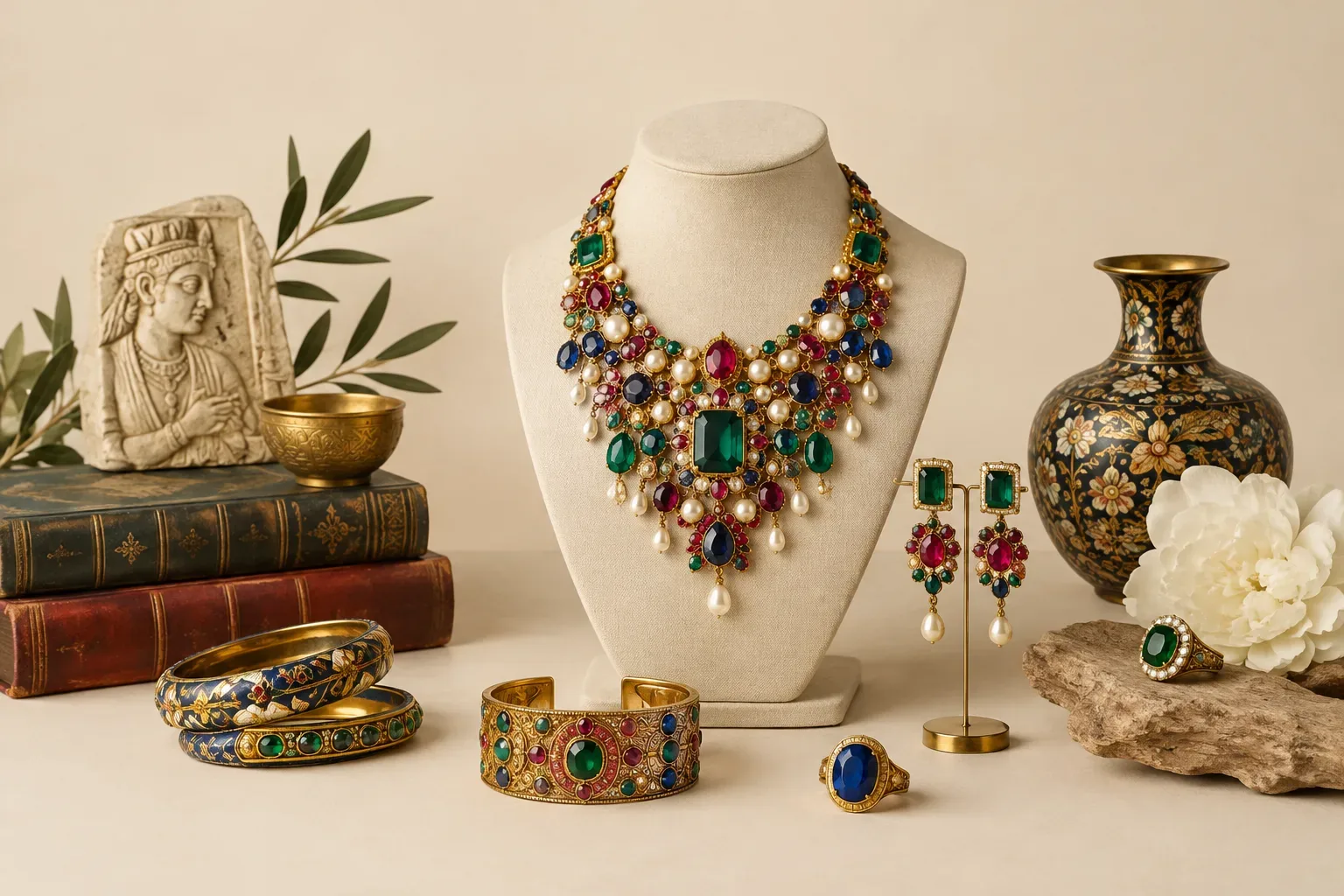
Meaning at a glance
Explain the documented history and changing contexts of jewelry for maximalist wardrobes, clearly separate cultural or religious evidence from later popular interpretations, and offer practical guidance for choosing proportion, color, and focus when wearing or gifting bold, layered jewelry.
Quick answer
Treat jewelry for maximalist wardrobes as a conversation between history, material realities, and personal expression: use documented historical context to inform choices but not to mandate meaning, distinguish long-standing cultural or religious uses from modern fashion reappropriation, and choose pieces by controlling proportion, color cohesion, and a clear focal point so an abundant look reads intentional rather than cluttered.
Why historical context matters
Jewelry has been used across societies not only as ornament but also to signal status, belief, identity, and memory. Curators and historians at the Victoria and Albert Museum describe a continuous record of changing styles and social uses from ancient Egypt through classical Greece and Rome, Byzantine and medieval Europe, the Renaissance and the Georgian and Victorian periods, into modern 20th- and 21st-century fashions. Knowing that history helps a maximalist approach draw on layers of reference—technique, material, or motif—without mistaking modern trends for ancient prescriptions.
When assembling a maximalist wardrobe, that background is practical: a technique such as filigree or a material such as enamel has different visual weight and fragility than a cast metal chain, and certain motifs have been used with specific meanings at particular times and places. Consulting museum resources and reputable historical surveys gives clarity about which associations are historically documented and which are later or popular reinterpretations.
Documented historical meanings versus modern personal interpretations
Some meanings attached to jewelry are documented by historians. For example, the V&A’s research records how signet rings functioned as seals of authority in Greco‑Roman contexts and how portraiture and sentimental motifs were emphasized in later European traditions. Museums document mourning jewelry and portrait lockets as important practices in certain periods, and they catalogue how materials and techniques signaled social rank or professional affiliation. These are historically specific phenomena tied to time, place, and social systems, as detailed by the Victoria and Albert Museum.
Modern wearers frequently reassign or personalize meaning. A dramatic coral necklace that once signaled seafaring trade may now read as a bold color statement; a dragon or lotus motif may be adopted for aesthetic reasons or to signal personal values unrelated to its original cultural or religious functions. Those contemporary readings are valid as individual expression, but they are distinct from the historically documented uses preserved in museum records. Keep those two registers separate: documented historical meanings tell you what a motif or technique meant in context, while personal interpretation explains what it means to you or your recipient today.
How motifs, gemstones, and traditions appear in jewelry
Motifs and traditions enter wearable form in predictable ways: religious symbols and amulets often become pendants or charms; portraiture and cameos become lockets, brooches, or intaglios; and geometric or floral designs are executed in metalwork, enamel, or stone setting. Techniques such as enamelling, filigree, and granulation give particular surface textures and light responses that influence how a piece reads in an abundant ensemble.
Gemstones are central to color strategy. The Victoria and Albert Museum’s A–Z of Gemstones explains how specific stones have particular optical characteristics—brilliance, translucence, or deep saturation—that affect how they pair with other elements. For a maximalist look, densely faceted stones reflect more light and read as high-energy accents, while cabochons and opaque stones provide color mass and grounding. Practical care and consumer protection matter here: the U.S. Federal Trade Commission recommends sellers disclose treatments, enhancements, and imitations of gemstones, so a buyer or giftee can understand an item’s material reality and expected durability.
Choosing proportion: scale, balance, and silhouette
Proportion is the single most important control when you wear many or large pieces. Begin with body scale and outfit silhouette. On a large‑scale coat or a voluminous dress, opt for broader necklaces, oversized brooches, and long, dramatic earrings. On a narrow, streamlined silhouette, medium‑scale combinations or one very large focal piece with small complementary items will read more harmonious. Consider how negative space works: a dense collar of necklaces demands simpler earrings, while chandelier earrings need space around the face, so collars should be lighter or shorter.
Think vertically and horizontally. Layer multiple necklaces of graduated lengths so the eye can travel without colliding; balance heavy bracelets with rings and a statement watch on the opposite wrist or hand to distribute visual weight. If you prefer symmetry, mirror large earrings with a central necklace; if asymmetry appeals, offset a large brooch to one shoulder and a stack of rings on the opposite hand. Maximalism is not randomness—its success depends on proportional control.
Choosing color: harmony, contrast, and materials
Decide whether you want the overall effect to be harmonious or strikingly contrastive. For harmony, limit your palette to two dominant colors or tones and add a third as an accent. For example, warm gold metals paired with amber and coral stones create a cohesive warm field; cool white metal with sapphires and aquamarine yields a crystalline, cool field. For deliberate contrast, mix warm and cool metals and pair complementary gemstone colors, such as deep blue with warm orange tones, to create high-impact tension. The optical properties of gemstones noted by the Victoria and Albert Museum—transparency, dispersion, and surface luster—will determine how colors read in light and in layers.
Mixing metals can work if you anchor the look with a repeating element, such as a repeated motif or a consistent stone color. Textural contrast—matted metals against high polish, or rough‑cut stones alongside faceted gems—also markets a maximalist look without requiring a crowded color palette.
Choosing focus: anchor pieces and supporting elements
Choose one or at most two anchor pieces that define the outfit: a cocktail ring, a bib necklace, or an architectural brooch. Everything else should support that anchor either by echoing its color, repeating a motif at smaller scale, or providing a contrary texture so the anchor remains the visual centerpiece. Supporting elements can be numerous—stacks of thin bangles, layered chains, small studs, charm bracelets—but they should read as ensembles that relate back to the anchor.
For wearable variety, plan for interchangeable anchors. A single outfit can accommodate a dramatic collar for evening, or the same pieces rearranged as layered necklaces for daytime. When gifting, consider giving a versatile anchor or a set of supporting pieces that can attach to an existing anchor so the recipient can integrate the new item into their maximalist approach.
Practical buying and gifting guidance
When shopping, use reliable descriptions and ask about treatments, enhancements, and imitations. The Federal Trade Commission advises consumers to seek transparent disclosure about gemstone treatments and any simulants; that transparency affects value and care. Inspect clasps, jump rings, and prongs—maximalist layering stresses connections through wear, and a weak clasp will fail a complex ensemble.
For gifting, research the recipient’s personal style and any cultural or religious associations of motifs you plan to give. If a motif has a documented spiritual or communal function in a particular culture, do not presume it is neutral; either choose a secular design inspired by the form or ask the recipient if such symbols are welcome. If you are purchasing vintage or antique pieces, verify provenance and condition and ask about any restoration work. When in doubt, choose an adaptable anchor piece—an oversize pendant, a sculptural ring, or a convertible necklace—that allows the wearer to integrate it into different maximalist combinations.
Respectful selection: provenance, symbolism, and adaptation
Respect for cultural provenance and religious symbolism is essential. Museums record that certain motifs and objects have been used as sacred or communal markers; borrowing a visual element for fashion can be fine if done knowledgeably and respectfully, but it becomes problematic when it trivializes living traditions. Research a motif’s documented role in its originating culture using reputable sources such as museum catalogues and specialist scholarship, and prefer contemporary makers from the tradition if you want an authentic, ethically sourced piece.
Adaptation is a constructive route: choose designs that reference a formal element—a repeated geometric pattern, a color combination, or a technique—without appropriating sacred iconography. Commissioning a maker who understands and respects the source culture is another respectful strategy, and asking the recipient directly about cultural preferences is often the best course when gifting.
A short buyer’s checklist
Before you commit, clarify the scale you want, confirm gemstone treatments and metal content, check closure and structural strength, consider care needs for delicate techniques, and reflect on cultural associations. If you are buying vintage, request documentation of provenance and condition. For gifts, think in terms of versatility and cultural sensitivity rather than only visual drama—an adaptable anchor piece or a set that integrates with the recipient’s existing jewelry will be used more often than a one-off novelty.
Closing
A successful maximalist wardrobe uses abundance with intention: historically informed choices add depth but do not prescribe personal meaning, and careful attention to proportion, color, and focus keeps the look coherent. Use museum resources to learn documented contexts for motifs and gemstones, follow consumer-protection guidance about materials and treatments, and choose or gift jewelry that balances a clear anchor with thoughtfully supporting pieces so richness reads as design rather than disorder.
Frequently asked questions
How do I start a maximalist jewelry look without feeling overwhelmed?
Begin with one clear anchor piece—a bold necklace, a cocktail ring, or a sculptural brooch—and add small supporting items in graduated scale. Keep the color palette to two dominant tones plus one accent to maintain cohesion, and balance visual weight across the body by placing heavy pieces and lighter complements opposite each other.
Are there motifs I should avoid because they are culturally sensitive?
Yes. If a motif has a documented sacred, communal, or religious role in a living culture, research its provenance and contemporary meaning before using it as fashion. Consult reputable museum resources or, when possible, creators from the source culture. When in doubt for a gift, choose a secular or adapted design instead.
How do gemstone treatments affect what I should buy or gift?
Gemstone treatments and simulants affect value, durability, and care. Follow the Federal Trade Commission’s guidance: ask for clear disclosure about enhancements, heat treatments, dyeing, or synthetic substitutes so you can make an informed choice and understand long‑term care needs.
Can I mix many colors successfully in a maximalist wardrobe?
Yes. For a cohesive maximalist palette, choose either harmony—two dominant tones and a single accent—or deliberate contrast using complementary colors. Anchor the mix with repeated elements, such as a recurring metal or repeated motif, to avoid a chaotic appearance.
Is vintage or antique jewelry better for maximalist styling?
Vintage and antique pieces add historical depth and unique texture, but verify condition and provenance before purchasing. Older techniques may be more delicate, and restoration history can affect wearability; when buying, request documentation and, if necessary, professional conservation advice.
How should I care for delicate techniques like enamel or filigree in a layered look?
Protect delicate techniques by avoiding abrasive contact with hard stones or sharp edges, check settings regularly, and store pieces so fragile surfaces do not rub against one another. When wearing layered looks, plan placement so fragile elements are not sandwiched between heavy pieces.
Sources and further reading
- Bedazzled: A History of Jewellery — Victoria and Albert Museum
- An A-Z of Gemstones — Victoria and Albert Museum
- Buying Gemstones, Diamonds, and Pearls — Federal Trade Commission