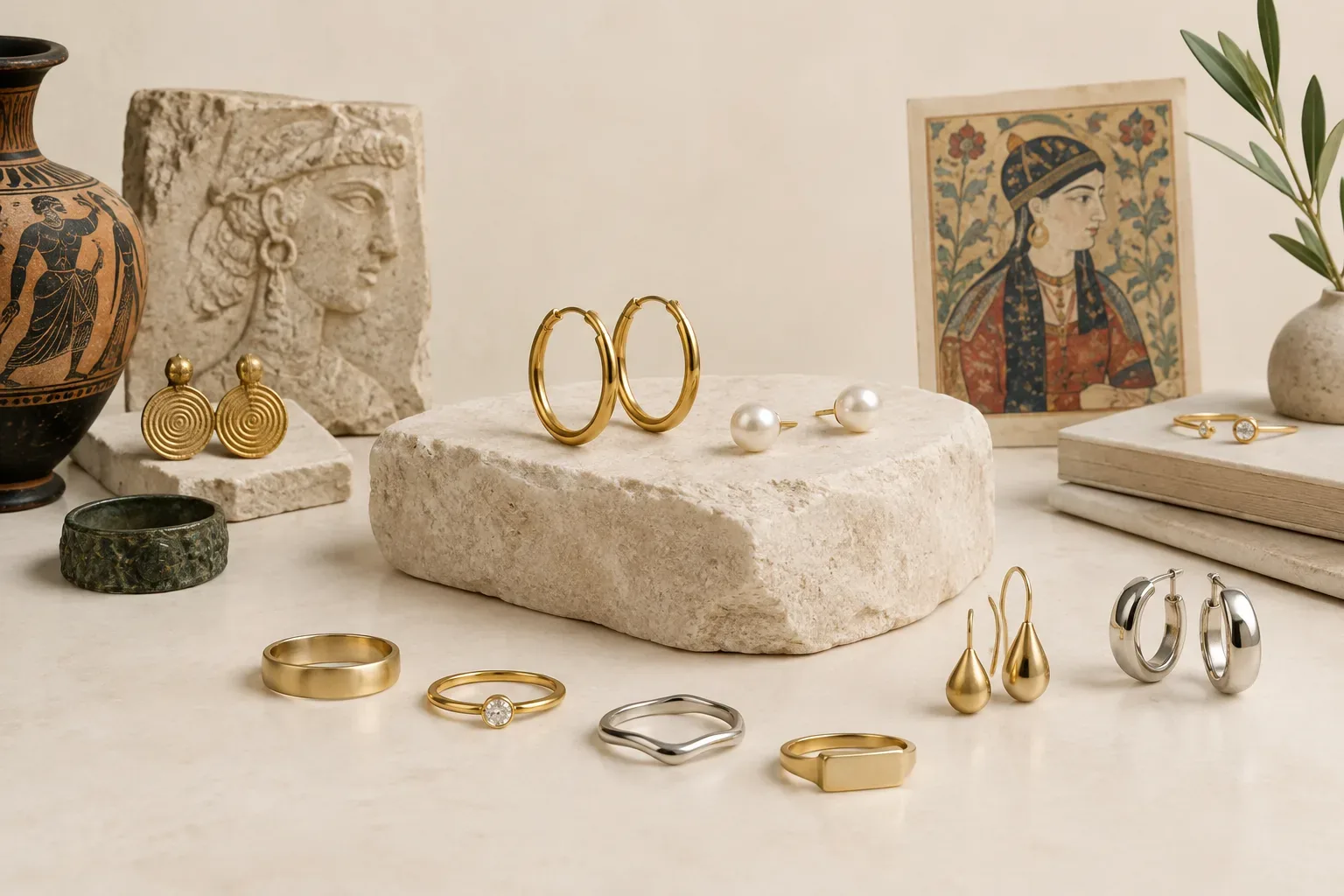
Meaning at a glance
This guide explains the documented history and evolving contexts of earrings and rings, separates historical meanings from modern personal interpretations, and gives clear guidance on choosing comfortable, proportionate pieces for minimalist wardrobes.
Why historical context matters for minimalist jewelry
Jewelry has never been purely decorative. The Victoria and Albert Museum documents that across ancient, medieval, and later periods jewelry signified status, identity, and memory as well as aesthetic preference. For people building a pared-back wardrobe, knowing how forms like studs, hoops, simple bands, and signet rings developed helps you choose pieces that are visually restrained but culturally informed.
Understanding documented history also prevents accidental appropriation or misinterpretation. Many motifs and formats that now read as minimal were once loaded with social or ritual meaning; the V&A’s overview of jewellery history shows how meanings and uses change over time and between cultures, so what feels neutral today may have a distinct history worth acknowledging.
Documented historical meanings, by culture and period
Ancient Mediterranean and Near Eastern contexts: Museums such as the Victoria and Albert Museum record that rings and earrings in ancient Egypt, Greece, and Rome often indicated social status or legal identity; signet rings, for example, functioned as personal seals in Roman contexts, while other rings announced rank or affiliation. These are documented uses rather than universal symbolic meanings.
Medieval and early modern Europe: The V&A notes that rings and simple metal bands could serve as betrothal or mourning tokens in different periods. Jewelry functioned as portable wealth and as a marker of social relations; styles shifted with economic and technical changes such as improved metalworking.
Victorian and nineteenth-century Britain: The V&A’s broader history of jewellery highlights how nineteenth-century tastes emphasized sentimental motifs such as lockets and memorial pieces. During this period, decorative choices were often shaped by mourning practices and by mass-market production technologies.
Gemstones across times: The V&A’s A–Z of Gemstones explains how particular stones were prized for durability, color, or cultural associations in different eras—for instance, pearls and diamonds being prized for their luster and symbolism in European high society. Those historical associations are documented uses and cultural preferences recorded by museums and curators.
History versus modern personal interpretation
Documented historical meanings are what museums, catalogs, and primary records show about how people used and understood jewelry in particular times and places. For example, the V&A documents signet rings’ use for sealing documents and the role of mourning jewelry in nineteenth-century Britain. These are historical facts about use and context, not contemporary prescriptions for meaning.
Modern personal interpretation is what an individual today chooses to feel or signal when wearing a piece. A tiny hoop may be chosen because it reads as calm and unobtrusive in a minimalist outfit, not because of any historical meaning. Both layers matter: historical context informs respectful choice, and personal interpretation helps the piece work within a modern wardrobe.
How motifs, gemstones, and traditions appear in minimalist jewelry
Motifs: Minimalist jewelry typically reduces motif to an essential line or silhouette. Traditional motifs—such as a signet oval, a small cross, or a botanical curve—are often rendered as flat, polished shapes or tiny reliefs so they read quietly against neutral clothing. When a historic motif is used, museums like the V&A show that its original context may be very different from how contemporary wearers read it.
Gemstones: The V&A’s A–Z of Gemstones catalogs many stones and their historical uses. In minimalist pieces, gemstones are usually small cabochons or single melee diamonds set to avoid visual clutter. Stones with enduring color and durability—such as small diamonds, sapphires, or pearls—are commonly used because they hold up to daily wear and maintain a refined look at a small scale.
Traditions and construction: Minimalist earrings and rings often borrow traditional construction techniques—such as bezel settings, flush-set stones, and hollow or tube construction—to reduce weight and to achieve a smooth profile. These techniques have historical precedents recorded by museums but are adapted today for comfort and low profile rather than for the original ceremonial uses.
Choosing for scale, shape, and comfort
Scale: For earrings, aim for pieces under about 15–25 millimeters in diameter for small hoops or huggies and studs in the 3–6 millimeter range if you want a quiet look that reads as intentional rather than absent. For rings, narrower bands (1.5–3.5 millimeters) keep a minimalist silhouette while wider signets or statement rings should be scaled so they do not overpower slender fingers. These are practical proportions rather than historical rules.
Shape: Simplify shapes to basic geometry—small circles, ovals, flattened bars, and thin polished bands—because these shapes layer well with minimalist clothing. Avoid complex dangling forms if you value a clean neckline and minimal visual movement; choose threader styles conservatively and prefer pieces that sit flush to the skin or ear lobe.
Comfort and construction: Prioritize lightweight construction and smooth profiles. Bezel or flush settings protect stones and reduce snagging, and hollowed shanks or tube-style rings cut weight without sacrificing visual presence. For earrings, check the backings—screwbacks, low-profile friction backs, or hinged closures add comfort and security. If metal sensitivity is a concern, choose solid gold (14k or higher), platinum, or implant-grade titanium; vermeil and sterling silver can be good options if the wearer tolerates them.
Durability and daily wear: If the piece is for daily wear, prefer harder gemstones and lower-profile settings to avoid chips or catching. The V&A’s gemstone summaries explain stone hardness and durability which inform suitable choices for everyday minimalist pieces.
Material truth and disclosure
When buying or gifting, be attentive to material disclosures. The Federal Trade Commission provides guidance that sellers should disclose treatments, enhancements, and imitations used in gemstones and pearls. If a stone is treated, filled, dyed, or simulated, that information affects long-term care and perceived value. Ask sellers or check labels for treatment disclosures and metal fineness marks so recipients know what they are receiving.
For gold and plating, know the difference between solid gold, gold-filled, and gold-plated items: plated surfaces wear differently and may not suit someone who wants a long-lasting minimalist investment piece. The FTC’s consumer guidance is a practical resource for understanding these differences before purchasing.
Gifting and respectful selection guidance
Respect cultural and religious symbols. If a motif has clear cultural or religious meaning—documented historically in museum or academic records—ask whether the recipient is comfortable wearing it before gifting. Historic use documented by trusted institutions like the Victoria and Albert Museum can provide context, but personal and community meanings today may differ.
Size and fit: For rings, discreetly determine size by borrowing a ring of the recipient’s or a close relative’s, or ask for a known size. For earrings, check whether the recipient has multiple piercings or preferences for studs versus hoops. Prioritize comfort over looks: a beautiful piece that irritates the skin or pulls on lobes will not become a wardrobe staple.
Material preferences and allergies: Ask about metal sensitivities and daily-care habits. If you do not know, choose hypoallergenic metals such as platinum, titanium, or higher-karat gold. Keep receipts and choose sellers with reasonable return policies in case adjustment or resizing is needed.
Meaningful presentation: If the historical meaning of a motif is important to you as the giver, state that context when you present the piece but make it clear that the recipient may attach their own interpretation. Reference materials from museum resources can provide reliable context without asserting universal meanings.
Practical styling examples for minimalist wardrobes
Day-to-day neutral look: Pair a 3–4 millimeter bezel-set solitaire earring or small polished huggie with a 2-millimeter plain band for a cohesive, non-distracting look that layers easily with sweater collars and shirt collars. The small scale keeps the eye on silhouette and fabric rather than the jewelry.
Work wardrobe: Select a pair of closed small hoops (10–15 millimeters) or flat studs and a slightly thicker band as a subtle anchor. Choose low-profile settings to avoid catching on clothing during active workdays.
Evening minimalism: To elevate a monochrome evening outfit, choose one slightly larger element—a small signet or single elongated bar earring—balanced with ultra-narrow stackable rings to maintain minimalism while adding intentional contrast.
Final notes
Minimalist wardrobes reward pieces that are quiet in scale but rich in craftsmanship. Use documented histories from institutions like the Victoria and Albert Museum to inform respectful choices, and rely on consumer guidance such as the Federal Trade Commission’s recommendations to understand material disclosures. Above all, choose earring and ring designs that prioritize comfort and proportion so the jewelry becomes a natural extension of a pared-back personal style.
Frequently asked questions
What earring sizes work best for a minimalist wardrobe?
Small studs (3–6 mm) and huggies or hoops under 25 mm usually read as minimalist. Choose low-profile post backs or hinged hoops for comfort and to reduce snags.
How wide should minimalist rings be?
Narrow bands between 1.5 and 3.5 millimeters are typically minimalist; thinner bands layer well. If you prefer a single statement ring, keep the overall silhouette simple and balance with narrow bands on other fingers.
Are gemstones appropriate for minimalist styles?
Yes—use small, hard stones such as melee diamonds, sapphires, or single pearls in bezel or flush settings to maintain a low profile. Consult reliable gemstone references to choose durable stones for everyday wear.
How can I avoid cultural insensitivity when gifting jewelry?
Research a motif’s historical context using reputable sources and ask the recipient about their comfort level if the symbol has cultural or religious significance. Museums like the Victoria and Albert Museum provide historical context without prescribing modern meanings.
What should I ask about material disclosures when buying?
Ask whether stones are treated or simulated and whether metals are solid, filled, or plated. The Federal Trade Commission advises buyers to request treatment and imitation disclosures because they affect care and value.
How do I ensure comfort for daily wear?
Choose lightweight construction, smooth settings (bezel or flush), and hypoallergenic metals if needed. For earrings, pick secure, low-profile backings; for rings, ensure a correct fit and consider rounded inner shanks for comfort.
Sources and further reading
- Bedazzled: A History of Jewellery — Victoria and Albert Museum
- An A-Z of Gemstones — Victoria and Albert Museum
- Buying Gemstones, Diamonds, and Pearls — Federal Trade Commission