Meaning at a glance
This article explains the documented history and changing contexts of necklace layering for evening wear, separates historically attested meanings from later personal or popular interpretations, describes how common motifs and gemstones are used in layered evening necklaces, and gives practical guidance on choosing, arranging, and gifting layered necklaces while avoiding tangles.
Direct answer — the essential point
Necklace layering for evening outfits works best when you start with a simple, deliberate plan: choose complementary lengths and weights so each piece sits distinctly, balance pendant sizes and sparkle against the neckline and fabric, and use practical anti‑tangle measures such as fixed connectors or differing chain textures. Historically, layered neck adornment has shifted in meaning with changing fashions and social contexts; this article explains what is documented about those changes, separates that evidence from contemporary personal symbolism, and offers concretely usable guidance for selection, wearing, and gifting.
Historical evidence and precisely identified contexts
The academic record shows that jewelry styles and the social meanings attached to them have changed over time rather than being fixed. The Victoria and Albert Museum's curatorial material and exhibitions document how jewellery forms, uses, and fashions evolved across different periods and social settings, and how people have layered and combined personal ornaments in different ways as part of changing dress practices. Where specific cultural or religious uses existed, museums such as the V&A present those as situated practices tied to particular places, times, and functions rather than universal rules.
Museum scholarship treats pieces and practices as evidence of shifting contexts: for example, the same necklace form could be a secular fashion statement in one period and a token of mourning or a devotional object in another, depending on how it was inscribed, worn, or distributed. The V&A materials emphasize style-change, social signaling, and craftsmanship as drivers of how jewellery was used historically, which is more reliable than assuming a single enduring meaning for layering itself.
Documented historical meanings versus modern interpretations
When historians and curators describe jewelry, they focus on documented provenance, inscriptions, and contemporary accounts; those documented meanings are specific to the culture and time that produced the piece. For example, a locket worn over a high collar in a particular archive photograph may be documented as a mourning object for a named individual or community. The V&A's resources support reading objects in their historical context rather than projecting later ideas onto them.
Modern, personal, or popular interpretations—such as seeing layered necklaces today as invariably expressing spiritual commitment, relationship status, or empowerment—are contemporary readings. They can be meaningful for the wearer, but they are not the same as the historically documented functions that museums record. Distinguishing these two layers—documented historical use and modern personal symbolism—lets you choose and wear layered necklaces with awareness rather than assumption.
How motifs, gemstones, and traditions appear in layered evening jewellery
Motifs and gemstones appear in evening necklaces in distinct ways: a pendant motif provides a focal point; fine pavé or single‑stone settings add controlled sparkle; and pearls or colored gemstones contribute texture, tone, and contrast. The Victoria and Albert Museum's guidance on gemstones explains how particular stones have been valued, treated, and set across histories, and how their colours and cuts have shaped jewelry design. In evening layering, motifs are often scaled and spaced so that each retains legibility under artificial light and across glossy fabrics.
From a craft perspective, motifs used in evening layering range from small signet or initial discs to more decorative lockets and dramatic statement pendants. Gemstones are set as singular accents in short pieces or as repeating elements on longer chains. Historically attested traditions—such as using pearls for formal occasions or using a family jewel as a focal pendant—appear alongside more recent fashion innovations like mixed-metal layering or combining delicate chains with heavier link necklaces. When you choose motifs or gemstones for evening wear, consider how the motif reads at the scale of an evening dress and how the stone's cut and setting catch light.
Length, balance, and practical layering techniques
Thinking in terms of distinct visual planes makes layering coherent: start with a piece that sits closest to the throat and add progressively longer elements so each rests on a different plane. Arrange pendants so they do not sit on top of one another; spacing is as important as length. Lighter, finer chains tend to drape closer and move more; heavier or more rigid chains hold shape and can prevent collapse into a single knot. For evening wear, prioritize clarity of silhouette—one dramatic pendant or stone balanced by subtler supporting chains typically reads better under low light than several comparably bold pieces.
Material contrast also helps balance: mix fine and substantial chains, matte and polished finishes, or metal colours to create separation between layers. Consider the neckline and fabric weight: a deep V or strapless dress suits a longer focal pendant, while a high neckline can be complemented with a choker or layered short chains that do not compete with the fabric. If a garment has heavy embellishment, choose simpler layers so the overall look does not feel crowded.
Tangle prevention and construction choices for evening wear
Tangling is the practical challenge that most often undermines layered necklaces at evening events. Use design and mechanical solutions to reduce risk. One approach is to use a multi‑strand collar or a single clasp with fixed connectors, which provides the layered look while keeping chains separated at the back. Another approach is to vary chain texture and thickness deliberately so the chains slide less against one another. Small modifications like attaching beads or tiny knots at strategic points, using chain stoppers, or choosing a lariat that can be locked at a chosen length reduce unwanted movement.
If you must layer separate necklaces, fasten them before you arrive and check each clasp point. A light coat of beeswax rubbed lightly along a thin chain can reduce sliding during wear; fixed metal separators are an alternative. For emergency fixes at an event, a thin sewing pin or a compact chain receiver can temporarily keep strands apart until you can arrange them properly.
Selection, gifting, and respectful considerations
Choose layers—both individually and together—based on the wearer’s style, the events they attend, and any cultural or religious significance the designs might carry. If you are gifting a layered set that uses a motif linked to a specific community or belief, check whether that symbol is considered sacred or private within the community before presenting it as a fashion item. Museum study and contemporary commentators remind us that objects gain specific meanings within cultures, and what is decorative in one context may be meaningful in another.
When selecting gemstones or diamonds for evening necklaces, rely on transparent supplier information about treatments, imitations, and origin. The U.S. Federal Trade Commission offers guidance on buying gemstones, diamonds, and pearls and stresses disclosure of treatments and imitations; when a stone's value or origin matters to you or the recipient, ask for written disclosure. For a gift, consider adjustable or flexible configurations so the recipient can adapt the layering to personal taste and avoid imposing a single stylistic choice. Choose reliable clasps and well‑finished chain ends to reduce the risk of loss, and include a care note if the piece contains softer stones or plated metals.
Putting it into practice: simple evening layering examples
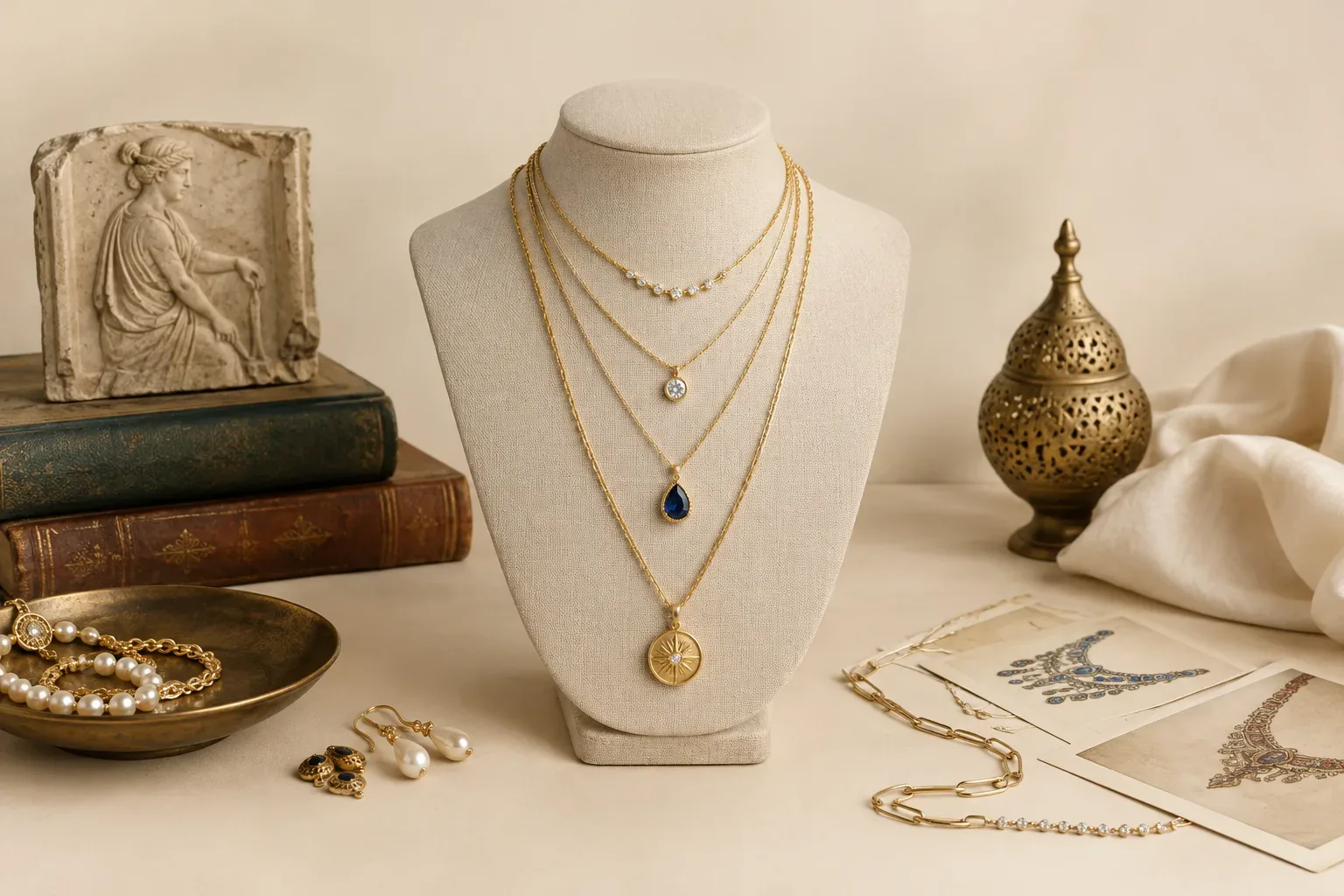
One low‑risk approach is to create a focal trio: a short, simple chain that frames the collarbone, a mid‑length necklace with a small focal pendant, and a longer, more delicate chain that adds vertical emphasis. Keep the focal pendant the most visually assertive element and make the supporting chains subtler in thickness or detail. This arrangement reduces visual competition and tangle risk while offering depth.
For a statement evening look, combine a single bold collar piece with one long pendant rather than multiple medium‑sized pendants. That preserves drama without producing a busy appearance. Whatever configuration you choose, practice fastening and adjusting at home so the pieces sit where you want them before you step out; small pre‑event checks prevent most on‑site fixes.
Care, documentation, and further reading
Document provenance and any formal meanings when buying or receiving historically significant pieces or family heirlooms. Museums and reputable dealers often keep records that help preserve the object's history; if a piece is presented as historically meaningful, ask for supporting provenance. For responsible shopping around gemstones and treatments, consult public guidance on disclosure from regulatory bodies such as the Federal Trade Commission.
For readers who want to explore the history and craft behind layered jewellery in greater depth, museum resources such as the Victoria and Albert Museum's historical overviews and gemstone guides are useful starting points, and they provide context for how jewellery meanings and fashions have shifted across time.
Frequently asked questions
What necklace lengths should I use when layering for an evening outfit?
For layered evening arrangements, choose pieces that sit on distinct planes so they do not overlap: a short piece close to the throat, a mid‑length with the main focal pendant, and a longer chain for vertical emphasis. The goal is visual separation more than a fixed set of numbers; adjust lengths to suit the wearer’s neck and the garment’s neckline and test the arrangement before the event.
How can I reduce tangling when wearing multiple necklaces?
Use construction solutions like multi‑strand collars or single‑clasp connectors to hold strands apart, vary chain textures and weights to reduce sliding, and consider chain stoppers or light coating (for example beeswax) on thin chains. Fasten and arrange necklaces ahead of time and carry a small separator or pin for emergency fixes.
Are there cultural or religious concerns I should consider when gifting layered necklaces?
Yes. Some motifs and symbols have specific cultural or religious meanings and may be considered sacred or private by communities. If a design appears tied to a particular belief or tradition, check whether it is appropriate to wear or gift as fashion. When in doubt, research the motif or ask respectfully.
How do I know if a gemstone in an evening necklace is treated or imitated?
Ask the seller for written disclosure about treatments, enhancements, and whether the stone is natural, synthetic, or an imitation. Regulatory guidance such as the Federal Trade Commission’s consumer advice recommends transparent disclosure about treatments and imitations, and reputable dealers will provide documentation.
Can I mix metals and gemstones in a layered evening look?
Yes. Mixing metals and gemstones can create visual separation and interest when done intentionally. Keep one strong focal element and make other pieces complementary in scale and finish so the overall composition reads as cohesive rather than cluttered.
Sources and further reading
- Bedazzled: A History of Jewellery — Victoria and Albert Museum
- An A-Z of Gemstones — Victoria and Albert Museum
- Buying Gemstones, Diamonds, and Pearls — Federal Trade Commission