Meaning at a glance
Choose earrings and rings for blazers by balancing the blazer's structure with jewelry scale and shape, prioritizing comfort for long wear, and selecting motifs or gemstones with awareness of their documented histories and modern interpretations.
Quick answer
Select jewelry for blazers by matching the blazer’s cut and proportion with the size and silhouette of your earrings and rings, favoring lighter, secure earring fittings for long wear and ring profiles that complement sleeve openings and hand movement. When a piece carries a motif, gemstone, or cultural reference, make choices informed by documented history and respectful of cultural contexts rather than assuming universal meaning.
What the historical record shows (and how I’m citing it)
Museum research shows that jewelry’s forms, materials, and social meanings change over time and across cultures. The Victoria and Albert Museum’s overview of jewelry history emphasizes that ornament has shifted in social function and fashion across periods and places, from status display to personal sentiment and artistic expression. Use that documented, institution-based scholarship as the basis for any historical claims about motifs, workmanship, or social use rather than later popular myths.
Likewise, the Victoria and Albert Museum’s A–Z of gemstones is the appropriate reference for identifying gemstones and noting broad historical associations recorded in museum collections and scholarship. For practical consumer issues—such as material treatments, synthetic stones, or disclosure obligations—rely on the Federal Trade Commission’s consumer guidance on buying gemstones, diamonds, and pearls, which documents regulatory expectations and common trade practices.
Separating documented historical meanings from modern interpretations
Documented meanings: museum catalogs and academic studies record how particular shapes and materials functioned in their original contexts. For example, certain gem types were prized for rarity or perceived properties at particular times, and specific forms of jewelry—such as portrait lockets or signet rings—had recognisable social roles. The Victoria and Albert Museum’s materials summarize these historical roles and changing contexts rather than presenting them as timeless truths.
Modern interpretations: contemporary fashion and popular culture often reassign or expand meanings. A symbol used historically for one purpose may be repurposed in modern jewelry as a fashion motif, a brand logo, or a personal emblem. These modern meanings are personal or cultural layers added later and should not be conflated with the original, documented uses preserved in museums and scholarship.
How motifs, gemstones, and traditions appear in blazer-appropriate jewelry
Motifs: Motifs used on earrings and rings—such as floral forms, geometric shapes, or heraldic elements—appear as engraved metalwork, relief carving, filigree, or cast silhouettes. Historically recorded motifs survive in modern designs but are often simplified for scale and wearability, especially when paired with structured garments like blazers.
Gemstones: Gemstones appear as faceted or cabochon stones set into studs, hoops, or ring bezels. The Victoria and Albert Museum’s A–Z of gemstones helps identify historically significant gems and explains how certain stones or cuts were associated with specific eras or aesthetic tastes; modern settings favor durability and weight considerations suited to daily wear with tailored clothing.
Traditional elements: Things like signet ring shapes, cluster settings, and enamel decoration derive from technical and social traditions. When adapted for contemporary blazer styling, these features are often reduced in scale or combined with modern findings to improve comfort and practicality while retaining a visual echo of the tradition.
Scale and shape: matching jewelry to blazer lines
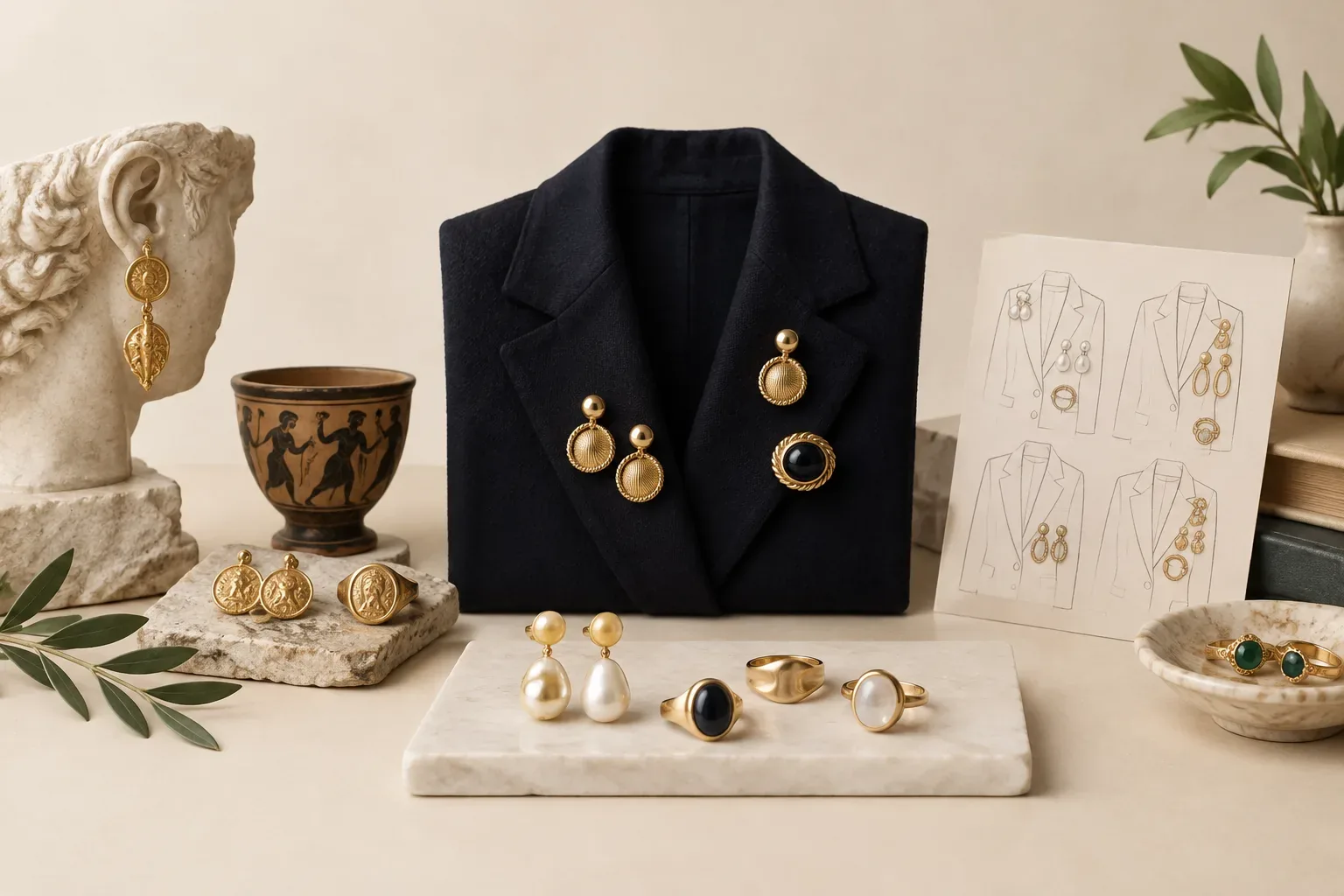
Consider the blazer’s collar, lapel width, and shoulder structure. A narrow lapel works best with modest studs or small hoops and low-profile rings; a wide, structured lapel can carry a longer earring or a larger statement ring. The visual rule to use is proportion: jewelry should neither vanish against a bold lapel nor overwhelm a delicate cut.
Shape matters. Angular blazers—those with sharp shoulder pads or a boxy silhouette—pair elegantly with geometric earrings and rings that echo straight lines or crisp angles. Soft-shouldered, draped blazers suit rounded jewelry: hoop earrings, cabochon stones, and domed rings that mirror the garment’s curves. Choose shapes that create a visual dialogue rather than one that competes.
Comfort and construction: what to prioritize for long wear
Earrings: For wearing a blazer through meetings or travel, prioritize light weight, secure closures, and comfortable backing. Posts with butterfly backs, screw posts, and lever-backs distribute weight and reduce fatigue. For non-pierced ears, high-quality clip-ons with padded backs reduce pinching. Heavy chandelier earrings can look dramatic but often become uncomfortable against collars or lapels during long wear, so reserve them for short events.
Rings: Choose ring profiles that don’t catch on sleeve hems or interior pockets. Low-profile bands and bezel-set stones sit closer to the finger and are less likely to snag than tall prongs or oversized settings. For everyday blazer wear, consider comfort-fit bands or rings with rounded interiors and avoid overly wide stacks that can impede hand movement. If you often put hands in trouser pockets, test ring width and edge shape before committing.
Material, treatment, and disclosure: practical considerations
Metals and alloys: Match metal tones to blazer hardware (buttons, belt buckles) for a cohesive look. Gold, silver, and plated metals all have different wear characteristics. If you have metal sensitivities, choose hypoallergenic metals or proper plating. The appearance of a metal can change with polish; matte and brushed finishes reduce reflections against tailored fabric.
Gemstone treatments and imitations: Many gemstones are treated or simulated. For reliable consumer information about treatments, synthetics, or imitations, consult the Federal Trade Commission’s guidance on buying gemstones, diamonds, and pearls, which explains common trade practices and disclosure expectations. When buying a meaningful piece, request written disclosure on treatments and origins so the recipient understands what the piece contains.
Selecting motifs and giving jewelry respectfully
Research before gifting: If a motif references a cultural or religious symbol, research its documented history and contemporary significance. The Victoria and Albert Museum’s work can help establish historical contexts for many motifs, but modern cultural meanings may vary. Avoid assuming that a symbol is purely decorative if it has known religious or identity associations.
Personalization and intention: When selecting a piece for another person, prioritize the recipient’s preferences and the relationship context. For a professional blazer-wearer, choose understated pieces that communicate taste and care without forcing symbolism onto the wearer. If the recipient has a personal attachment to a gem, color, or motif, a thoughtfully chosen piece that acknowledges that preference is more meaningful than imposing a prescriptive symbolic reading.
Practical styling examples
Office-to-evening: Pair small faceted stud earrings or huggie hoops with a single low-profile cocktail ring. If the blazer is single-breasted with narrow lapels, keep earrings under two centimeters in drop length to avoid catching on fabric.
Layered look: For a relaxed blazer over knitwear, mix a thin signet or plain band worn alone or stacked with slim rings and medium hoops to create texture without bulk. Avoid more than three bulkier rings on one hand to preserve hand mobility and professional polish.
Statement moments: If you want one standout item, choose either a single bold earring style (worn with a minimal ring) or a single statement ring with discreet ear studs. This keeps the overall silhouette balanced against the blazer’s lines.
Care, testing, and final checks
Try pieces with the actual blazer: Test earrings with the blazer buttoned and unbuttoned and while you sit or raise your arms. Try rings while performing typical activities such as handling a phone, placing hands in pockets, or typing. Practical wear tests reveal catches, pinches, and weight issues that photos cannot.
Documentation and care: When you buy a piece, ask for documentation about metals, gemstone treatments, and care recommendations. The FTC guidance outlines what consumers should expect in terms of disclosure. Proper care—storing earrings with separate backs and keeping rings away from harsh chemicals—extends wearable life and preserves comfort.
Closing summary
When styling jewelry for blazers, balance is the guiding principle: match scale and shape to the garment’s structure, prioritize comfort for long wear, and choose motifs and gemstones with sensitivity to their historical documentation and contemporary meanings. Use museum scholarship such as the Victoria and Albert Museum’s resources for historical context and the Federal Trade Commission’s guidance for practical disclosure and buying concerns. Thoughtful selection and simple testing will keep your jewelry both attractive and appropriate to the blazer and the occasion.
Frequently asked questions
What earring length works best with a blazer?
Aim for earring lengths that respect lapel width: under two centimeters for narrow lapels, medium drops for wider lapels, and lightweight studs or huggies for close-collared styles. Always test earrings with the actual blazer to ensure they won’t catch or press uncomfortably against fabric.
Are statement rings appropriate with professional blazers?
Yes, but use restraint: choose either one statement ring or several slim bands rather than multiple large rings. Prefer low-profile settings that won’t snag on pockets or sleeves, and opt for a matte or polished finish that complements your blazer hardware.
How can I tell if a gemstone has been treated or is a simulation?
Request written disclosure from the seller. The Federal Trade Commission’s guidance explains that dealers should disclose common treatments and whether a stone is synthetic or an imitation. Ask for certification or lab reports for high-value purchases.
Is it disrespectful to wear cultural or religious motifs on a blazer?
Context matters. Research documented histories of the motif using museum resources such as the Victoria and Albert Museum and consider contemporary cultural meanings. If a symbol has sacred or identity-specific significance, prioritize the feelings and preferences of people from that community before wearing or gifting it.
What earring closures are best for comfort under a blazer collar?
Posts with secure backs, screw posts, and lever-backs distribute weight well and stay in place. For non-pierced ears, choose padded clip-ons. Avoid heavy, dangling designs when you expect to wear the blazer for long periods.
Sources and further reading
- Bedazzled: A History of Jewellery — Victoria and Albert Museum
- An A-Z of Gemstones — Victoria and Albert Museum
- Buying Gemstones, Diamonds, and Pearls — Federal Trade Commission