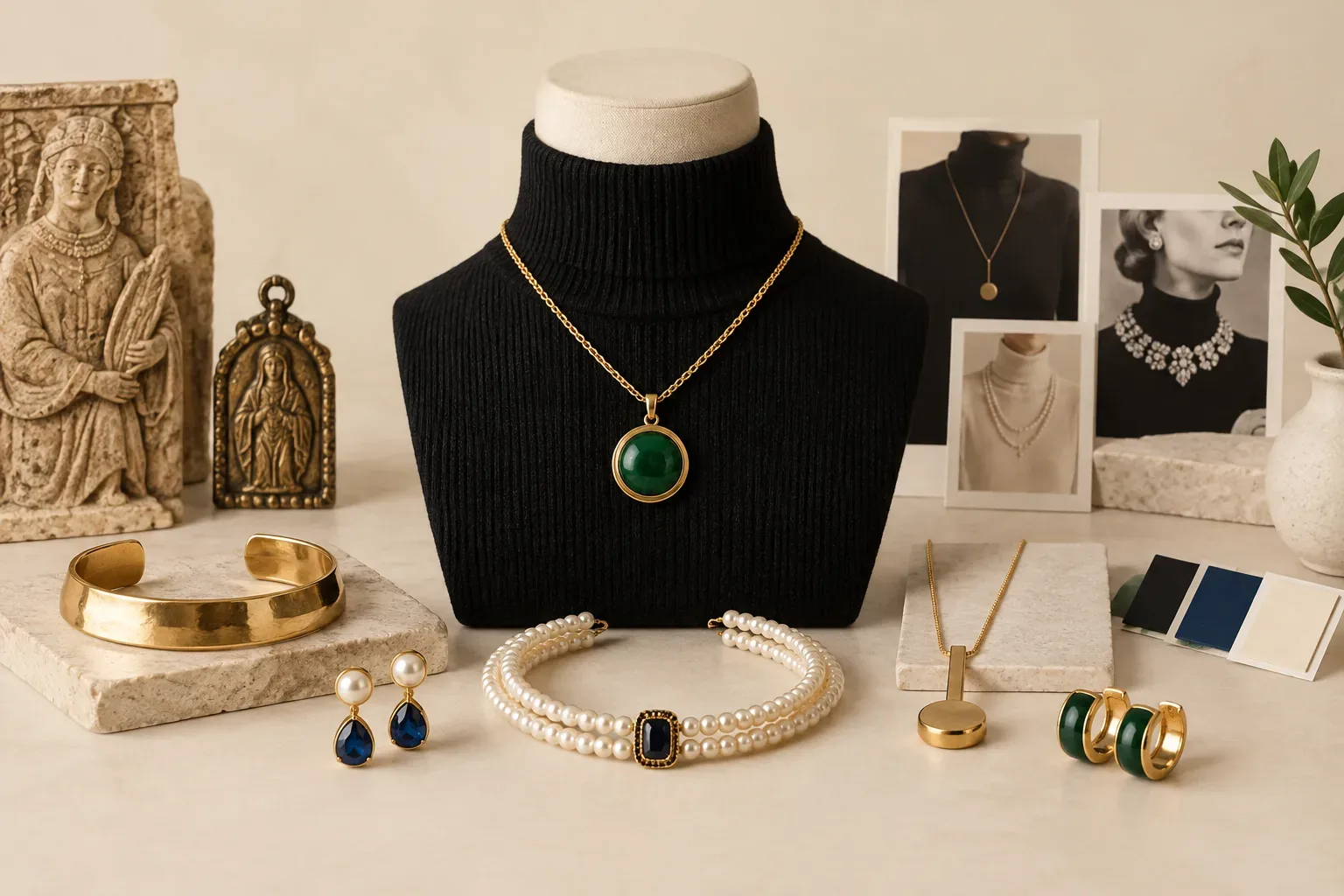
Meaning at a glance
This guide explains how clothing silhouettes have shaped jewellery choices historically, separates documented historical uses from modern personal meanings, and gives practical, respectful guidance for choosing necklace length, scale, color, and focal pieces to wear with turtlenecks.
Why clothing silhouettes matter to jewellery
Clothing changes how jewellery reads. Necklines that leave the throat visible call for different scales and placements than collars that cover the neck, and knit textures behave differently from smooth fabrics. Museums and curators who study jewellery emphasise that jewellery designers and wearers have always adjusted scale, placement and function to match changing fashions in clothing. The Victoria and Albert Museum documents the long history of jewellery adapting to changing social contexts and silhouettes, which helps explain why different necklace lengths and types appear with high collars or open necks in historical collections.
Documented historical evidence (what the record shows)
Curatorial research collected by institutions such as the Victoria and Albert Museum shows that jewellery styles respond to clothing. When necklines were high or garments heavily layered, jewellery either became more compact and close to the throat or was repurposed as fastening and decorative hardware. For example, small portrait lockets, brooches, and collar pins are part of documented collections and exhibition narratives that demonstrate this practical adaptation of jewellery to garments that covered the neck or chest.
Those museum records focus on design, materials and social context rather than on a single universal meaning for any object. That documentation supports the practical point that the shape and function of jewellery historically changed in response to clothing, climate and social custom rather than remaining fixed across cultures or periods.
Separating documented history from modern personal interpretation
There is a difference between what historical sources record and how contemporary wearers interpret symbols. Museums and historical sources record form, material and context: what an object looked like, how it was worn, and sometimes who owned it. Assigning a particular symbolic meaning—especially a universal one—to a motif or how it was worn is a modern interpretive step unless contemporary historical records explicitly note that meaning.
Modern wearers often project personal or cultural meanings onto jewellery—sentiment, political statements, or identity signals—that are valid for them but not necessarily documented for earlier periods. When you select or give jewellery, state whether you mean the piece to have a personal symbolism, and avoid asserting that the piece carried that same meaning historically unless you can point to a documented source.
How motifs, gemstones, and traditions appear in jewellery for turtlenecks
Motifs and symbols appear in many forms: a central pendant, a small charm repeated on a chain, a brooch placed at the shoulder or throat, and engraved or relief surfaces that read as texture against knitwear. For turtlenecks, the most visible formats are chokers and collar necklaces that sit on top of the fabric, pendant necklaces that sit above or lie against it, and brooches or pins that fasten and decorate the knit itself.
Gemstones and pearls are used either as the focal point or as an accent. Pearls, for example, are prized for their lustre and are often mounted in small strands or single-drop pendants that contrast with matte knits. It is important to be precise about biology and symbolism: pearls are produced by certain mollusks, whereas large marine mammals like whales are unrelated to mollusk pearl production—resources such as NOAA Fisheries explain those biological distinctions, which helps separate natural facts from symbolic associations.
Metals and finishes also play a role: high-polish gold or rhodium-plated silver creates bright highlights against darker fabric, while brushed or oxidised finishes read as more subdued. Heavier textiles support thicker chains and larger pendants; lightweight turtlenecks work best with finer chains or delicate chokers.
Choosing proportion: length, scale, and balance
Consider the thickness of the turtleneck fabric first. A thin, fine-gauge turtleneck will allow small pendants and thin chains to show their shape cleanly and is a good canvas for short chokers or collar necklaces. A bulky, chunky knit will swallow thin chains and small pendants, so choose thicker chains, larger discs, or place a brooch on top of the knit as a clear focal point.
Length matters. Short necklaces and chokers sit on top of the turtleneck and immediately draw the eye to the throat. Short, graphic pieces are effective if you want the jewellery itself to be the statement. Longer pendants create a vertical line and can elongate the torso; they work best if the pendant sits at a point where the fabric relaxes and the silhouette allows the pendant to be visible and move freely.
Scale must be balanced to the wearer’s proportions. A broad-shouldered person may carry a wider, bolder collar necklace without it appearing overlarge, while someone with a smaller frame will find a delicate choker or single, smaller pendant more proportionate. Because turtlenecks already frame the face, jewellery that competes for attention can feel cluttered; choose one strong focal element rather than multiple competing pieces.
Choosing color and finish: harmony versus contrast
Decide whether your jewellery should harmonize with or contrast the colour of the turtleneck. Warm-toned metals such as yellow gold or rose gold harmonize with warm fabrics and create a softer, integrated look. Cool-toned metals like silver, white gold or rhodium-plated finishes create a crisp contrast against darker or brightly coloured knits.
Gemstone colour can either echo or punctuate a garment. A monochrome approach—matching the metal to buttons or other accessories—tends to read as curated and restrained. A contrasting gemstone, like a turquoise or a deep blue sapphire against a black turtleneck, becomes an intentional focal point. Fabric texture also affects perceived colour: matte knits soften reflective metals, so you may choose a brighter finish to ensure jewellery still reads at a distance.
Creating a visual focus: single statement or layered subtlety
Pick one visual focus. With a turtleneck, the simplest and most effective strategy is a single clear focal point: a small, elegant choker, a pendant centered over the sternum, or a brooch pinned at the left shoulder or throat. This clarity prevents the outfit from appearing overworked and respects the strong framing that a turtleneck provides.
Layering can work if done deliberately. Layer short pieces of differing textures or a delicate choker with a slightly longer, thin chain. Avoid many long chains that become tangled against knitwear; if layering, keep the palette restrained and the lengths staggered so each piece reads independently against the fabric. If you choose multiple pieces, ensure one remains the primary focal point to anchor the look.
Practical and respectful selection and gifting guidance
When selecting jewellery for yourself or as a gift, start with practical details: the recipient’s typical clothing (do they often wear thin or chunky turtlenecks?), metal allergies, and lifestyle. If the wearer is active or moves frequently, choose secure clasps and lower-profile pieces that won’t catch on knit. For gifting, consider the height of the turtleneck they typically wear; measure an existing necklace that they enjoy wearing as a clue to preferred scale.
Respect cultural meanings and personal symbolism. If a motif has cultural, religious or political significance, check with the recipient or research the symbol carefully before gifting. If you intend a piece to carry personal meaning, communicate that intention to the recipient rather than assuming others will read it the same way.
When buying gemstones or pearls, ask retailers for written information about treatments, enhancements and whether stones are natural, lab-grown or imitations. The Federal Trade Commission advises buyers to request seller disclosures about gemstones, diamonds and pearls to ensure you understand treatments and origin. That transparency helps you choose pieces that meet the recipient’s ethical and aesthetic preferences.
Care notes and final styling tips
Consider maintenance and wear. Knits can abrade soft stones and settings; choose protective mounts for pearls and soft gems or consider wearing such pieces over the fabric rather than letting them rub directly against it. Fastenings should be secure, and brooches used on knitwear should have a sturdy pin and a smoothing backing to avoid snags.
Earrings and bracelets also matter because a turtleneck frames the face and wrists become more visible when sleeves are pushed up. Simple studs or small hoops complement a bold throat piece without competing for attention. When in doubt, photograph options on the actual turtleneck before committing to a purchase to judge proportion, shine and movement in real life.
Frequently asked questions
Can I wear a long pendant with a turtleneck?
Yes. Long pendants create a vertical line that can elongate your torso, but make sure the pendant sits where the fabric relaxes so it is visible and can move without bunching. Choose a proportionate pendant size for the knit’s weight and fabric thickness.
Are brooches appropriate on turtlenecks?
Brooches can be a very effective focal point on a turtleneck. Use a sturdy pin with a smooth backing to avoid snagging knits and place the brooch where it balances the body—at the shoulder, collarbone or just below the throat depending on the piece’s size.
How do I match metal colour to a sweater?
Decide whether you want harmony or contrast. Warm metals like yellow gold and rose gold harmonize with warm-toned fabrics, while silver and white metals offer a crisper contrast. Consider fabric saturation and texture: matte knits may need a brighter finish to make the metal read at a distance.
What should I ask when buying gemstones or pearls as a gift?
Ask the seller for written disclosures about whether stones are natural, treated, lab-grown or imitations and about any enhancements. The Federal Trade Commission advises buyers to request transparent information about gemstones, diamonds and pearls before purchase.
Do pearls need special care on knitwear?
Yes. Pearls are relatively soft and can be abraded by rough fabrics. Consider wearing pearl pieces over the fabric rather than rubbing directly against it and store them separately to avoid scratches.
Sources and further reading
- Bedazzled: A History of Jewellery — Victoria and Albert Museum
- 11 Cool Facts About Whales, Dolphins, and Porpoises — NOAA Fisheries
- Buying Gemstones, Diamonds, and Pearls — Federal Trade Commission