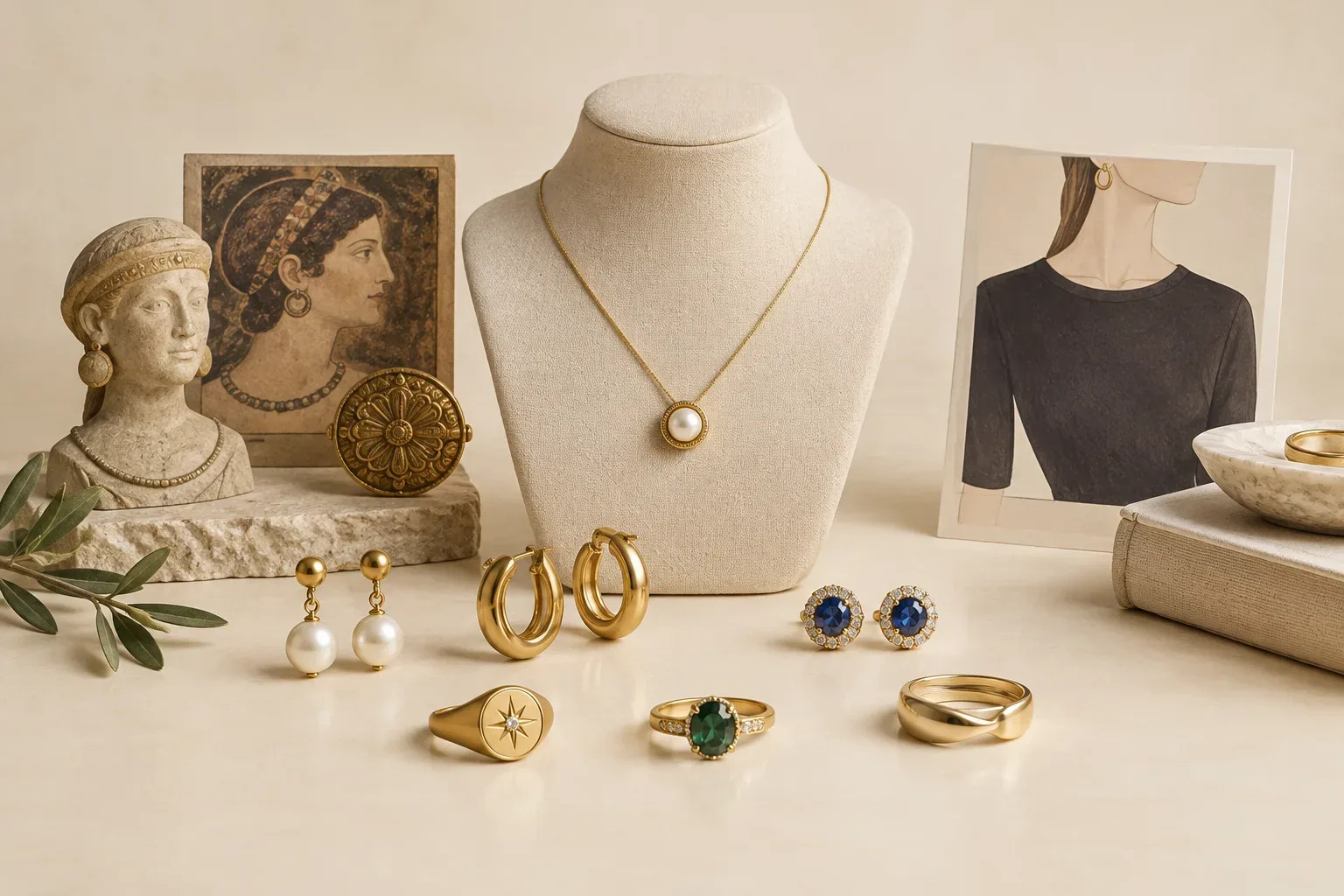
Meaning at a glance
For crew-neck outfits, prioritize earrings with shorter drops or studs and rings with low profiles so jewelry complements the neckline without crowding it; this article traces historically documented uses of similar jewelry forms (as recorded by the Victoria and Albert Museum), separates those historical meanings from modern personal interpretations, explains how motifs and gemstones typically appear in earrings and rings, and offers practical, respectful selection and gifting guidance including required disclosure questions about treatments and imitations (per the Federal Trade Commission).
What the historical record shows (and where that record comes from)
Museum collections and curatorial research show that jewelry has long been adapted to clothing styles and social roles. The Victoria and Albert Museum describes how jewellery forms and wearing practices changed with technology, social hierarchy, and fashion, meaning that the relationship between a neckline and the jewellery worn with it has varied by culture and period rather than being universal.
In ancient Egyptian ensembles, small pendants and ear ornaments were worn close to the head and often integrated with wigs and collars; those pieces functioned as personal adornment, ritual markers, and status indicators, as discussed by the Victoria and Albert Museum. In classical Mediterranean cultures, artists favored balanced proportions between facial adornment and garments, producing a range of earring shapes, from simple studs and discs to modestly elongated drops, recorded in museum collections.
Across medieval and Renaissance Europe, jewellery usage reflected rank, ceremony, and sentiment. The V&A notes that brooches, rings, and pendants were frequently worn in ways corresponding to dress structure: some pieces were deliberately small and close to the body when clothing was structured at the neck, while long pendants and chain-mounted jewels appeared alongside open or low necklines.
Later fashion eras, including the periods observed in the V&A’s survey of jewellery history, introduced new silhouettes and materials. The rise of modern jewelry craftsmanship and mass production in the 19th and 20th centuries gave wearable jewelry greater variation in scale and comfort, and photographic and museum evidence shows choices increasingly reflected individual taste and technological possibilities rather than strict prescribed rules.
Documented historical meanings versus modern personal interpretations
Historical meanings that are documented in museum collections and curatorial notes are usually tied to function, material rarity, social rank, or explicit ritual use. For example, signet rings and certain engraved gems served legal and social functions; mourning jewelry and lockets held portraits or hair as mementos; and pearls or particular metals signaled wealth or status, as the Victoria and Albert Museum’s historical surveys describe. These usages are documented through surviving objects and contemporary records.
Modern interpretations often layer personal, aesthetic, or marketing-driven meanings on top of those documented histories. A contemporary wearer might choose a motif because it feels empowering or nostalgic, or a brand may promote a gemstone as carrying a specific emotional meaning. Those newer interpretations can be meaningful to the wearer but should not be presented as a continuation of any single, universal historical symbolism. Distinguishing documented purpose from personal or commercial meaning helps the buyer respect cultural provenance while making a considered aesthetic choice.
How motifs, gemstones, and traditions actually appear in earrings and rings
Motifs show up in jewellery as engraved surfaces, cast forms, or settings. Cameos and portrait lockets appear as small intaglios or pendants set into rings or earrings; floral and foliate motifs are commonly used as metalwork around a stone or as the entire silhouette of a stud or hoop. Structural motifs such as hoops, discs, drops, and baguette shapes have functional implications: discs and short hoops remain close to the face, while drops and chandeliers require more clearance beneath a neckline.
Gemstones are used for visual weight, color, and perceived value, and the Victoria and Albert Museum’s A–Z of Gemstones outlines how different stones have been used in decorative jewellery over time. Pearls historically appear as strings and small studs that sit neatly at or above a high neckline. Harder gems like diamonds and sapphires are commonly used in rings because they withstand frequent contact; softer or porous stones need protective settings or cautious wear. The way a gemstone is cut and mounted — bezel, prong, channel, or flush setting — affects profile and comfort when worn with a close neckline.
Traditions such as signet rings, wedding bands, and mourning jewels are visible in both rings and, less commonly, earrings. The physical form communicates purpose: lockets and sentimentals have space for inserts; signet rings have flat faces for engraving; and costume earrings adopt lighter materials or hollow construction to mimic larger shapes without heavy weight. These are the actual ways motifs and traditions appear in wearable objects.
Practical selection guidance: scale, shape, and comfort for crew-neck outfits
Start with scale: a crew-neck sits high on the collarbone and frames the jawline, so choose earrings that do not extend far below the earlobe. Studs, short huggie hoops, and drops that end above the jawline maintain balance. If you prefer more length, opt for lightweight materials and fine chains so the drop reads delicate rather than heavy.
Consider shape: round or short teardrop silhouettes echo the curve of a crew-neck and read as harmonious. Vertical‑emphasis shapes such as long bars or elongated chandeliers create contrast; they can work if carefully proportioned to body size and hair length but are more likely to interrupt the clean neckline of a crew style.
Prioritize comfort: earring weight, post and back design, and ring profile determine whether a piece is wearable all day. Look for earrings with secure backs that distribute weight (locking backs, screw-backs for heavier studs) and for rings with lower-set stones and smoother shanks if the wearer uses their hands often. For rings, choose settings that do not snag clothing and consider comfort-fit bands for continuous wear.
Select materials with durability and wearer sensitivity in mind. For rings worn daily, harder gemstones and durable metals resist abrasion. The Victoria and Albert Museum’s gemstones overview explains historical choices and appearances; today those considerations still guide practical material selection. If the wearer has metal sensitivity, choose high-quality alloys or plated pieces with known base metals rather than assuming hypoallergenicity.
Ask about treatments and imitations. The Federal Trade Commission advises buyers to inquire about gemstone treatments, synthetics, and imitations and to expect truthful disclosure from dealers. Request written information on treatments and return policies so a gifted piece can be exchanged if it proves unsuitable.
Gifting and respectful selection
When gifting, research the cultural or traditional meanings tied to motifs or stones rather than assuming a motif is harmless decoration. If a piece uses a symbol or an ethnographic design, work with sellers who can attest to provenance and respectful production. Use museum resources and guides to background motifs when appropriate; our related guide on researching jewelry symbols can help you investigate context before purchasing.
Keep the recipient’s lifestyle and wardrobe in mind. A crew-neck wardrobe often benefits from jewelry that prioritizes facial framing over dramatic necklines, so a set of coordinated studs and a low-profile ring is a practical gift. For sentimental gifts, personalize size and metal choices rather than creating a piece with a heavy or fragile structure that the recipient might not wear regularly.
Lastly, ask the seller for certificate or written details about treatments, origins, and care. The Federal Trade Commission recommends consumers get clear disclosure about gemstones, and reputable sellers will provide the information that helps a gift remain valued and wearable.
Everyday pairing guidance and final notes
A simple pairing for a crew-neck tee is a pair of pearl or small gemstone studs and a slim signet or band on the dominant hand. For a knit crew-neck, choose matte or brushed metal finishes to reduce glare and choose rings with flush or bezel-set stones to avoid snagging. For evening crew-neck dresses, a small drop earring in a complementary metal and a cocktail ring with secure setting can elevate the look without overwhelming the neckline.
Remember that historical evidence shows jewellery practices adapt to technology, social norms, and clothing design; modern wearers can borrow historical cues while making choices grounded in comfort, proportion, and respect for the cultural origins of specific motifs. For more practical guides and deeper research on symbol meanings and historic jewellery use, see our related content and the Victoria and Albert Museum resources cited below.
Frequently asked questions
What earring length works best with a crew-neck top?
For crew-neck tops, choose earrings that remain close to the earlobe such as studs, small hoops, or short drops that end above the jawline; if you prefer more length, select very lightweight designs so the drop reads delicate rather than heavy.
How should ring profile be considered for everyday crew-neck outfits?
Pick rings with lower-set stones and smoother shanks for daily wear so they do not snag collars or feel cumbersome; comfort-fit bands and bezel or flush settings are good choices for active hands.
Are certain gemstones better for rings I’ll wear constantly?
Harder gems like diamonds, sapphires, and rubies resist abrasion and are generally better for daily rings; consult the Victoria and Albert Museum’s gemstone guidance for historical context and ask sellers about specific stone hardness and care.
What should I ask a seller about gemstone treatments or imitations?
Ask the seller to disclose any treatments, whether the stone is synthetic or an imitation, and to provide written details or certification; the Federal Trade Commission advises consumers to expect truthful disclosure about treatments and origins.
How can I gift jewelry respectfully when a motif has cultural meaning?
Research the motif’s cultural history before gifting, prefer pieces with transparent provenance, and choose contemporary designs by makers from that tradition when possible; avoid treating meaningful symbols as mere fashion without understanding their origins.
How do I balance a bold ring with a crew-neck outfit?
If gifting or wearing a statement ring, keep ear jewelry minimal—opt for a small stud or simple hoop—and select a ring with a secure, low profile so it reads intentional without crowding the neckline or becoming uncomfortable.
Sources and further reading
- Bedazzled: A History of Jewellery — Victoria and Albert Museum
- An A-Z of Gemstones — Victoria and Albert Museum
- Buying Gemstones, Diamonds, and Pearls — Federal Trade Commission