Meaning at a glance
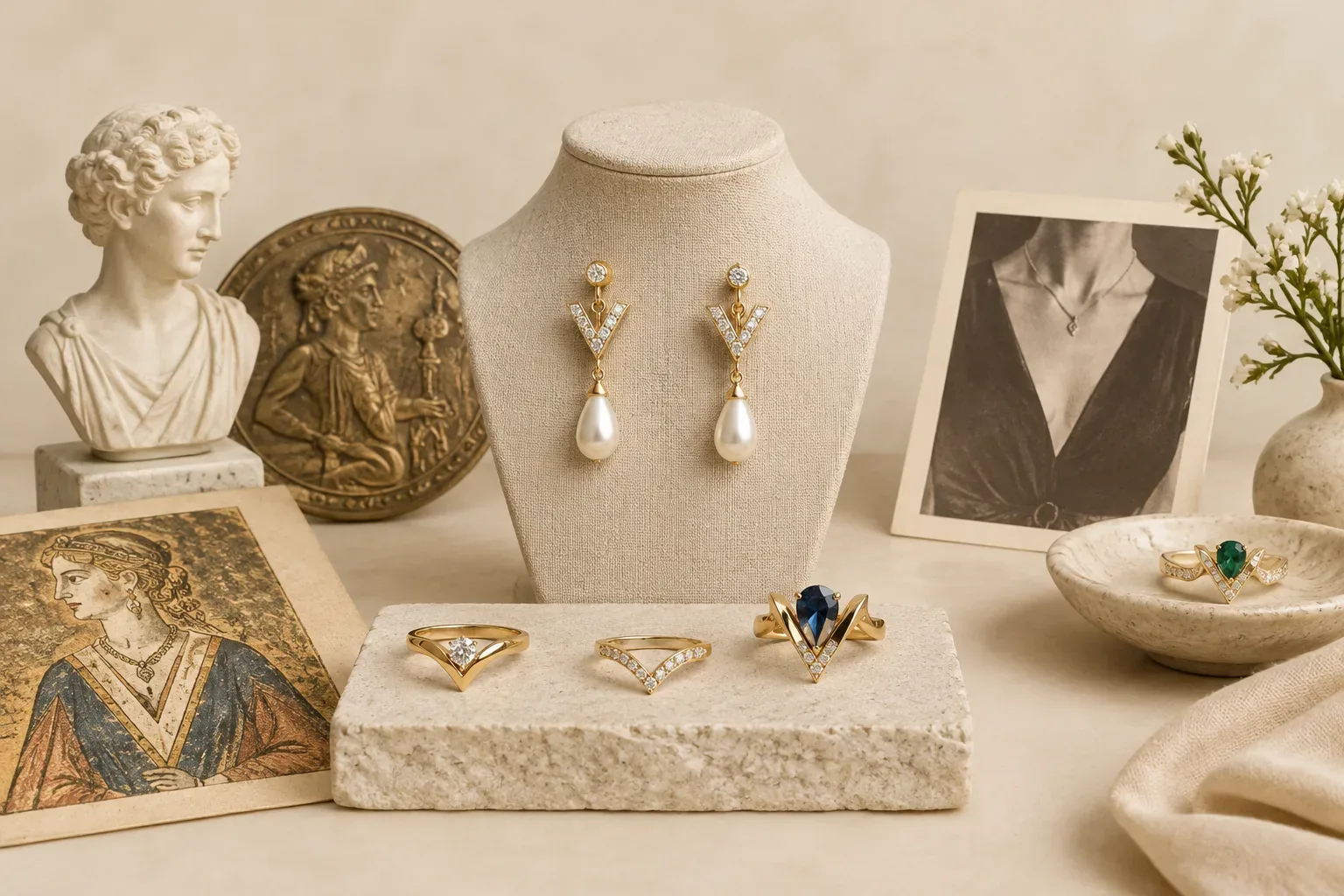
For jewelry for v-neck outfits earring and ring styling, prioritize a clear focal point at the V, balance earring length to your face and neckline, choose ring scale that complements your hands and other jewelry, and consider comfort and materials; historical uses and gemstone associations are varied and context-dependent, as documented by museum research and consumer guidance.
Why scale, shape, and comfort matter with V-necklines
A V-neck creates a natural visual channel that draws the eye downward toward the chest. When you place jewelry in or around that channel, its scale relative to the neckline determines whether it accentuates the line or clashes with it. A small pendant that sits above the V can appear lost; a very long, heavy pendant can pull the eye away and feel physically uncomfortable.
Shape matters because angular necklines and jewelry interact visually. A sharp, steep V pairs well with softer, rounder earring shapes to soften the overall silhouette, while a shallow V can be reinforced by angular pendants or geometric ring motifs. Comfort is a practical constraint: heavy dangle earrings or chunky rings that catch on fabric can ruin an outfit, so always consider how long you expect to wear the pieces and what activities you will do while wearing them.
What historical evidence says about jewelry, context, and meaning
Museum research emphasizes that jewelry meanings and uses change over time and among cultures. The Victoria and Albert Museum notes that jewellery has served many functions across history—status display, personal identity, memory, and ornamentation—and that those functions shift with social context and fashion. This broad interpretive framework helps explain why certain silhouettes and gemstone uses recur but do not mean the same thing in every setting.
For example, European collections preserved in museums include portrait miniatures, lockets, and other pieces that functioned as intimate or commemorative objects rather than simple decoration. The V&A’s materials on jewellery history and gemstones show that objects can have layered meanings: a pendant can be a status marker in one era and a sentimental keepsake in another. Those documented roles are useful background when you consider how to place jewelry with a V-neck today, but they are not prescriptions for contemporary styling.
Documented historical meanings versus modern personal interpretations
Documented meanings are what historical records, inventories, and museum collections show people used jewellery for—status, marriage tokens, mourning or remembrance, trade, and religious display. The Victoria and Albert Museum’s resources demonstrate these documented functions without assuming they apply universally to every object or wearer.
Modern wearers often layer personal interpretations on top of historical associations. A gemstone once associated with protective properties in one culture may be chosen today purely for color or personal resonance. Distinguishing documented historical meanings from contemporary personal interpretation keeps historical respect and avoids assuming a single meaning for a motif or stone.
How motifs, gemstones, and traditions appear in contemporary earrings and rings
Motifs: Common motifs—floral, geometric, symbolic (hearts, keys), and heraldic elements—show up in both earrings and rings in scaled versions. On a V-neck outfit, motifs that echo the neckline (for example, angular pendants with triangular shapes) can reinforce the line, while rounded motifs can create contrast. Motifs are adapted to the smaller canvas of an earring or ring by simplifying detail and focusing on silhouette.
Gemstones: Museums document the long history of gemstone use for color, rarity, and attributed properties. In contemporary jewelry, gemstones appear as single-stone pendants, clustered earrings, or accent stones in rings. The Victoria and Albert Museum’s A–Z of Gemstones explains identification and historical context, which helps when choosing stones that achieve a specific visual weight or historical resonance without assuming a universal symbolic meaning.
Traditions and techniques: Historical traditions—engraving, enamel, granulation—are often referenced in modern pieces as surface texture or craftsmanship cues. Rings might use signet shapes or bezel settings derived from older practices, and earrings may reference historical silhouettes (hoops, drops, chandeliers) in lighter contemporary materials so they are more comfortable for everyday wear.
Practical guidance for selecting jewelry to wear with V-neck outfits
Establish the focal point. Decide whether the necklace at the V apex will be the main statement, or whether earrings will take precedence. If the necklace is the focal point, choose earrings that are smaller or clearly complementary in shape and tone. If earrings are the focal point, keep the necklace minimal or omit it to avoid competition.
Balance earring length to face and neckline. Short studs and small drops work with deep V-necks when the necklace occupies the chest space. Longer drops or chandeliers can balance a high or shallow V that needs vertical emphasis, but avoid excessively heavy earrings that will tug at the ear or catch on fabric.
Scale rings to hands and other jewelry. On hands, wider bands and larger stones read as statement pieces; stackable thin bands are subtler. When coordinating with a strong chest focal point, opt for simpler ring silhouettes so the overall look feels harmonious. Conversely, if the neckline is minimal, a bolder ring can provide visual interest.
Consider metal and color harmony. Match or intentionally contrast metal tones to knit the look together. A warm-toned pendant will pair naturally with warm gold rings, while mixing metals can feel modern if done sparingly and with an eye to repeating one tone at least twice in the outfit.
Prioritize comfort and practical details. Try earrings on for weight and check backs (butterfly, locking lever-back, screw-back) for long-term wear. Ensure rings are measured correctly for the wearer’s typical conditions—fingers swell with heat and activity—and consider half-sizes or adjustable bands when uncertain.
Account for activity. If you will move a lot, choose low-profile pieces that won’t catch or snag. For formal events, you can choose more delicate settings if you expect minimal movement; for travel or outdoor wear, favor durability and secure settings.
Gifting guidance and buying tips (respectful and practical)
Consider the recipient’s habitual choices. Look at what they already wear: do they favor studs or dangly earrings, thin bands or signet rings, warm or cool metals? Respect the person’s style and practical needs—if they work with their hands, choose durable, low-profile rings and secure earring backs.
Ask about allergies and maintenance. Many people react to nickel or lower-quality alloy components. If you are unsure, choose known hypoallergenic metals (verified by the seller) or ask gently about sensitivities before buying. Also ask whether the recipient prefers high-maintenance stones (porous or soft gems) or low-maintenance materials.
Check material disclosure and treatment information. The Federal Trade Commission recommends that buyers seek clear disclosure about treatments, imitations, and metal composition. Confirm whether gemstones are natural, treated, or synthetic and whether metals are stamped or hallmarked, and keep receipts and documentation in case the recipient prefers to exchange.
Choose thoughtful packaging and a flexible approach. If you are unsure about ring size or necklace length, gift with an exchange receipt or choose an adjustable design. Include a note explaining why you thought the piece suited a V-neck outfit—this connects the gift to use without imposing a single meaning on the piece.
Care, sourcing, and respectful use of historic styles
When a piece references historic styles or cultural motifs, consider provenance and respect. Museums like the Victoria and Albert Museum document how styles emerged and evolved; modern designers often borrow elements. Wearers and gifters should avoid claiming a single authoritative meaning for a motif borrowed from another culture and should favor makers who acknowledge sources or work collaboratively with communities where appropriate.
For purchases, follow FTC guidance on disclosure and ask dealers about gemstone treatments and metal composition. That documentation matters for insurance and future resale, and it provides the recipient with the facts needed to care for the piece correctly.
Final takeaways
Jewelry for v-neck outfits earring and ring styling is about visual hierarchy, proportion, and wearer comfort as much as about symbolic meaning. Use the V as your guide: place the strongest visual element at the apex, then balance earrings and rings in scale and tone so the whole look reads as coherent. Respect historical contexts as documented by museum research while allowing personal meaning to guide modern choices, and rely on transparent seller disclosures for material and treatment information when buying or gifting.
Frequently asked questions
Should I wear a necklace with a dramatic V-neck?
You can, but decide whether the necklace will be the focal point. A pendant that rests at the V apex will reinforce the neckline; if you prefer earrings to stand out, choose a minimal or no necklace so the visual focus remains on your face.
What earring length works best with a V-neck dress?
There’s no single best length; shorter studs or small drops pair well when the necklace is the main feature, while medium-length drops can balance a shallow V. Avoid very heavy long earrings if you’ll be active, and test for comfort before committing to an evening.
How should rings be scaled when wearing a bold pendant?
When the neckline has a strong focal piece, choose simpler ring silhouettes—thin bands or smaller stones—to avoid visual competition. If the neckline is minimal, a bolder ring can provide counterpoint without overwhelming the look.
Are certain gemstones better for V-neck styling?
Choose gemstones for color, brightness, and the visual weight they add. Museums document how different gems have been used historically, but modern selection should prioritize color harmony with your outfit and the piece’s intended prominence rather than relying on assumed symbolic properties.
What should I check when gifting jewelry to someone who wears V-necks?
Observe the recipient’s existing jewelry preferences, check for metal allergies, verify ring size or choose adjustable options, and ask sellers for clear disclosure about gemstone treatments and metal composition per FTC guidance so the recipient can care for and, if necessary, exchange the piece.
How do I avoid cultural appropriation when choosing motifs?
If a motif is clearly rooted in another culture, research its meanings and provenance, prefer makers who acknowledge sources, and avoid claiming a single meaning for the symbol unless you have documented guidance. Museums such as the Victoria and Albert Museum provide historical context that can inform respectful choices.
Sources and further reading
- Bedazzled: A History of Jewellery — Victoria and Albert Museum
- An A-Z of Gemstones — Victoria and Albert Museum
- Buying Gemstones, Diamonds, and Pearls — Federal Trade Commission