Meaning at a glance
Viking Age jewelry was made through skilled metalworking and decorative processes including casting, stamping, wirework, filigree, gilding, and inlay; craftsmen adapted techniques and materials to local resources and the object type, as shown in museum collections and archaeological reports.
What archaeologists and museums tell us
The material and technical record for Viking Age jewellery comes from hoards, graves, and waste deposits across Scandinavia, the British Isles, and parts of continental Europe. The National Museum of Denmark describes a landscape of specialized crafts and trade in which metalworkers produced both local forms and pieces influenced by contacts with the British Isles and the Continent.
The Metropolitan Museum of Art places high-quality gold and ivory work in northern Europe around 1000 A.D. in a broader artistic and technical context, describing complex decorative methods applied to small objects. Together, these museum accounts form the backbone of what is documented about how Viking Age jewelers worked.
Materials and workshop context
Metals commonly used included silver (often the everyday standard), bronze or copper alloys, and gold for higher-status pieces. Organic materials such as glass, amber, and carved ivory complemented metalwork. The available resources and local trade networks influenced what materials were used in any given place or period, and workshop organization ranged from itinerant smiths to more settled, specialized craftsmen in towns and magnate households, as described by the National Museum of Denmark.
Tools and furnaces left few direct traces in many deposits, but characteristic tool marks, sprues, mould fragments, and waste help archaeologists reconstruct working methods. Metalworkers reused and recycled metal, a practice evident from melted fragments and the high frequency of hacksilver in the archaeological record.
Casting: forming shapes from metal
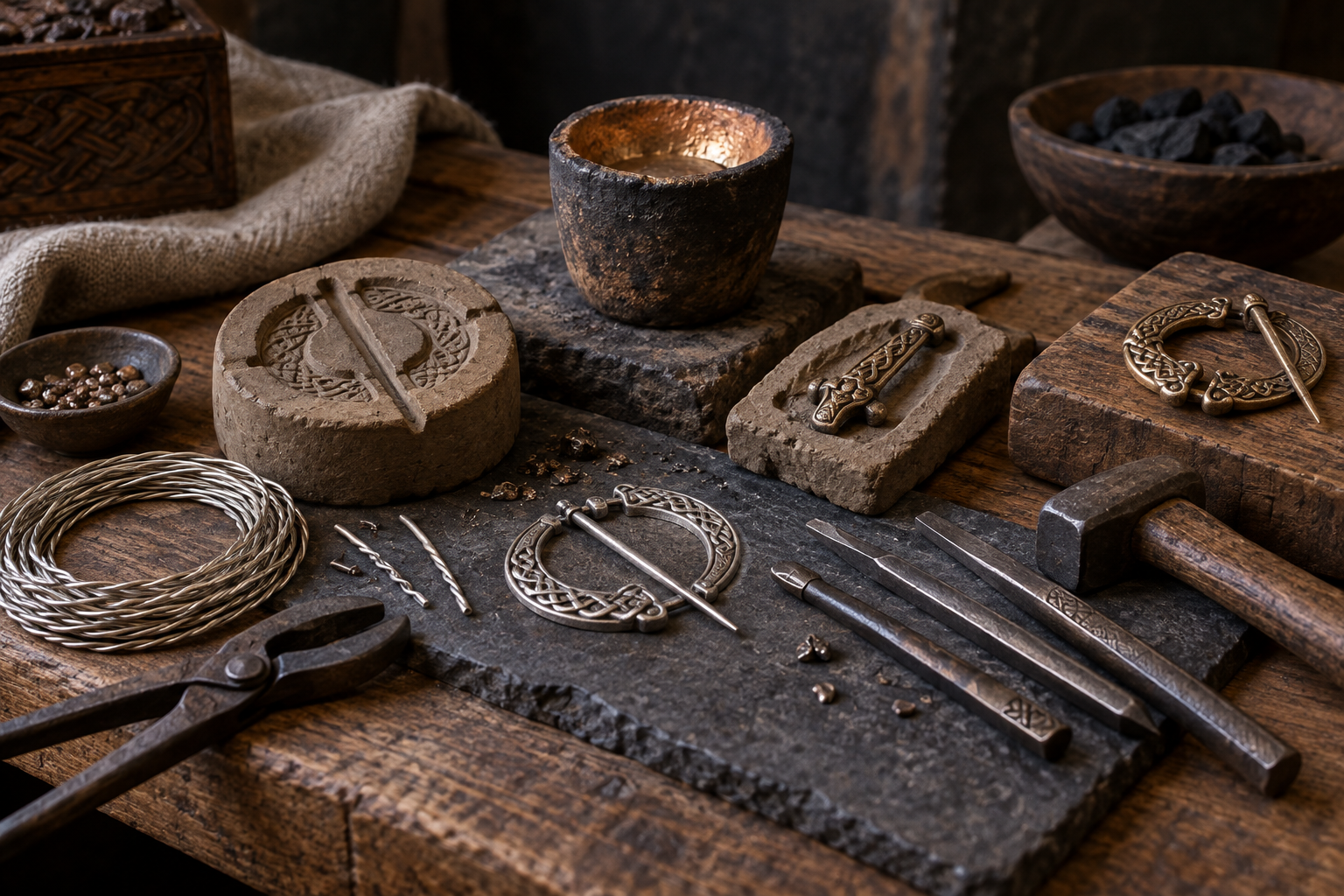
Casting was a central method for producing three-dimensional forms such as animal-head terminals, strap-ends, and small figurative pendants. Evidence for casting includes mould fragments and the fit of sprues and seams on surviving objects. The process typically involved pouring molten metal into stone, clay, or cuttlefish-bone moulds to produce the basic shape, which was then filed and chased to refine details. The National Museum of Denmark discusses casting as one of the crafts tied to towns and trade hubs where skilled metalworkers operated.
Stamping and die-work: repeated forms and patterns
Stamping and die-impression allowed craftsmen to reproduce consistent decorative motifs and shapes, particularly for small plate-like elements, seals, and decorative panels. Archaeological finds show repeated motifs and technical traces consistent with punched decoration. The efficiency of stamping helped meet demand for dress fittings and portable wealth forms such as arm rings and ingot-like pieces.
Wirework and twisted rods
Twisted wire, spirals, and granulated-like decorations were common decorative devices. Wirework could be used structurally—as in the frames of brooches—or decoratively, forming raised lines, downward coils, or complex interlace. The Metropolitan Museum of Art describes northern European goldwork around 1000 A.D. that includes fine wire additions on high-status pieces, demonstrating a mastery of drawing, twisting, and soldering thin metal wire.
Filigree, granulation, and soldering
Filigree—delicate networks of fine wire soldered to a surface—appears on some Viking Age pieces, often in combination with cloisonné and inlay techniques. Granulation (tiny applied beads) is less common in northern examples than in Mediterranean contexts, but small applied pellets and soldered details do appear on high-quality objects. The technical skill required indicates access to heat control and soldering techniques, which the Metropolitan Museum of Art essay highlights in its discussion of luxury metalwork.
Gilding and inlay
Gilding—applying a thin gold layer to another metal—and inlays of niello, glass, or enamel were used to increase visual contrast and status. Enamelled and glass inlays appear in many brooches and mounts, producing brightly colored patterns. The National Museum of Denmark and the Metropolitan Museum of Art illustrate how these surface treatments contributed to the look and perceived value of objects while also signaling workshop sophistication and access to trade materials.
Motifs, gemstones, and how traditions appear in jewelry
Common motifs across Viking Age jewelry include animal interlace, stylized beasts and human faces, geometric patterns, and simple runic inscriptions on some pieces. Amber, glass beads, and occasionally imported gemstones were used as inlays or pendants. These elements appear across brooches, arm rings, necklaces, and strap-ends, with variation by region and date. The National Museum of Denmark collection highlights how dress and jewellery combined to signal identity, wealth, and connections to wider trading networks.
Documented historical meanings versus modern interpretations
Archaeology and museum records can show where, how, and when objects were made and found, and they can suggest social functions such as dress markers, personal wealth stores, or ritual deposition. The National Museum of Denmark emphasizes the social and economic contexts of jewellery within Viking Age communities. These are documented, evidence-based interpretations tied to finds and contexts.
Modern interpretations—such as assigning universal spiritual powers to specific motifs or claiming a single ‘Viking’ meaning for a widely used animal or knot design—are contemporary readings that often reflect modern identity projects. Museums caution that symbolic meanings can vary by community and time, and that modern personal or commercial symbolism should be labeled as contemporary interpretation rather than historical fact, as noted by both the National Museum of Denmark and the Metropolitan Museum of Art.
Choosing and gifting Viking-style or historically informed pieces
If you are selecting jewelry inspired by Viking Age techniques or looking for a historically informed piece, consider material honesty, maker transparency, and cultural respect. Prefer pieces made with clear information about which techniques are authentic reproductions and which are modern adaptations. Museums recommend labeling reproductions and modern designs so they are not mistaken for archaeological originals.
When gifting, be mindful of context: explain whether a piece is an archaeological replica, a modern design inspired by Viking forms, or an original artifact offered by a reputable dealer with provenance. For those interested in historical accuracy, seek makers who use traditional techniques such as lost-wax casting, hand-twisted wire, and appropriate metal alloys; for those who prefer ethical sourcing, ask about metal origin and lab testing for authenticity.
Care, reproduction, and responsible collecting
Reproductions can help people appreciate historical techniques without removing artifacts from the archaeological record. Museums like the National Museum of Denmark encourage public engagement through replicas and clear interpretation. If you collect, buy from reputable sources that provide accurate dating, provenance, and whether an object is a modern copy. Conserve metal jewelry by avoiding harsh chemicals, storing pieces dry, and consulting a conservator for valuable or fragile items.
Final note
The combined archaeological record and museum research show Viking Age metalworkers used a sophisticated toolkit of casting, stamping, wirework, filigree, gilding, and inlay to produce varied jewelry forms. Techniques and meanings varied across regions and over time; when you admire or acquire Viking-style jewelry, look for clear information about technique, origin, and whether symbolic meanings are historical or modern interpretations.
Frequently asked questions
Were all Viking Age pieces made the same way across Scandinavia?
No. Techniques and materials varied by region, social context, and date. Museums note local variation influenced by resource availability and trade contacts, so a brooch from Denmark may be technically and stylistically different from one made in the British Isles.
Did Viking jewelers use gemstones?
Yes. Amber and glass beads were common, and higher-status pieces sometimes used imported gemstones or carved ivory. These materials appear as inlays or pendants alongside metalwork.
How can I tell if a piece is an original Viking artifact or a modern reproduction?
Provenance, archaeological context, museum documentation, and professional testing help establish authenticity. Reputable sellers and institutions will provide clear information; reproductions should be labeled as such.
Is filigree a Viking technique?
Filigree—delicate wire decoration—does appear on some northern European pieces around 1000 A.D., especially on high-status objects. The Metropolitan Museum of Art discusses filigree and related fine metalwork in its essay on ivory and gold in northern Europe.
Are motif meanings (such as animals or knots) the same today as in the Viking Age?
Not necessarily. While motifs had social and possibly symbolic roles historically, modern meanings are often contemporary reinterpretations. Museums caution that symbolic meanings can change by place and time and should not be universalized.
How should I care for historically inspired metal jewelry?
Store pieces dry, avoid abrasive cleaners, and remove jewelry before swimming or bathing. For valuable or archaeological items, consult a conservator for tailored care advice.
Sources and further reading
- Trade and crafts — National Museum of Denmark
- The Art of Ivory and Gold in Northern Europe around 1000 A.D. — The Metropolitan Museum of Art
- Clothes and jewellery — National Museum of Denmark