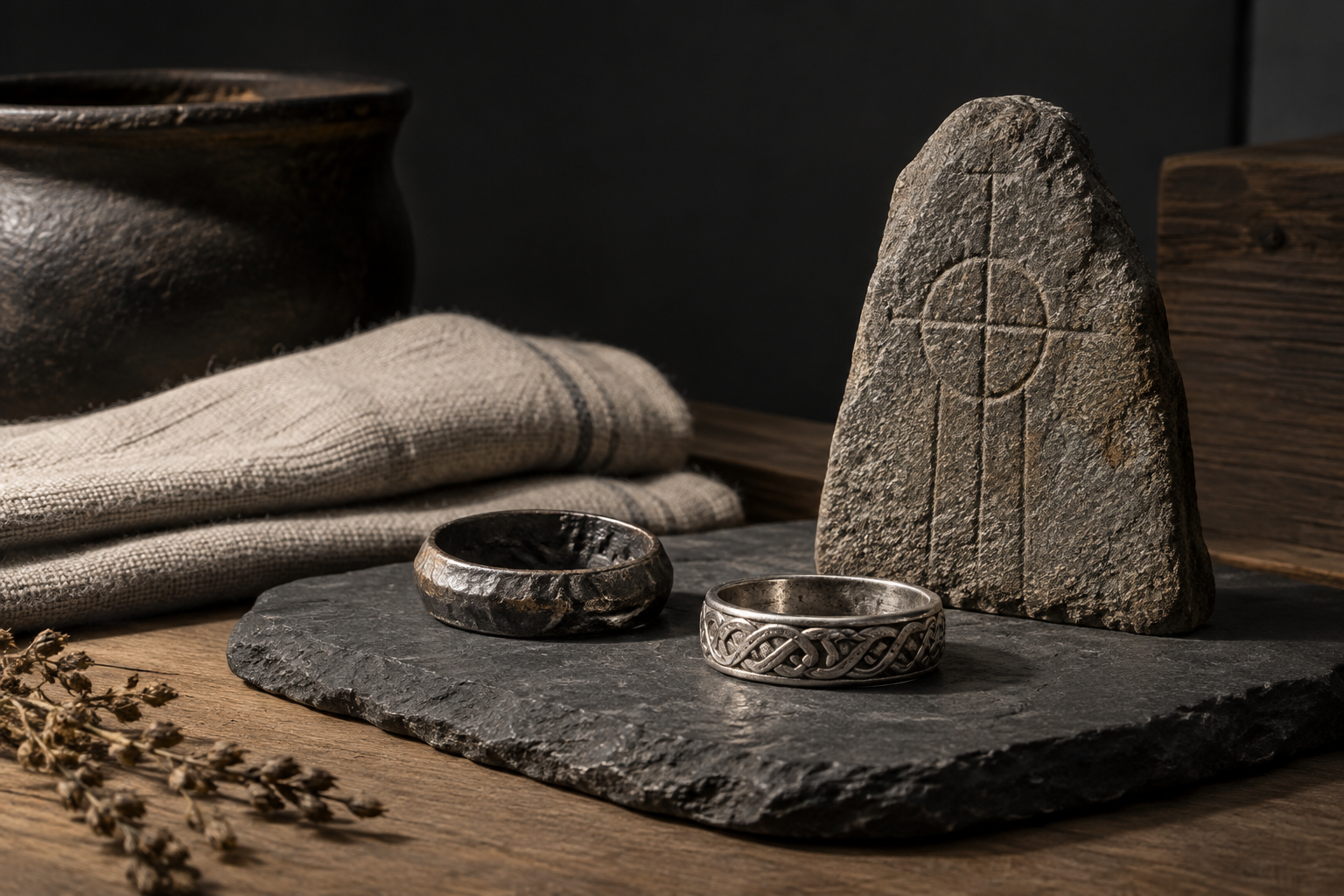
Meaning at a glance
Old Norse texts and comparative historical evidence link rings with oath-taking, yet archaeological finds and museum research show many rings served other purposes; therefore no surviving arm ring should be assumed to be an oath ring.
What historians and archaeologists actually document
Discussion of rings and oaths in medieval Scandinavian contexts comes from two complementary kinds of evidence: literary or legal texts that describe oath-taking and the material record of rings, arm rings, and other jewelry. Scholarship summarized by Cambridge University Press emphasizes that written Old Norse material and later comparative evidence associate rings with promises and obligations, but that material culture is more complex and needs careful interpretation.
Museum collections and catalogues show a wide range of ring types recovered from Viking Age and related contexts. The Swedish History Museum has objects described as amulet rings and arm rings that appear to have had ritual, decorative, or practical functions, and the National Museum of Denmark places jewelry into everyday clothing and social use contexts. These museum records demonstrate that rings could be amuletic, decorative, portable wealth, or functional—so archaeological provenance and context matter for any specific claim that a ring was used in oath rituals.
Separating the Old Norse textual record from archaeological finds
Old Norse sagas, law codes, and poetic fragments contain depictions of oath-making where objects—often rings or other valuables—figure in promises, gift exchange, or the sealing of agreements. Cambridge University Press discussion of institutional and visual material in Viking studies draws on these comparative textual traditions to connect rings with social obligations and trust-making rituals.
However, literary evidence alone cannot prove that every physical ring from the period was used in oath-making. The Swedish History Museum's catalogue of amulet rings and the National Museum of Denmark's treatments of Viking-age jewellery emphasize that context—grave assemblage, hoard, findspot, and wear—determines possible functions. In short, texts show a cultural association; archaeology shows multiple material realities. Treat the two together, rather than conflating them.
Documented historical meanings versus modern interpretations
Documented historical meanings are the uses and symbolic roles attested in the sources and in secure archaeological contexts. Those include rings used as portable wealth (a way to carry value), personal adornment, amulets, and items exchanged in gift-giving and political relationships. The museums cited above document items with those clear functions and make no blanket claim that every ring was an 'oath ring.'
Modern interpretations—how contemporary jewelers, reenactors, or consumers understand and wear ‘Viking oath rings’ today—draw on the past but also project new meanings. Today some people use rings inspired by Viking forms as promise rings, commitment rings, or as expressions of cultural identity. Such personal meanings are valid and meaningful to the wearer, but they are different in kind from documented ritual use unless supported by specific historical evidence for a particular object.
How the motif, gemstone, and tradition appear in modern jewelry
When jewelers reference ‘Viking’ styles, they often adopt motifs and forms visible in the museum record: simple solid rings and arm rings, twisted-wire bands, and rings with runic or animal ornament. The National Museum of Denmark’s descriptions of clothing and jewellery illustrate how such pieces sat within dress and status displays, and modern makers translate those visual cues into wearable pieces.
Gemstones and settings are less consistently attested in the archaeological record for everyday arm rings; where gemstones appear historically they often carry additional meanings or indicate higher status. Contemporary Viking-inspired pieces may combine historically attested forms with modern stones—such as garnet or amber—that have their own historical associations in Northern Europe, but the presence of a modern-cut gemstone does not itself prove continuity of ritual function.
Practical and respectful guidance for selection and gifting
If you want a piece that honors the idea of an oath ring without making unstated historical claims, choose language carefully. Describe the piece as 'Viking-inspired promise jewelry' or 'ring inspired by Old Norse oaths' rather than asserting that it is a direct replica of a known oath ring. This respects both the historical uncertainty and the recipient’s intentions.
For gifting as a promise or commitment, focus on deliberate symbolism: select a form and metal that communicate the meaning you intend and explain the symbolism when you give the ring. If authenticity matters to you, look for makers who base designs on documented finds and provide provenance or a museum reference. The National Museum of Denmark and the Swedish History Museum can help you compare modern designs to archaeological types.
When buying or displaying historical objects, follow museum guidance: treat genuine finds as cultural heritage. If you commission a reproduction for ritual use, consider materials and craftsmanship that echo historical practice—twisted-wire or solid band construction, for example—while being transparent that the item is a modern creation informed by historical sources.
Conclusion: meaningful modern use, careful historical claims
Rings have a documented place in Old Norse social life and in texts that describe oath-taking and sworn bonds, and museums record rings with ritual or amuletic associations. At the same time, archaeological evidence shows rings fulfilled many different roles. The most honest reading of the evidence is the thesis: Old Norse texts and comparative historical evidence connect rings with oath-taking, while archaeology also preserves many rings with other functions; therefore no surviving arm ring should automatically be labeled an oath ring.
You can honor the past and use Viking-inspired rings in meaningful modern rituals, but it matters both intellectually and ethically to distinguish modern personal meaning from what the historical record actually demonstrates.
Frequently asked questions
Were Vikings actually using rings to seal oaths?
Medieval Old Norse textual sources portray rings and other valuables used in oath-making and reciprocal obligations, and scholars discuss this association in comparative studies (see Cambridge University Press). However, the material record is more nuanced; museum catalogues—such as the Swedish History Museum and the National Museum of Denmark—show many rings with different functions, so while rings could be used in oath rituals, not every ring was.
Is every arm ring or 'armring' an oath ring?
No. Archaeological finds and museum research indicate arm rings served as status markers, portable wealth, jewellery, or amulets in addition to any ritual uses (see the Swedish History Museum and the National Museum of Denmark). Context of discovery and documentary support are required before designating a specific object an oath ring.
Can I wear a Viking oath ring as a modern promise ring?
Yes. Wearing a Viking-inspired ring as a personal or relational symbol is a contemporary practice and can be meaningful. Be explicit if you want it to reference historical practice, but acknowledge that modern use is a personal interpretation rather than a direct continuation of a documented ritual unless the object’s provenance supports that claim.
How can I tell if a ring is an authentic archaeological find or a modern reproduction?
Authentic finds are documented by provenance, find records, and often published or held by museums. Reproductions are usually sold as such and may use modern tools, finishes, or gemstones not consistent with museum catalogues. Consult museum resources—such as the Swedish History Museum or the National Museum of Denmark—or trusted dealers who provide clear provenance and references.
What motifs or gemstones are historically appropriate for Viking-inspired rings?
Historically attested motifs include twisted wire, simple solid bands, and animal or interlace ornament seen in the museum record. Gemstones do appear in the archaeological record but are less ubiquitous; where used, they often signal higher status. Modern designers combine these historical cues with contemporary stones and settings—decide whether you prefer strict historical reference or a modern adaptation.
Sources and further reading
- New institutional economics in Viking studies: visualising immaterial culture — Cambridge University Press
- Amulet ring — Swedish History Museum
- Clothes and jewellery — National Museum of Denmark