Meaning at a glance
A responsible Viking jewelry gift matches the recipient with a well-explained design, distinguishes archaeological forms from later or modern symbols, and describes materials and meanings without promising supernatural effects.
What the archaeological record actually shows (and which cultures or periods that covers)
When people say “Viking” in a jewelry context they are usually referring to objects produced in Scandinavia and regions influenced by Scandinavian crafts during the Viking Age. The National Museum of Denmark treats the Viking Age as part of its prehistoric-to-1050 AD coverage and documents the kinds of costume and metalwork that appear in that period, while the Swedish History Museum collects and explains runic inscriptions and the archaeological sources that inform our knowledge of Viking-period life.
Archaeologists and museum curators rely on physical finds such as grave goods, hoards, and everyday dress accessories to reconstruct what people wore. The surviving corpus includes metalwork (bronze, silver, and some gold), cast and forged fittings, beads, pendants, brooches, arm rings, and some items with runic inscriptions. The Swedish History Museum emphasizes that these archaeological sources, together with runic texts and contemporary written accounts, are the basis for what we know about motifs and forms from the period.
Separating documented historical meanings from modern interpretations
Museum documentation shows that many object types are well attested in the archaeological record, but the specific personal or spiritual meanings attached in the Viking Age are often not directly recorded. The Swedish History Museum notes that runes and material culture are primary sources for interpretation, and that modern narratives can drift beyond what the evidence supports.
The National Museum of Denmark advises clear labeling and careful interpretation for modern reproductions. In practice that means treating an archaeological form—such as a certain brooch shape or an arm ring—as a documented object type and avoiding claims that a motif guarantees protection, luck, or other supernatural effects. Modern sellers and gift-givers should distinguish historical fact (this type of brooch existed and was used as a clothing fastener) from contemporary symbolic meanings buyers or recipients may personally attach to an object (for example, ‘strength’ or ‘ancestral connection’).
How motifs, runes, and traditions appear in jewelry
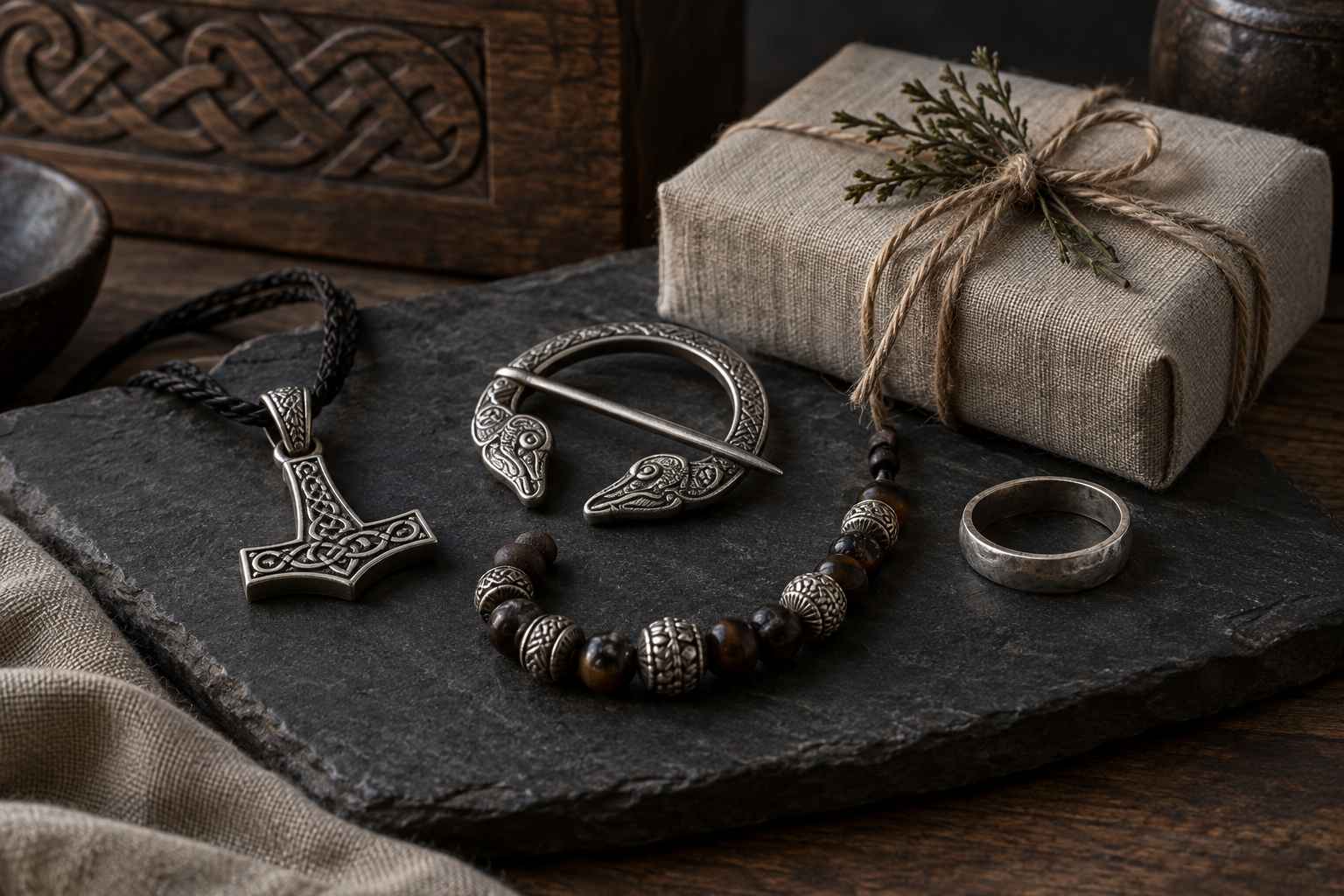
Archaeological jewelry appears in a few common forms: dress fittings such as brooches, neck chains and torcs, arm and wrist rings, beads strung into necklaces, and small pendants. These forms are documented in museum collections and excavation reports as parts of dress and personal adornment. Many modern pieces take inspiration from those forms when creating reproductions or ‘inspired’ designs.
Runes appear on a subset of archaeological objects. The Swedish History Museum’s material on runes explains that inscriptions can be names, ownership marks, short messages, or memorial dedications. Where a modern piece carries runic text, the wearer or gift-giver should be careful to research or translate the inscription accurately and to explain whether it is a historically attested inscription or a modern composition.
Figural and zoomorphic motifs—interlaced animals, stylized beasts, and geometric patterns—are visible in extant metalwork and are often echoed in contemporary jewelry. Museums distinguish between patterns that are directly derived from finds and modern graphic motifs inspired by those patterns; the difference is important for historical responsibility.
Materials and gemstones: what appears in Viking-age jewelry and how that informs choices
Museum collections show that metalwork—bronze, silver, and occasional gold—was central to Viking-age jewelry. Silver, including cut and hammered silver used for arm rings and hoarded as bullion, appears frequently in finds catalogued by Scandinavian museums. The National Museum of Denmark documents how metal fittings and wirework were used for fastenings and ornament.
Beads are another common category: glass beads, faience, and organic materials such as amber appear in archaeological assemblages. Amber is repeatedly associated with northern European prehistory and the early medieval periods in museum displays, so amber beads in modern jewelry legitimately reference a long-standing material tradition. Modern makers also add contemporary stones and manufactured beads; when a seller markets a stone as historically Viking, check whether that material is archaeologically attested or a modern substitution.
Choosing a motif respectfully and matching it to the recipient
Start by considering the recipient’s tastes and the intended meaning of the gift. Are they drawn to historically grounded reproductions, or do they prefer modern designs that borrow Viking elements? If historical accuracy matters, choose pieces that are clearly modeled after documented archaeological types and that come with provenance or a note explaining which object or find inspired the design. The National Museum of Denmark recommends labeling that clarifies whether a piece is a replica, inspired, or a modern design.
If the recipient values symbolism, discuss what the motif personally means to them and be explicit about whether that meaning is a modern interpretation. Avoid assuming universal meanings; neither museums nor archaeologists can reliably assign single, universal symbolic meanings to many motifs. For pieces with runic inscriptions, verify translations and be transparent about whether an inscription is historically attested or newly composed.
Practical selection and gifting guidance
Consider metal sensitivity and comfort: many reproductions use sterling silver or plated metals, and some authentic-styled pieces are heavier than typical modern jewelry. Ask about metal content, hypoallergenic options, and the weight and dimensions of the piece. For rings and arm rings, get a reliable measurement or a flexible sizing policy from the maker.
Choose reputable sources: museums and established historical-replica smiths often provide clear descriptions of which archaeological type a piece is based on. The Swedish History Museum and the National Museum of Denmark both emphasize careful interpretation, so prefer sellers who describe their sources rather than making unverifiable claims about mystical properties or ancient prescriptions.
Respect cultural context: if a design is clearly a ritual or religious object in a different living tradition, research that context and avoid casual appropriation. For Viking-age material specifically, explain to the recipient whether the item is a grounded archaeological reproduction, a modern reinterpretation, or a hybrid inspired by historic forms.
Care, presentation, and responsibility
Present the gift with information: include a card or note that explains the object’s form, the inspiration or archaeological type, the materials used, and whether any runic text is a historical inscription or a modern composition. This practice follows the museums’ guidance to label modern interpretations clearly.
Care instructions should match the materials provided. Silver will tarnish and require polishing; organic beads such as amber need guarded exposure to chemicals and heat. If the piece is a reproduction of an archaeological design, check whether modern fabrication choices have been made for comfort and durability and note those differences to the recipient.
Final checklist before you buy
Confirm the material and any alternative modern materials used. Confirm whether runic or pictorial motifs are historically attested or modern creations. Verify sizing, weight, and return policies. Prefer descriptions that cite museum types or specific finds rather than emotive claims about magic or universal meanings. Include a short explanatory note with the gift that clarifies these points for the recipient.
Frequently asked questions
How can I tell if a Viking-style piece is an archaeological replica or a modern design?
Look for explicit labeling from the seller. A historically grounded replica will usually state which archaeological object or object type inspired the piece and may reference museum collections or a specific find. Modern designs should be described as inspired by Viking motifs rather than as direct copies of a named artifact.
Do runes on jewelry carry the same meaning now as they did in the Viking Age?
Not necessarily. Runes on archaeological objects are primary-source evidence that may record names, ownership, or short messages, but interpreting their meaning requires specialist knowledge. Modern runic inscriptions can be newly composed and carry contemporary meanings chosen by the maker or wearer. Verify translations and state whether an inscription is historical or modern.
Are there materials I should avoid because they aren’t historically accurate?
Using modern materials is common and often practical, but sellers should be transparent. Some metals and synthetic stones are modern substitutions. If historical accuracy matters, ask whether materials such as amber, glass beads, silver, or bronze were used in the original type and whether the seller’s materials match those traditions.
Should I expect any spiritual or protective properties from Viking jewelry?
No archaeological or museum source can guarantee spiritual or supernatural effects. Museums advise distinguishing documented function from modern symbolic attributions. If spiritual meaning matters to the recipient, explain that this is a modern personal interpretation rather than a historic fact.
How should I care for Viking-style jewelry?
Care depends on materials. Silver benefits from occasional polishing to remove tarnish, while organic materials like amber need protection from harsh chemicals and heat. Ask the maker for specific care instructions and store pieces separately to avoid abrasion.
Sources and further reading
- Clothes and jewellery — National Museum of Denmark
- Runes — Swedish History Museum
- The sources for what we know — Swedish History Museum