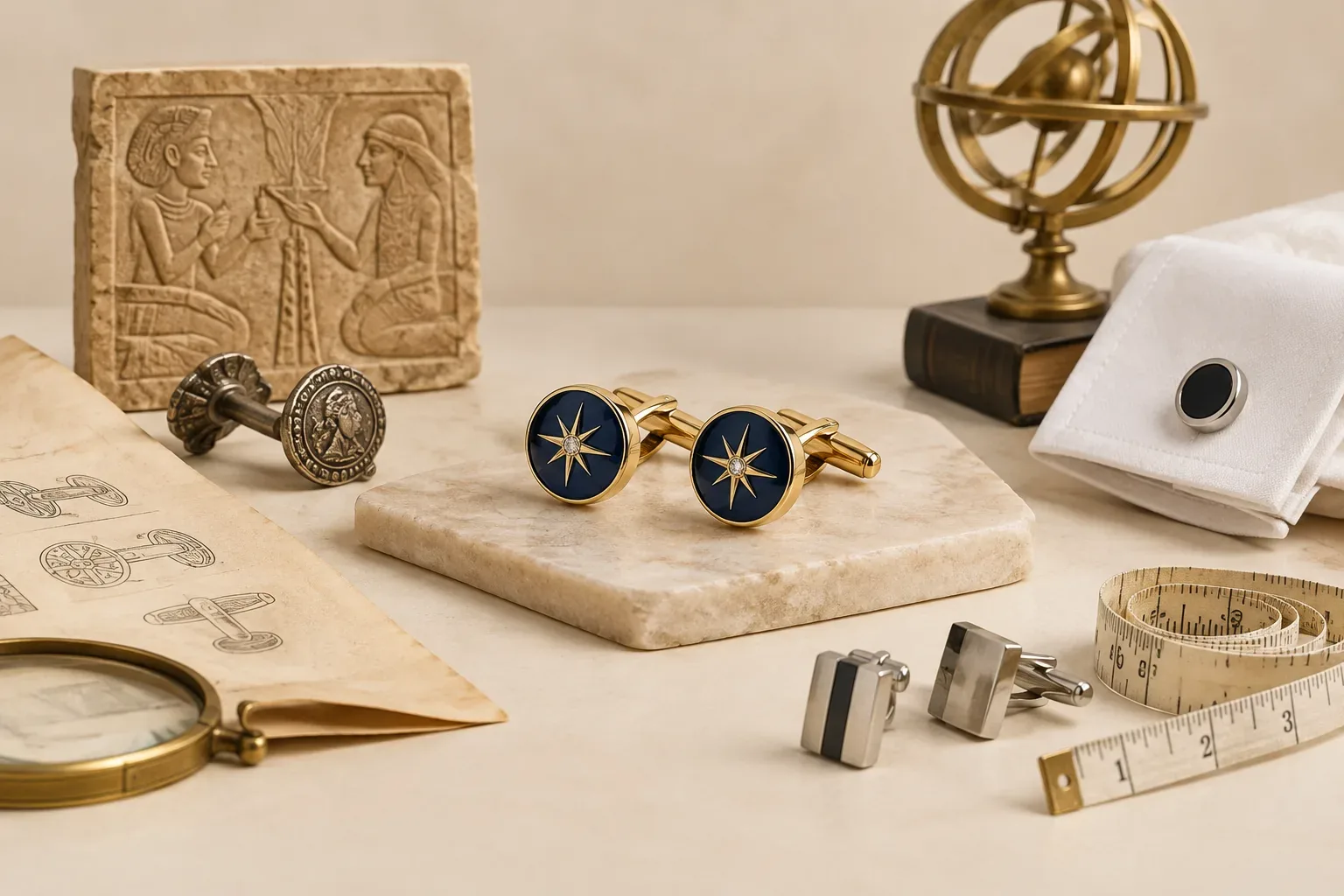
Meaning at a glance
A precise cufflink fit depends on cuff thickness, buttonhole length, and the cufflink’s post and fastening style; historically cufflinks functioned as both practical fasteners and status symbols as documented by the Victoria and Albert Museum, while modern wearers layer personal meaning through motifs and gemstones—this guide separates documented history from contemporary interpretation and gives practical measuring and gifting advice.
Quick, direct answer
Measure the thickness of the folded cuff and the length of its buttonhole, then choose a cufflink with a post or chain long enough to clear the cuff (typically within the common ranges used by modern makers) and a face diameter that balances the cuff style and wearer preference. Historical evidence shows that small wearable items like cufflinks changed in form and meaning with social fashion; use measurements and mechanism type (toggle, whale-back, fixed post, or chain) to guarantee a secure, comfortable fit while selecting motif and material for the personal or formal context you intend.
What historical sources document
Museum research and exhibition material at the Victoria and Albert Museum trace how jewellery has shifted in manufacture, use and social meaning across different cultures and periods. The V&A’s coverage of jewellery history places small wearable accessories in wider social contexts—showing that what people wore and why often changed with fashion, technology, and social conventions rather than remaining fixed meanings.
Applied to cufflinks specifically, the documented history in museum collections emphasizes two clear, evidence-backed points: first, small fastenings and decorative cuff closures served both practical and status-signalling functions in European dress traditions; second, changes in tailoring and shirt construction altered the object’s form, materials and visibility. The V&A material supports reading cufflinks as part of these changing social and material practices rather than as having a single, unchanging symbolic meaning.
Separating documented meanings from modern interpretations
Documented meaning: museums such as the Victoria and Albert Museum record that items like cufflinks functioned within systems of dress that indicated social standing, wealth and adherence to contemporary fashions. That is a historical, contextual observation about use and social signaling supported by curatorial research and collections.
Modern interpretation: many contemporary wearers attach personal or cultural meanings to cufflinks based on motif, gemstone, or the gift-giver’s intention. These modern symbolic readings—for example, seeing a nautical motif as signifying a personal connection to the sea—are subjective and not universal. Distinguish between what curators document about how items were used and what individual wearers choose to mean by them today.
How motifs, gemstones and tradition appear in cufflinks
Motifs appear on cufflinks in many ways: engraved metal faces, enamel scenes, intaglios, carved stones, or applied elements set into a metal surround. Motifs travel between functional ornament and intentional emblem depending on the maker and wearer; museum commentary at the V&A demonstrates that jewelers historically used motifs to reference fashion, family, profession or fashion trends, but interpretation varies by culture and period.
Gemstones are used primarily for ornament and value. The V&A’s A–Z of Gemstones explains how particular stones have been selected historically for color, durability, rarity and associative meaning. In cufflinks that can mean small cabochons, faceted stones set in bezels, or inlaid semi-precious stones. Modern makers may use diamonds or colored gemstones to increase perceived luxury, while others prefer enamel or engraved metal for a slimmer profile.
Tradition appears in cufflinks through recurring styles and fastening mechanisms. Chain links, fixed posts, toggle backs and whale-back closures each reflect a manufacturing moment and a wearer's practical needs. As tailoring and shirt design evolved, so did the cufflink mechanisms favored by turn-of-the-century workshops and by later twentieth-century mass manufacture; museum narratives place those shifts in broader social and industrial changes.
Measurements and fit: what to check before buying
Start by measuring the cuff. With the shirt buttoned at the wrist, fold the cuff as you would for a double (French) cuff. Use a ruler or caliper to measure the thickness of the folded cuff where the cufflink will pass. Note the thickness in millimetres and in a simple range such as thin, medium or thick for your records.
Measure the buttonhole length across the folded cuff. The buttonhole often determines the minimum post or chain length required for the cufflink to pass through without strain. A cufflink must pass through the buttonholes comfortably before engaging its fastening; if the post is too short, the cufflink will be difficult to attach and may pull the cuff.
Consider the fastening mechanism. Chain and fixed-post styles are more forgiving of small length differences, whereas rigid fixed posts require closer matching to cuff thickness. Toggle and whale-back fastenings usually give a secure hold for a standard range of cuff thicknesses, but check that the toggle can freely rotate once inserted so the cufflink locks in place without stress.
Choose a face diameter in proportion to the cuff. For narrow, formal dress shirt cuffs a smaller face (subtle, closer to the cuff edge) is generally more elegant, while wider, casual or French cuffs can take a larger, bolder face. Balance the face size with the wearer’s frame and the cuff style rather than adhering to a single 'correct' dimension.
Typical size ranges and what they mean
Face diameters: contemporary cufflink faces commonly range from compact sizes to bolder statement sizes. Smaller faces suit minimalist or formal contexts, medium faces work for most everyday dress, and larger faces are used for decorative, sporting or novelty pieces. Exact millimetre dimensions vary by maker; check product specifications before purchase.
Post and chain lengths: makers usually provide post length or chain length in product details. A cufflink should allow the wearer to slide the post or chain through both buttonholes without stretching the fabric. If you cannot find precise numbers for a particular style, compare the design to a cufflink you already own that fits well and use that as a practical template.
Mechanism-specific notes: chain links accommodate thicker cuffs more easily because they allow additional slack. Rigid posts or fixed-back links require a closer match to cuff thickness but can offer a flatter profile for a sleeker look. Toggle and whale-back styles are convenient for quick fastening and are commonly used in contemporary designs.
Practical buying and gifting guidance
When buying for yourself, test a cufflink on the shirt you intend to wear it with if possible. Bring the shirt or a measurement to the shop, or use the maker’s sizing guide online. If you purchase online, use accurate measurements and double-check return policies in case the cufflink doesn’t fit the way you expected.
When gifting, ask discreet questions about the recipient’s usual cuff style and whether they wear French cuffs or single-button cuffs. Choose a fastening known to be versatile if you cannot confirm cuff thickness: chain or toggle backs are generally easier for a range of cuffs. Select a motif and finish that match the recipient’s typical wardrobe—subtle metal tones and small faces for conservative dressers, bolder designs for those who prefer visible accessories.
Disclose material treatments and imitations when relevant. The Federal Trade Commission advises that sellers should disclose gemstone treatments and imitations. If a cufflink uses treated gems, simulated stones, or plated metals, present that information openly so the buyer understands the piece’s care needs and value.
Respect cultural and personal meanings. If a motif has an identifiable cultural or religious association, be mindful and, when in doubt, research or ask before gifting. The Victoria and Albert Museum’s commentary on jewelry history shows how context matters: what seems decorative in one culture or era may carry different associations in another.
Care, adjustment and professional help
Check moving parts periodically. Toggles and hinges can loosen; jewelers can tighten or replace worn fixtures. Leather or fabric insets and glued elements should be treated gently and, if necessary, taken to a trusted repairer.
For custom sizing or bespoke cufflinks, consult a jeweler. If a cufflink’s post length does not suit a particular cuff, many reputable workshops can alter posts or fit alternative closures. For valuable gemstones, ask about secure settings and appropriate insurance or appraisal.
Final considerations
Cufflink fit is a practical measurement problem solved by matching cuff thickness, buttonhole length and mechanism type. Museums like the Victoria and Albert Museum document the historical roles of small jewellery items within changing social and fashion contexts, which helps explain why forms and materials vary across time and place. Use those documented histories to inform respectful choices about motifs and traditions, but treat contemporary symbolic meanings as personal and culturally specific rather than universal.
Frequently asked questions
How do I measure my cuff to choose the right cufflink?
Fold the cuff as you will wear it (for a double or French cuff), measure the thickness of the folded cuff where the cufflink will pass, and measure the length of the buttonhole across the folded cuff. Use those measurements to select a cufflink with a post or chain length that allows the piece to pass through before the fastening is engaged.
What fastening type works best for unknown cuff thicknesses when gifting?
Chain-backed and toggle-backed cufflinks are generally more forgiving of varying cuff thicknesses because they offer some slack or rotational action; these mechanisms are often the safest choice when you cannot confirm the recipient’s cuff construction.
Do I need to worry about gemstone treatments or imitations?
Yes. The Federal Trade Commission advises that sellers should disclose treatments and imitations. Ask the seller whether stones are treated, synthetic, or simulants and request clear information about care and value before purchasing.
Can a jeweler adjust cufflinks if the post is the wrong length?
Many jewelers can alter posts, replace fastenings, or fit an alternative closure to improve fit. For valuable or complex settings, consult a reputable craftsman who can advise on safe adjustments and any warranty implications.
Are there cultural meanings attached to certain cufflink motifs?
Motifs may carry cultural or personal significance, but documented historical evidence shows that meanings change across time and place. If a motif has an identifiable cultural or religious association, research or ask before gifting to avoid unintended offense.
Sources and further reading
- Bedazzled: A History of Jewellery — Victoria and Albert Museum
- An A-Z of Gemstones — Victoria and Albert Museum
- Buying Gemstones, Diamonds, and Pearls — Federal Trade Commission