Meaning at a glance
This cufflinks buying guide explains what the historical record shows about cuffed shirt fasteners, distinguishes documented meanings from modern personal interpretations, describes how motifs and gemstones are used in cufflinks, and gives practical guidance on materials, quality checks, pricing, selection, and gifting.
Direct answer — what this buying guide does
Concise answer: This cufflinks buying guide summarizes the documented history and changing social contexts of cuff-style shirt fasteners as recorded by museum scholarship, separates those documented facts from later popular or personal meanings, explains how motifs and gemstones appear in cufflinks, and offers practical, respectful guidance on choosing, buying, and gifting cufflinks based on material, construction, and price concerns.
What the historical evidence shows (and how scholars present it)
Museum research and exhibition material outline the broader history of jewellery and how personal ornaments and dress accessories change meaning across periods and cultures. The Victoria and Albert Museum frames jewellery as a form of social expression whose forms and uses shift with fashion, technology, and social norms. Relying on that documented approach helps avoid assuming a single unchanging meaning for cufflinks or other accessories.
In concrete terms, the historical record preserved in museum collections shows that ornamental fastenings and men's decorative dress accessories have appeared in many styles and contexts as social dress codes evolved. The V&A's work highlights changing social contexts—practical uses becoming sartorial signals and vice versa—but does not reduce those objects to a single cultural or religious meaning. Use museum descriptions to identify when a specific form or motif belonged primarily to a particular social class, region, or era rather than assuming that meaning carries forward automatically to the present.
Separating documented historical meanings from modern interpretations
Documented meanings are the purposes and associations that contemporary records, inventories, portraits, or museum catalogues attribute to objects at the time they were made or used. For example, museum documentation may record that certain ornaments functioned as status markers, mourning jewellery, or trade goods in specific places and periods. Those attributions are supported by archival evidence and curatorial research and should be cited when you claim historical meaning.
Modern interpretations—what people today understand a cufflink motif to mean—often arise later through fashion cycles, marketing, or personal symbolism. A motif that functioned primarily as a fashionable motif in the 19th century can acquire sentimental, corporate, or new cultural associations in the 21st century. Treat modern meanings as layered and subjective: they can be real and useful for gifting or personal expression, but they are not the same as historically documented meanings unless you can point to period evidence to support a continuity of meaning.
How motifs, gemstones, and traditions appear in cufflinks
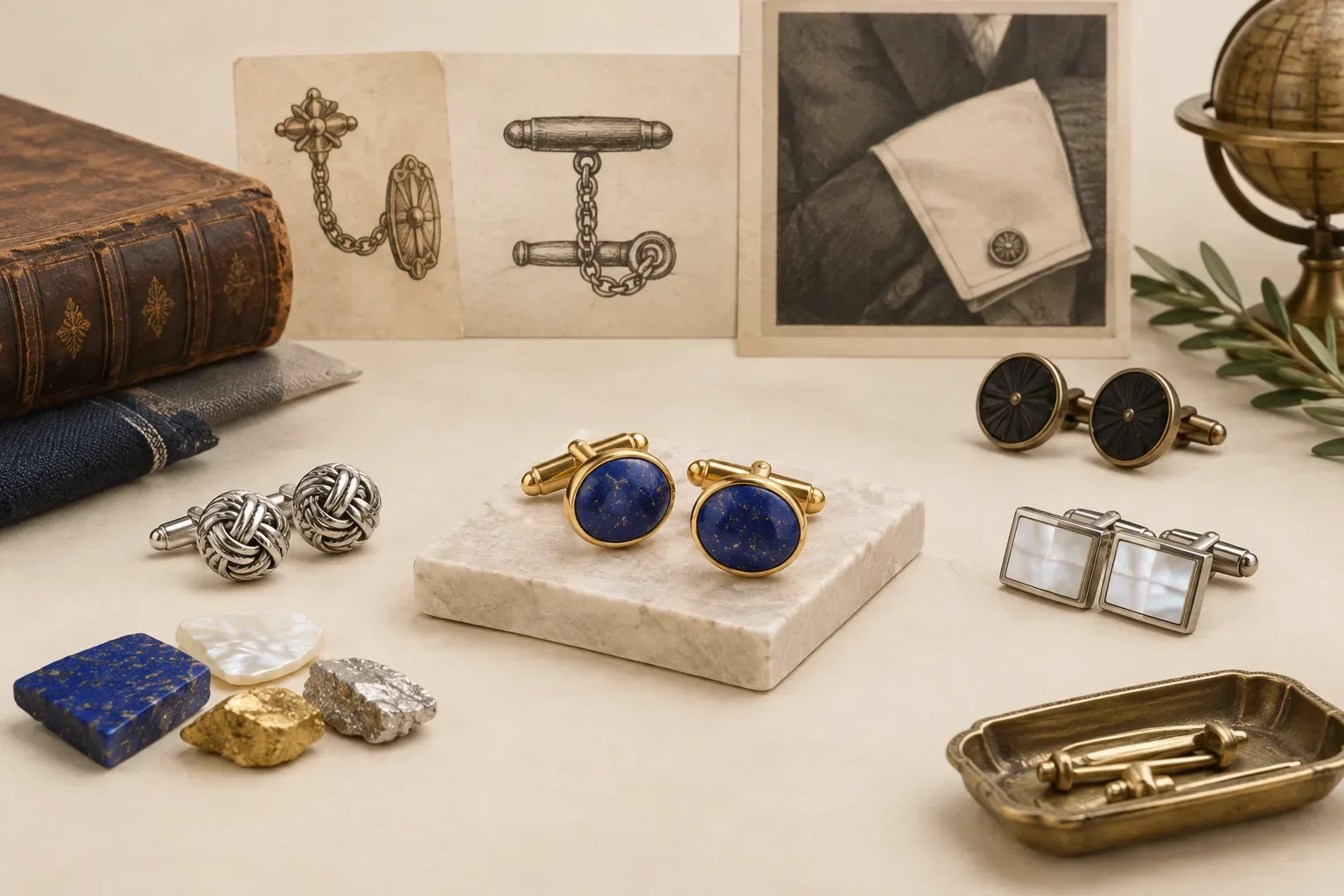
Motifs and decorative choices in cufflinks follow the same design and material logic as other jewellery. Designs range from monograms and geometric forms to figurative motifs, heraldry, and novelty designs. These choices are typically expressions of identity, affiliation, or fashion rather than fixed cultural scriptures; their precise historical significance should be checked against period sources when relevant.
Gemstones are used in cufflinks for colour, sparkle, and perceived value. For information on specific stones, identification, and historical associations, museum resources such as the Victoria and Albert Museum’s Gemstones A–Z provide technical descriptions and historical contexts for individual gems. That source can help you understand which stones were prized in different eras and why a particular gem might be chosen for a cufflink setting today.
Metal choices and finishing appear in cufflinks as they do across jewellery: precious metals confer intrinsic metal value and traditional prestige, while plated or base-metal options provide affordability and a different wear profile. Manufacturing techniques—cast, stamped, set with stones or enamelled—affect longevity and appearance, and those differences are visible in close inspection or product documentation.
Assessing quality and materials
Start by identifying the metal and whether any markings exist. Hallmarks or maker’s marks, where present, are a documented indicator of metal content and origin in many jurisdictions; museum cataloguing practices use such marks to attribute works. For gemstones and treatments, rely on trustworthy disclosure: official consumer guidance explains that treated or synthetic stones must be disclosed to buyers. The Federal Trade Commission’s guidance on buying gemstones, diamonds, and pearls explains the importance of seller disclosure for treatments, enhancements, and imitations, and recommends asking for written confirmation of claims about origin, treatment, and authenticity.
Inspect construction: check the hinge or toggle mechanism for smooth action and secure solder joints, look for symmetrical settings, and evaluate the finish for consistent polishing. For gemstone-set cufflinks, ensure stones are secure with no visible gaps in the setting and that any glue or filler is not exposed. For plated items, understand that plating wears over time and may require re-plating to maintain appearance.
Price questions: what affects value and how much to expect
Price depends on materials, maker, craftsmanship, and rarity. Precious metals (solid gold, platinum) and natural gemstones increase intrinsic material value. Maker reputation or historic provenance can add premium value beyond materials. For comparable modern pieces from mass producers, expect price variance based mainly on metal and stone content and finishing quality.
Be mindful of tradeoffs: a lower-priced accessory can still offer good wearability if constructed well and finished neatly, whereas expensive pieces justify their price through material content, skilled finishing, or artisanal detail. When a listing claims a stone is natural, untreated, or of particular geographic origin, ask for documentation or a clear disclosure, following the consumer guidance reflected in the Federal Trade Commission’s materials.
Practical tips for choosing and wearing cufflinks
Match the formality of the cufflink to the occasion and outfit. Simpler metal styles or small gemstone studs work well for business settings; more elaborate motifs, larger stones, or novelty designs are suited to evening wear or personal expression. Consider the shirt’s cuff type—double (French) cuffs commonly require cufflinks—so ensure the cufflink’s post length and toggle type suit the cuff thickness.
Think about scale and proportion: choose cufflinks that complement the wearer’s build and the shirt’s cuff size. Avoid overly large, heavy pieces if the wearer prefers a subtle look. For engraved or monogrammed cufflinks, use correct initials and spellings; consider whether a personalized gift is appropriate given cultural or organizational associations that initials may carry.
Respectful selection and gifting guidance
When buying cufflinks as a gift, respect the recipient’s personal and cultural context. If the motif has cultural, religious, or institutional significance, confirm that the recipient will welcome that symbolism. Museum scholarship reminds us that meanings can be historically specific: a motif rescued from a historic setting does not automatically carry the same meaning today for all audiences.
Choose personalization thoughtfully. Monograms, dates, or meaningful symbols can make a cufflink special, but ensure accuracy and appropriateness. If uncertain, select classic metal or gemstone styles that communicate thoughtfulness without risking misinterpreted symbolism. Present cufflinks in a fitted box with care instructions and, where relevant, documentation of materials or treatments to make future care and resale clearer.
Care, repair, and provenance
Regular care extends the life of cufflinks. Wipe metals and gemstones with a soft cloth after wear, avoid exposure to harsh chemicals, and store in a compartmentalized box to prevent scratches. For plated items, be aware that re-plating is a normal maintenance option; for solid precious-metal pieces, routine polishing by a jeweller can restore lustre.
If provenance or maker matters to you, seek documented history. Museum catalogues demonstrate how provenance enhances scholarly and market value; for buyers, clear provenance or a maker’s warranty increases confidence in the piece’s authenticity and fair pricing.
Final checklist before purchase
Before you buy, confirm metal content and any hallmarks, check for disclosure about gemstone treatments or synthetics, test the fastening mechanism if possible, and consider the item’s scale in relation to the intended wearer’s wardrobe. Ask the seller for written confirmation of any claims that affect value or care needs. These steps follow the practical consumer guidance reflected in museum practice and government consumer information.
Frequently asked questions
How do I know if cufflinks are solid gold or just plated?
Look for hallmarks or maker’s marks that indicate metal content and ask the seller for documentation. Solid gold pieces usually carry standard marks for karatage in jurisdictions that enforce hallmarking. If there is no hallmark, request a written statement from the seller about metal content and, when possible, an assay or appraisal to confirm.
Should I buy cufflinks with natural gemstones or synthetic stones?
Choose based on budget, intended use, and desired durability. Natural gemstones typically cost more and may have unique inclusions; synthetics and simulants can offer consistent colour at lower cost. Always ask the seller to disclose treatments, synthetics, or simulations in writing, in line with consumer guidance on gemstone disclosure.
What mechanism is best for everyday wear?
For frequent use, choose a cufflink with a robust hinge or toggle that moves smoothly and resets reliably. Fixed-back designs are simple and durable, while hinged or bullet-back toggles offer ease of use but can wear over time; inspect the moving parts for tight, smooth operation before purchase.
Are engraved or symbolic cufflinks appropriate as gifts?
Engraved initials are a classic, generally safe gift if you confirm spelling and the recipient’s preferences. Symbolic motifs can be meaningful but check cultural or organizational associations so you do not give a symbol that has unintended significance for the recipient.
How should I care for plated cufflinks versus solid metal ones?
Wipe plated pieces gently after wear and avoid abrasive cleaners that remove plating. Solid precious metals respond well to gentle polishing and professional cleaning. For any gemstone-set pieces, avoid exposure to harsh chemicals and have settings checked periodically by a jeweller.
Sources and further reading
- Bedazzled: A History of Jewellery — Victoria and Albert Museum
- An A-Z of Gemstones — Victoria and Albert Museum
- Buying Gemstones, Diamonds, and Pearls — Federal Trade Commission