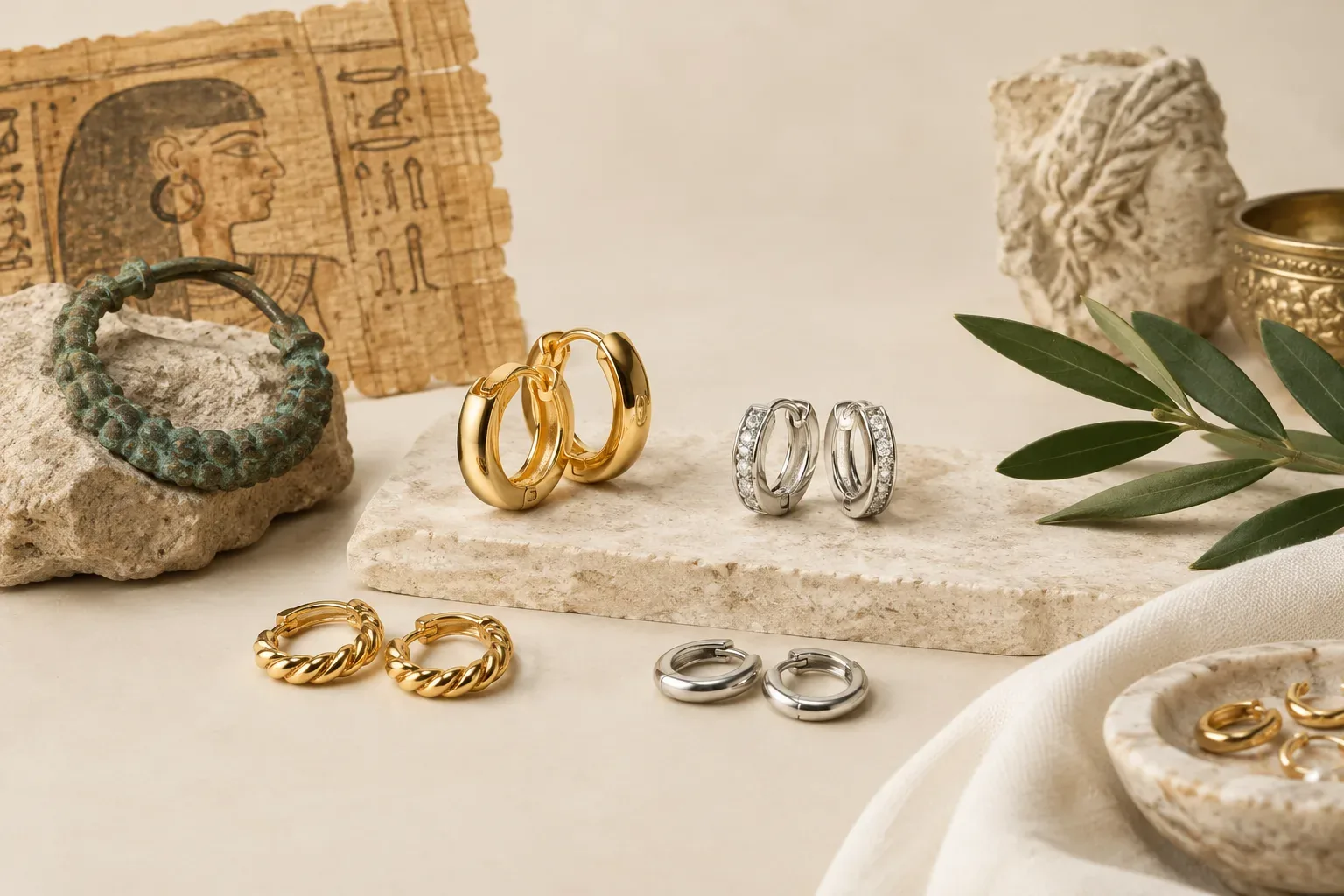
Meaning at a glance
Huggie earrings are small hinged hoops that 'hug' the earlobe; their use and decoration have changed across periods and cultures, and a careful purchase should separate documented historical context from modern personal meanings, assess metal and setting quality, check gemstone disclosure and treatments, and consider fit, allergies and care when buying or gifting.
Short answer
Huggie earrings are small hinged hoops designed to sit close to the earlobe; historically, small hoop-style earrings and gem-set ornaments appear across many cultures but their social meanings have shifted over time, so when buying you should treat historical notes as contextual rather than universal, evaluate metal and construction quality, ask for disclosure about gemstone treatments or imitations, and choose size and material to match the wearer’s health and style needs.
What huggie earrings are and how they relate to jewellery history
The term 'huggie' is modern retail language for a compact hinged hoop that closes securely and sits snugly around the lower part of the ear. The Victoria and Albert Museum discusses how jewellery forms, including small hoops and close-fitting rings, have been used in many periods and regions, with designs and social uses changing as technology, fashion and available materials evolved.
Museum accounts emphasize that the same basic form—a small circular earring—has appeared in different contexts rather than having a single continuous meaning. For example, close-fitting hoop forms have been worn in ancient Mediterranean societies, in medieval Europe, and in many later fashions, but the V&A frames these appearances as examples of changing social context rather than evidence that a specific symbolic meaning travelled unchanged between cultures.
Documented historical meanings versus modern personal interpretations
When researching symbolism, separate what museums and historical sources document from what contemporary wearers may now ascribe. The V&A describes jewellery history and shifting social uses, which allows us to say that small hoop forms have been common and adaptable, but it does not support treating a huggie as carrying one universal message across time or place.
Modern interpretations—such as seeing huggies as a casual, minimalist style marker, a statement of youth culture, or as a token of intimacy between friends—are contemporary cultural readings. Those interpretations can be meaningful to individuals and communities today, but they are social developments rather than documented cross-cultural continuities in the historical record.
How motifs, gemstones and traditions appear in huggie jewellery
Huggies serve as a platform for many decorative approaches. Motifs such as engraved patterns, tiny charms, religious symbols, or textured finishes reproduce motifs historically used in larger jewellery forms but scaled to the huggie’s small circumference. The V&A’s coverage of objects and styles explains how makers adapted motifs and stones to emerging tastes and techniques.
Gemstones appear in huggies in common settings like bezel, flush, channel and pavé, and small pearls or cabochons are also typical. The Victoria and Albert Museum’s 'A–Z of Gemstones' explains how particular stones were used and valued in historical contexts; in modern huggies the same materials may be chosen for color and durability rather than any fixed symbolic meaning. For any gemstone used in a huggie, the Federal Trade Commission’s guidance reminds buyers to ask whether stones are natural, treated, or lab-created and whether imitations are being sold as genuine.
Materials and construction: what determines quality
Primary quality drivers for huggies are the metal, the clasp mechanism, the finish and the setting method for any stones. Solid precious metals such as 14K or 18K gold and sterling silver generally outlast plated alternatives because of wear resistance and the ability to be repaired. For historical and technical context on materials and treatments, the Victoria and Albert Museum provides background on how makers have worked with metals and gems over time.
Construction details matter: a well-made hinge and a sturdy locking mechanism reduce the chance of loss. Check that the hinge operates smoothly and that the post or click closure aligns securely without play. Soldered seams are stronger than thin folded or glued joins. For gemstones, inspect setting quality—tight bezels or well-executed pavé reduce the risk of stones loosening.
Gemstone considerations and disclosure
If a huggie contains gems, ask about the type of stone, whether it is natural, lab-grown, or an imitation, and whether it has been treated. The Federal Trade Commission’s consumer guidance on buying gemstones stresses that sellers must not misrepresent treatments or origins. Treatments such as heat, fracture filling, or coatings change value and care requirements, so buyers should expect clear disclosure.
Small stones set into huggies are often brilliant-cut diamonds, sapphires, or cubic zirconia. The V&A’s gemstones overview helps explain historical uses and shifting desirability of different stones, but buyers should treat historical prestige as context rather than a direct measure of contemporary value for a specific pair of huggies.
Price drivers and common price questions
Typical factors that influence price are metal type and weight, gemstone type and quality, the complexity of manufacture, brand, and whether the piece is handcrafted or mass-produced. Solid gold huggies cost more than gold-filled or plated versions because of metal content and repairability. Gemstone quality and size—even small accents—affect price, and lab-grown stones are usually less expensive than equivalent natural stones.
Do not rely on price alone as a proxy for quality. Inspect construction, ask about karat markings and hallmarks, and request documentation for significant gemstone purchases. The FTC guidance emphasizes clear labeling on treatments and imitations—if a price seems low for a claimed natural stone, ask for a written disclosure or certificate.
Fit, health and daily wear considerations
Huggies are intended to be close-fitting, so size and weight matter. Too-large or heavy huggies will pull the earlobe; too small may be difficult to manipulate or cause pressure. Try huggies in person when possible to assess comfort and how they move with your ear. Consider the post gauge and whether the wearer has recent or healing piercings; many jewelers recommend waiting until a piercing is fully healed before switching to styles with tight closures.
If someone has metal sensitivities, choose metals with low nickel content such as 14K+ gold, platinum, titanium, or certain surgical stainless steels. Ask the seller about alloy composition if allergies are a concern. Regular exposure to water, sweat, or lotions can affect plated surfaces more quickly than solid metals, so plan care routines accordingly.
Practical selection and gifting guidance
When selecting or gifting huggies, match scale and style to the wearer’s wardrobe and existing jewellery. Consider whether they prefer mixed-metal looks or match their other pieces. For a safe, wearable gift choose a comfortable diameter and hinge style, verify metal and stone disclosures, and keep the receipt in case sizing or allergies require an exchange.
Be culturally respectful: some communities have specific ear-piercing and jewellery traditions, and religious motifs can carry meanings that are important to wearer identity. If you are unsure whether a religious symbol is appropriate, ask discreetly or select a neutral decorative motif. For sentimental gifts, pairing a huggie with a short note about why you chose the piece communicates meaning more clearly than assuming a universal symbol.
Care, repairs and resale considerations
Ask about care recommendations and whether small stones can be tightened or the hinge serviced locally. Solid metal huggies are generally easier to repair than heavily plated items. For pieces with gemstones, follow care instructions tied to the specific stone—some treatments reduce resistance to ultrasonic cleaners or harsh chemicals.
If resale value matters, prioritize solid precious metals and documented natural stones with reliable disclosure. Custom or artisan pieces may hold sentimental value but not necessarily strong resale value, whereas classic solid-gold huggies with certified stones have more predictable marketability.
Final checklist before you buy
Before purchasing, confirm the metal type and hallmark, inspect the hinge and closure for secure operation, ask for written disclosure on gemstone type and treatments, check return and repair policies, try the fit if possible, and confirm what cleaning methods are recommended. If buying online, request clear close-up photos of the hinge and any stones and verify the seller’s disclosure practices against Federal Trade Commission guidance.
Closing
Huggie earrings are a small, versatile form with roots in many historical jewelry practices, but the meanings they carry today are primarily shaped by contemporary style and personal choice. Use historical sources as context, follow disclosure guidance when assessing gemstones and treatments, and prioritize construction, fit, and wearer health when selecting or gifting. That approach keeps your decision both well informed and considerate of the wearer’s preferences.
Frequently asked questions
What are huggie earrings and how do they differ from hoops and studs?
Huggie earrings are small hinged hoops that close snugly around the earlobe; they differ from larger hoop earrings in scale and from studs in that they encircle part of the ear rather than sitting as a single post and backing.
How can I tell if huggie earrings are good quality?
Check the metal hallmark, test the hinge and closure for smooth secure operation, inspect soldering and seam work, and examine gemstone settings for tightness and even alignment; solid metal and neat construction are better for longevity than thin plating.
Are huggies safe for new piercings?
Most jewelers recommend waiting until a new piercing is fully healed before wearing tight-fitting huggies. If you plan to wear them soon after piercing, choose inert metals such as titanium or implant-grade stainless steel and consult a piercer or medical professional.
Do I need to worry about gemstone treatments?
Yes. Treatments like heating, fracture filling, or coatings affect appearance, value and care. Ask the seller for written disclosure about treatments and whether stones are natural, lab-grown or imitations as recommended by the Federal Trade Commission.
How much should I expect to pay for quality huggies?
Prices vary widely. Expect higher cost for solid 14K–18K gold and natural gemstones, mid-range for gold-filled or vermeil with good construction, and lower prices for plated or base-metal versions. Consider metal content, craftsmanship and disclosure when evaluating price.
How should I care for huggie earrings?
Follow care guidance for the specific metal and stone: avoid harsh chemicals and ultrasonic cleaners for treated stones, remove huggies during heavy exercise or swimming if they are plated, and store them to avoid scratching. Regular inspection of hinges and settings helps prevent loss.
Sources and further reading
- Bedazzled: A History of Jewellery — Victoria and Albert Museum
- An A-Z of Gemstones — Victoria and Albert Museum
- Buying Gemstones, Diamonds, and Pearls — Federal Trade Commission