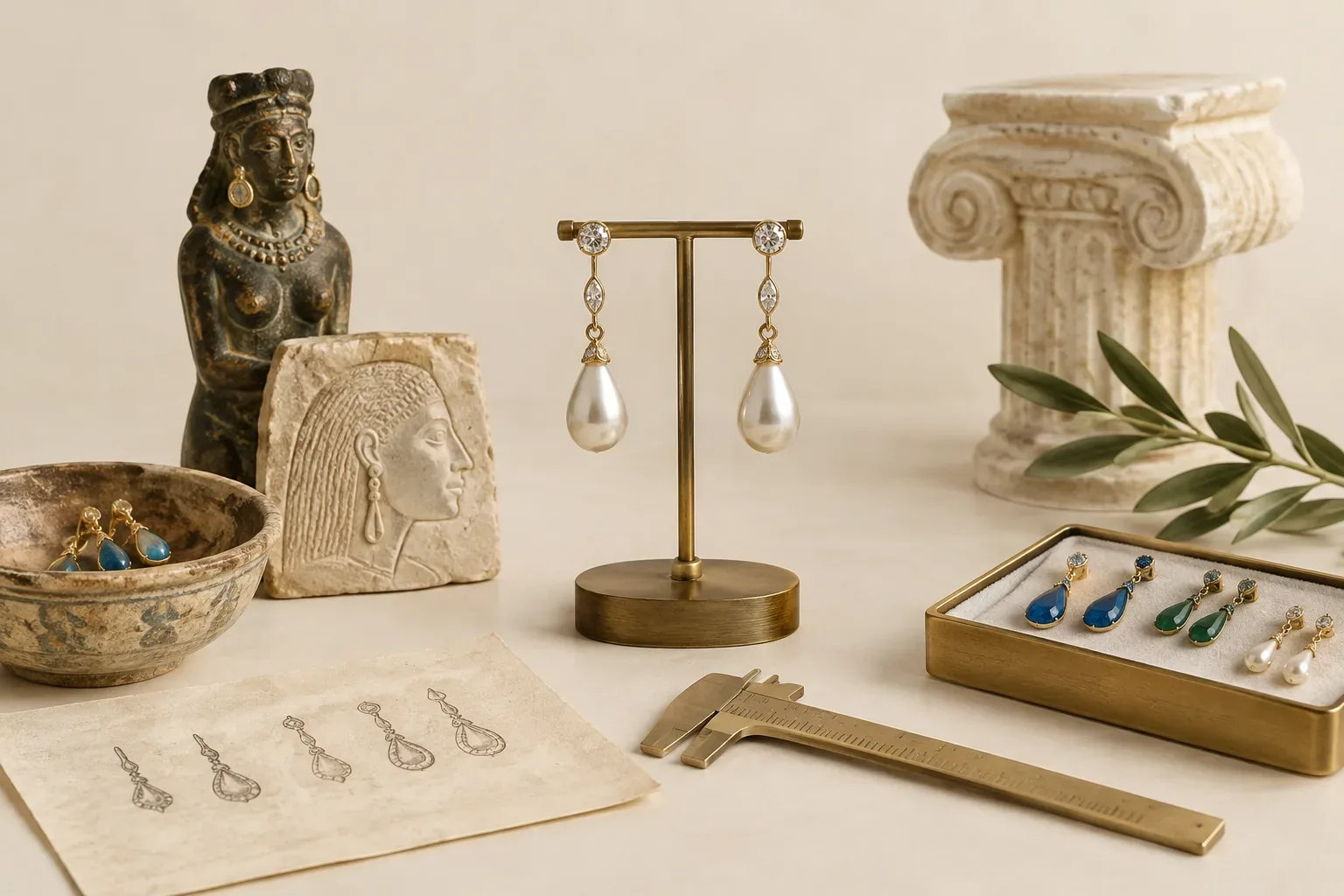
Meaning at a glance
This guide explains the documented history and changing contexts of drop earrings, separates historical evidence from modern interpretation, and gives practical, measurement-based advice for choosing and fitting drop earrings today.
What the historical record shows (and how we know it)
Museums and curators are the main repositories of documented jewelry history. The Victoria and Albert Museum (V&A) presents an overarching narrative that jewellery styles, including drops and pendants suspended from ear fittings, recur across many cultures and eras as both decorative and status objects. The V&A’s exhibition and interpretive materials place such objects in social and technological contexts rather than treating any single symbol as having an unchanging, universal meaning.
Specific cultures and periods developed drop-style earrings in their own ways. For example, ear ornaments with hanging elements appear in ancient Mediterranean and Near Eastern collections, Byzantine and Ottoman examples show complex metalwork and suspended gems, and European fashions in the 18th and 19th centuries revived and adapted pendant motifs. The V&A’s resources document these changing contexts and how techniques, available gemstones, and social uses shifted over time.
When reading museum summaries, note that they report what objects and inscriptions show about use, materials, and craftsmanship. They usually do not claim a single symbolic meaning applied identically across time and place. The V&A emphasizes changing social contexts—how jewelry signaled status, identified group membership, or followed fashion—rather than proving a single religious or cultural interpretation for all drop motifs.
Documented meanings versus modern personal interpretations
Documented meanings are those supported by primary evidence such as inscriptions, burial contexts, inventories, or contemporary texts discussed in museum catalogues. For example, jewellery in funerary contexts may indicate status or beliefs about the afterlife, while portraiture and inventories can show how certain styles identified social rank. The V&A’s descriptions focus on these kinds of evidence when attributing historical context to objects.
Modern personal meanings—what a wearer feels a motif represents today—are distinct from that archaeological or documentary evidence. A contemporary wearer might choose a teardrop shape because it feels elegant or because they associate it with a personal memory. Such modern interpretations are valid at the personal level but should not be presented as historically documented facts unless supported by evidence.
Do not assume that a motif had the same connotation in different places or times. A suspended pearl in a medieval context might signal wealth because of rarity and trade networks; the same pearl shape used in a 21st-century fashion line may primarily signal a style trend or personal taste. No single symbolic meaning is universal across cultures or eras.
How motifs, gemstones, and traditions appear in drop earrings
Motifs in drop earrings commonly include simple geometric pendants, teardrops, drops shaped like leaves or grains, pearls, and cut gemstones set as focal points. The motif choice affects both aesthetic and physical behavior: narrow teardrops move more easily and tend to sit closer to the jawline, while wide or multi-element drops create more surface area and can catch on clothing.
Gemstones change the character of a drop by color, refractive properties, and density. The V&A’s A–Z of Gemstones explains how different stones were valued and used historically, which helps us see why certain gems appear repeatedly in specific periods. For example, pearls and certain colored gems were prized where trade and technology made them desirable and available, and their use in drops often emphasized shimmer and movement.
Traditions shape construction techniques. Hinged joints, separate bezel-set drops, and multi-tiered designs appear in different eras because of advances in metalworking and consumer tastes. The physical construction—how an element is soldered, wired, or pegged—affects how a drop hangs, swings, and wears over time. Heavier stones or more elaborate metalwork increase torque on the ear fitting, which matters for both comfort and the type of back or closure used.
Measurements and fit: a practical guide
Length is the simplest measurable attribute. Measure drop length from the point where the earring rests at the top of the earlobe (the post or hinge) to the lowest point of the earring while hanging naturally. Small variations in how an earring is worn—where the post sits, whether the wearer has a slightly longer lobe—change perceived length, so always measure on the intended wearer if possible.
Consider categorizing lengths into shorthand for conversation: short drops sit just below the earlobe and tend to be discreet; medium drops extend toward the jawline and are versatile for daytime and evening wear; long drops fall below the jawline and make a stronger fashion statement. Which category suits someone depends on their personal style, neck and jawline proportions, and comfort with movement.
Weight and balance matter as much as length. A long earring made of hollow metal or light resin behaves differently from a shorter earring set with a dense gemstone. Try on earrings and move your head to feel how they swing and whether they tug. If the wearer plans to wear earrings for many hours, choose lighter weights or designs with distributed mass so the earlobe is not under sustained strain.
Closures and fittings influence fit and security. Leverbacks and hinged closures secure drops close to the ear and reduce rotation. Hooks and shepherd wires allow more swing and can slip out if not properly sized. Clip-ons and screw-backs exist for non-pierced ears, but their pressure must be adjusted for comfort. When in doubt, test the closure with typical movements—talking, leaning, turning—to ensure the earring will stay comfortable and secure.
Consider how the wearer’s lifestyle will interact with the earring. A long, swinging drop may be beautiful but impractical for someone who frequently wears scarves, helmets, or works in roles where jewelry could snag. For everyday wear, many choose shorter drops or medium drops with secure backs; for occasional evening wear, longer, more ornate drops are often appropriate.
Materials, disclosure, and durability
Ask about materials and treatments. The U.S. Federal Trade Commission advises consumers to inquire about gemstone treatments, imitations, and disclosure practices when buying gemstones, diamonds, or pearls. Sellers should be able to tell you whether a gem is natural, treated, or synthetic, and whether metals are plated or solid. That information affects both value and care.
Durability depends on metals, stone hardness, and construction. Softer gems scratch more easily and may require protective settings; delicate joins can fatigue over time if the design places repeated stress on a small link. Consider how often the wearer will remove and store earrings. Simple designs with strong soldered joins tend to be more durable for daily wear.
Choosing and gifting drop earrings with respect
Selecting or gifting drop earrings respectfully begins with attention to the recipient’s preferences, sensitivities, and cultural background. If a design incorporates a motif tied to a specific culture or religious tradition, make sure the recipient welcomes that reference; do not assume symbolic meanings or that such motifs are appropriate as casual fashion without understanding their context.
Practical questions are also respectful: confirm whether the recipient has pierced ears, known metal sensitivities such as nickel allergy, and whether they prefer lightweight or statement pieces. If the earring’s length is important, give measurements in the gift note or include a simple ruler diagram so the recipient can assess fit before trying them on.
When in doubt about size, choose a versatile medium drop or select a style with an adjustable or removable element. Include care and material information in the gift so the recipient can make an informed choice about wear and upkeep. If you are buying antique or historically styled pieces, include any provenance or museum references so the recipient understands the object’s cultural and historical context.
Care, adjustments, and when to ask a jeweler
Small adjustments—shortening a drop, changing a hook to a leverback, or adding a stabilizing rubber stopper—can make a major difference in comfort and wearability. A professional jeweler can replace a fragile link, rebalance a pendant, or advise on lighter alternatives for long designs without changing the aesthetic.
If the earlobe is stretched or sensitive from prior heavy wear, seek designs that spread weight across the lobe or use a stabilizing disk to distribute pressure. For vintage pieces, ask a jeweler to inspect settings and soldered joins before regular use. Proper maintenance prolongs both the beauty and the wearable life of drop earrings.
Final note
A good drop earrings size and fit guide balances measurable facts—length, weight, closure type—with the wearer’s body and lifestyle. Historical examples, as documented by institutions such as the Victoria and Albert Museum, show variation across times and cultures rather than a single, persistent meaning. Use measurements and material disclosures to make choices that are comfortable, durable, and culturally respectful.
Frequently asked questions
How do I measure drop length correctly?
Measure from the point where the earring rests at the top of the earlobe (the post or hinge) down to the lowest point of the earring while hanging naturally. For accuracy, measure on the intended wearer if possible because lobe size and posture affect perceived length.
What closures are best for long or heavy drops?
Secure closures like leverbacks or hinged latch fittings reduce rotation and spread weight over a stable point. Hooks allow more movement but can be less secure; you can add a rubber stopper for extra security.
Are certain gemstones unsuitable for everyday drop earrings?
Softer stones scratch and chip more easily, so for everyday wear choose harder gems or protective settings. Ask about treatments and durability when purchasing; the FTC recommends buyers request disclosure about treatments and synthetic materials.
How can I make vintage drop earrings more comfortable?
A jeweler can replace fragile links, rebalance a pendant, or change to a more secure closure. Adding a small stabilizing disk behind the lobe can reduce pressure from heavier drops.
Is it disrespectful to wear culturally specific motifs?
It can be sensitive. Research the motif’s context and consider whether the wearer welcomes that reference. Museum sources like the V&A document cultural origins and changing uses; use that information to make respectful choices.
What should I include when gifting drop earrings?
Include the measurement of drop length, information about materials and gemstone treatments, the type of closure, and any provenance or historical context if the piece is vintage or culturally specific so the recipient can assess fit and meaning.
Sources and further reading
- Bedazzled: A History of Jewellery — Victoria and Albert Museum
- An A-Z of Gemstones — Victoria and Albert Museum
- Buying Gemstones, Diamonds, and Pearls — Federal Trade Commission