Meaning at a glance
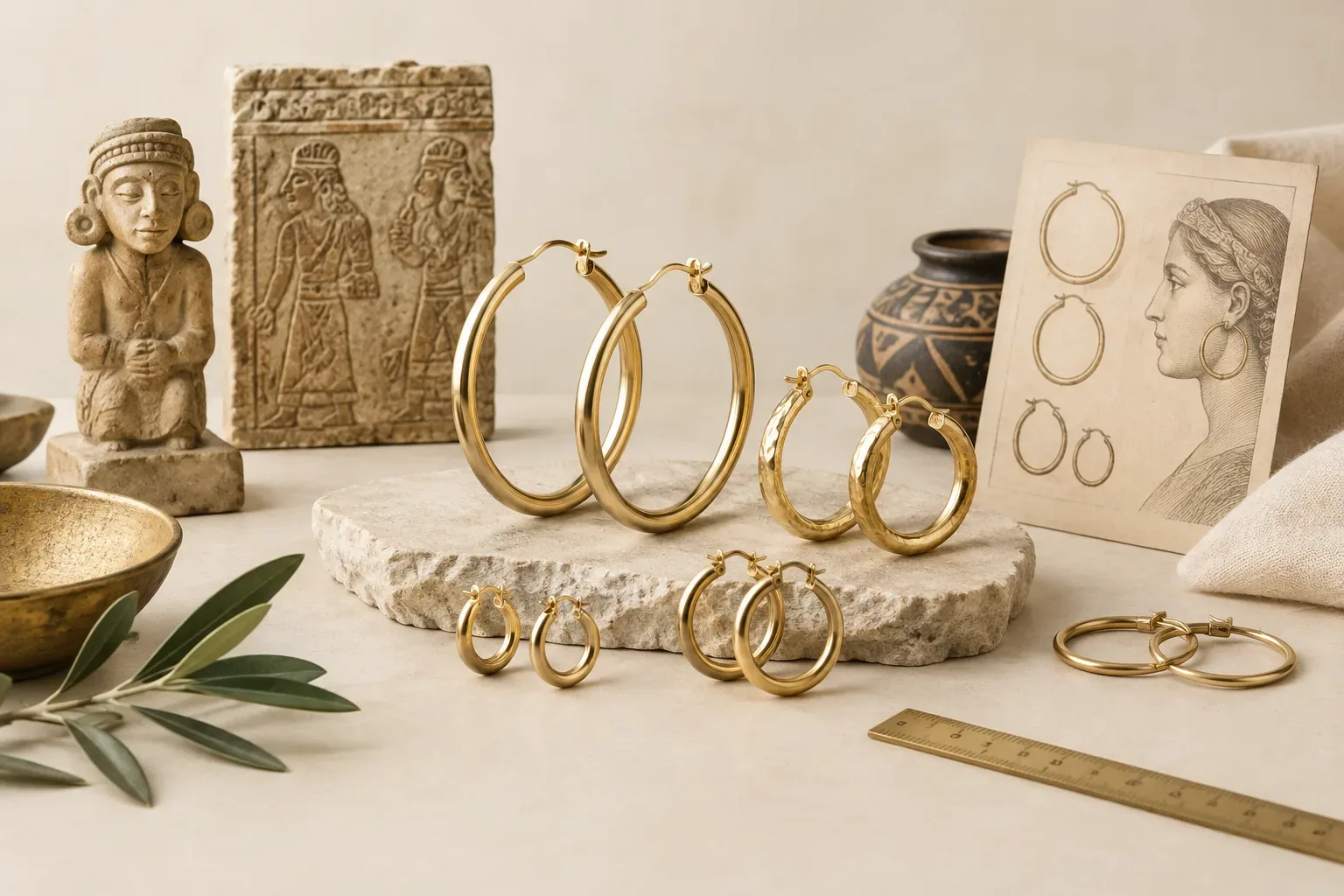
Hoop earrings size and fit depend chiefly on diameter, wire thickness (gauge), weight, and closure type; measure the drop you want, balance diameter with thickness to control weight, and check materials and disclosures when buying. Museum research shows hoop forms recur across many cultures and periods, while modern meanings are often personal and culturally specific.
What the historical record shows
Museum scholarship traces hoop-like forms throughout the history of personal adornment rather than to a single origin. As the Victoria and Albert Museum’s work on jewellery history emphasizes, hoop forms recur in many societies and periods because the simple circular shape is a natural and durable way to hang ornament from the ear and because metalworking techniques producing rings were widely available across regions and eras.
The V&A’s exhibition materials and essays on jewellery history describe changing social contexts for similar forms: in some periods and places hoops were everyday accessories, while in others they were markers of status or part of funerary and ceremonial dress. Those changing contexts show that the hoop motif does not carry one fixed meaning across time or cultures; instead its significance depends on local traditions and social circumstances, as explained in the V&A’s overview of jewellery history.
Distinguishing documented meanings from modern interpretations
When historians and museum curators describe how hoop earrings were used or worn, they focus on material evidence, documentary records, and context. Those documented historical meanings—such as indicators of trade connections, access to certain metals, or participation in a particular dress practice—are different from modern symbolic readings.
Contemporary meanings attached to hoops—such as expressions of identity, feminism, or fashion statements—are largely modern interpretations and personal or communal reassessments rather than universal continuations of an ancient symbolic language. The Victoria and Albert Museum’s research on jewellery highlights how meanings change as objects move between contexts and centuries, so it is important to keep historical evidence and modern personal interpretations separate.
How the motif, gemstones, and tradition appear in hoop jewellery
The hoop is a flexible motif: it can be plain metal, twisted or textured, set with stones, or act as a frame for hanging charms. Gemstones may be incorporated as single bezel-set accents, pavé or channel-set rows on the hoop band, or as pendants suspended within or below the hoop. These variations reflect technical choices and fashion tastes rather than a single symbolic program.
For guidance on gemstones themselves—their historical use, varieties, and common treatments—the Victoria and Albert Museum’s gemstone materials provide identification and historical context that help buyers understand what they are seeing. Gemstones in hoop designs are subject to the same testing, treatment disclosures, and identification standards as other gem-set jewellery.
Material disclosure and buyer protections
Because treatments, enhancements, and imitations are common in gem and metal markets, always look for seller disclosures. The U.S. Federal Trade Commission’s guidance on buying gemstones, diamonds, and pearls explains that sellers should disclose treatments, synthetic origins, and whether a metal is plated rather than solid. Asking for written confirmation of materials and any treatments is a practical way to avoid surprises.
When shopping for hoops that include gemstones or plated metals, use the FTC recommendations to request documentation or lab reports for higher-value purchases and to clarify return policies when a piece does not match the description.
Practical measurements and fit considerations
Diameter is the visual measure: common small hoops often range from about 10mm to 25mm in diameter, medium hoops typically fall between 30mm and 50mm, and large statement hoops exceed 50mm. Diameter determines how the hoop frames the face and how much it will swing below the earlobe. Choose a diameter that complements the wearer’s proportions and daily activities—smaller diameters for active or professional settings, larger when making a stylistic statement.
Gauge or wire thickness affects both comfort and durability. Thicker wires feel sturdier and distribute weight better on larger diameters, while thinner wires are lighter but can bend and may pull more on a piercing. For a given diameter, increasing thickness generally increases perceived quality and decreases flex, but also adds weight.
Weight is the often-overlooked factor that determines whether a hoop is comfortable for long wear. Hollow or tubular construction and thin bands can keep diameter large without excessive mass. If possible, try on hoops and wear them for at least an hour to test comfort, or ask the seller for the piece’s weight if you cannot try them first.
Closure type matters for security and ease of use. Common closures include hinge-and-snap (comfort and security), latch-back (traditional and reliable), continuous/endless hoops (clean look but harder to open), and wire-hook closures (simple and lightweight). Match the closure to the wearer’s dexterity and comfort with insertion and removal.
Piercing placement and earlobe thickness affect how hoops hang. A long drop on a thin earlobe can pull or droop; a very small hoop on a thick earlobe may sit flush and appear smaller. When in doubt, measure an existing pair the wearer likes: measure from the top of the hoop to the bottom when worn to estimate the drop.
Selecting and gifting hoops respectfully
Consider cultural and personal meaning before gifting hoops. Because hoop forms have been adopted and reinterpreted in different communities, what is a neutral fashion gift in one context may carry personal or cultural significance in another. If you are unsure, ask gently about the recipient’s preferences and whether they would welcome hoops as a gift.
For first-time piercings or sensitive wearers, prioritize hypoallergenic materials (such as 14k+ gold, platinum, or surgical stainless steel) and modest diameters with lightweight construction. For heirloom or high-value gifts, request clear material disclosure and any gemstone reports so the recipient has documentation for care and insurance.
When giving a statement pair, include the option to exchange or return, and consider including a small care note on cleaning and storage. Respecting the recipient’s style and providing flexibility shows thoughtfulness and reduces the risk of an unusable gift.
Care, repair, and long-term considerations
Hoops need routine care: wipe with a soft cloth after wear, store them individually to avoid scratching, and avoid wearing plated or gem-set hoops in swimming pools or during heavy physical activity. For gem-set hoops, follow the gemstone’s recommended cleaning method; the Victoria and Albert Museum’s materials on gemstones discuss how different stones respond to cleaning and wear.
For repairs—such as replacing a closure or reforging a bent hoop—use a reputable jeweller who can match the metal and confirm whether a repair will affect any plating or settings. Keep receipts and documentation of materials, especially when pieces include treated or synthetic gems, because that information matters for care and resale.
Frequently asked questions
How do I measure hoop diameter correctly?
Measure the diameter straight across the hoop from inner edge to inner edge for the visual size (internal diameter) or from outer edge to outer edge if sizing by overall appearance (external diameter). If you are matching a worn pair, measure while the earring is closed to capture the on-ear drop.
What hoop size suits my face shape?
There are no universal rules, but small to medium diameters commonly complement round faces by adding vertical drop, while larger circular or oval hoops can balance longer faces. Personal taste and comfort should guide the final choice; try different diameters to see what feels and looks best.
Will larger hoops damage my earlobes?
Excessively heavy hoops or large-diameter thin wires that concentrate weight can stretch or stress the piercing over time. Choose lightweight constructions or thicker bands for large hoops, and avoid consistent wear of very heavy earrings without giving the ears rest.
How can I check if gemstones in hoops are real or treated?
Ask the seller for written disclosures and any laboratory reports. The U.S. Federal Trade Commission recommends that dealers disclose treatments, synthetic origins, and whether gems are imitation. For higher-value purchases, request a gemological report.
What closures are easiest for daily wear?
Hinge-and-snap and latch-back closures are secure and straightforward for regular use, while continuous hoops offer a seamless look but can be fiddlier to open and close. Choose a closure that the wearer can comfortably operate.
Sources and further reading
- Bedazzled: A History of Jewellery — Victoria and Albert Museum
- An A-Z of Gemstones — Victoria and Albert Museum
- Buying Gemstones, Diamonds, and Pearls — Federal Trade Commission