Meaning at a glance
This article explains the documented history and changing contexts of stud-style earrings, separates cultural and religious evidence from later popular meanings, and gives a practical checklist for choosing and gifting durable, comfortable stud earrings.
Historical evidence and cultural contexts
Museum scholarship treats jewelry as a material witness to changing social roles and aesthetic priorities. The Victoria and Albert Museum presents jewelry history as a series of shifting contexts in which form, function, and ornament carry different social meanings depending on time and place. Its overview of jewellery history identifies important approaches and periods—examples include pieces associated with ancient Egyptian and classical cultures, medieval European forms, and the rapidly changing tastes of nineteenth-century Britain—without asserting a single universal meaning for any object.
When you read a provenance or a historical label for a pair of stud-style earrings, the most reliable claims are those tied to material evidence, documented manufacture, or contemporary records. The V&A’s historical work emphasizes that motifs, techniques, and materials travel and transform: a small stud set with a gemstone may serve as a marker of status in one period, a devotional object in another, or simply a fashionable accent in yet another.
Documented historical meanings versus modern personal interpretations
Documented historical meanings arise from contemporary records, inventories, inscriptions, or clearly identifiable ritual contexts. Museum catalogues and curated exhibitions, such as those produced by the Victoria and Albert Museum, distinguish cases where a piece functioned within a religious practice, as part of distinctive dress, or as evidence of wealth and rank. Those documented functions are tied to specific cultures or periods and should be presented as such.
Modern personal interpretations are valid as subjective meanings people attach today—sentiment, identity, or trend. These contemporary readings are not the same as documented historical use. For example, a nineteenth-century catalogued pair of gemstone studs may have been purchased as a sign of social standing then, but today a wearer might choose identical-looking studs to celebrate a personal milestone or simply because they like the color. Both uses are meaningful, but only the former is a historical claim supported by period evidence.
How motifs, gemstones, and traditions appear in stud earrings
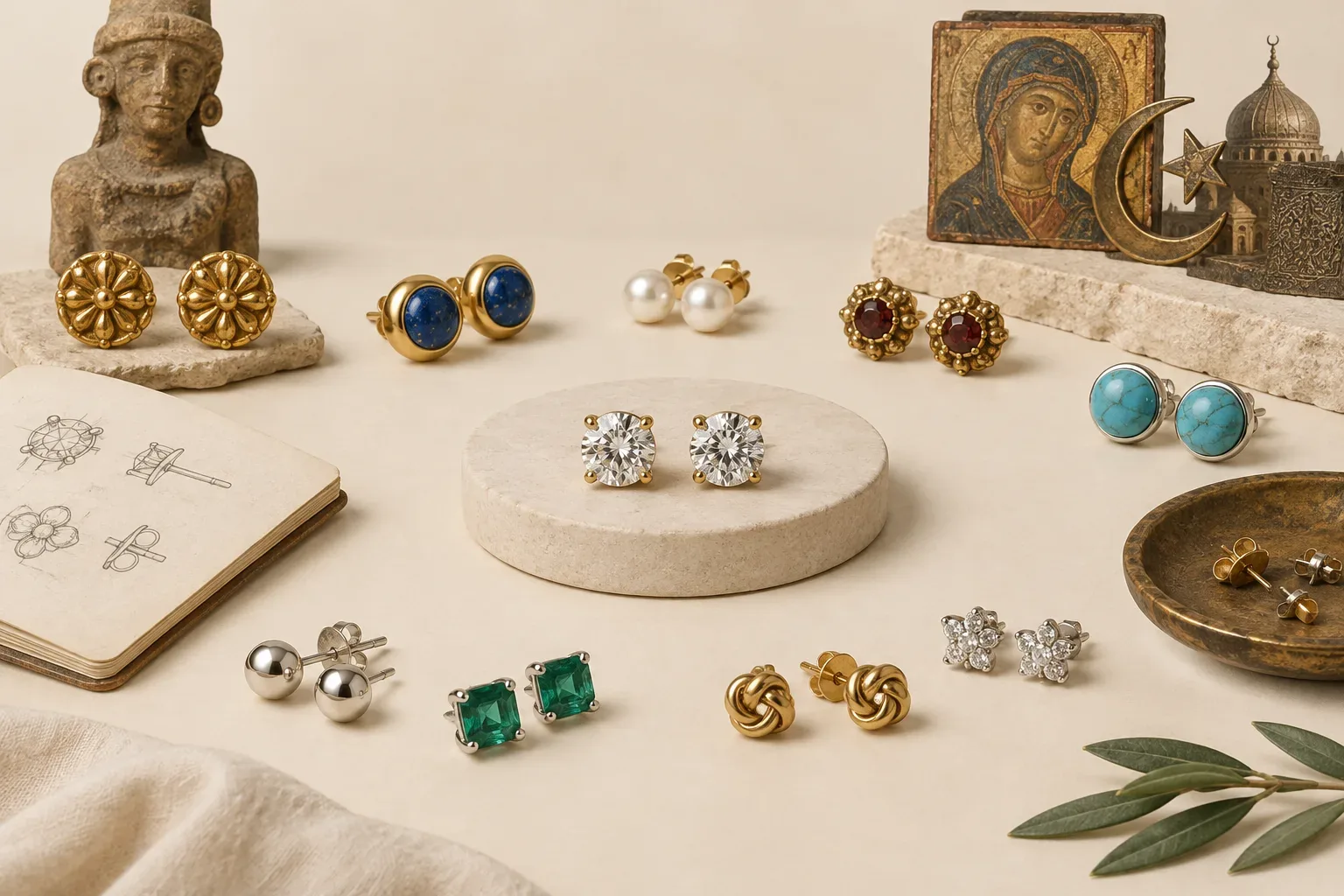
Stud earrings are a structural form: a small decorative element fixed to a post that passes through the ear and is secured with a backing. Motifs such as discs, flowers, or inset stones are adaptations of broader decorative vocabularies found across cultures. The same ornamental motif can appear in many different settings: bezel-set cabochons, faceted stones in prong settings, or sculpted metal that sits flush to the earlobe.
Gemstones and their historical uses are well covered in reference collections. The Victoria and Albert Museum’s A–Z of Gemstones provides identification guidance and historical context for individual stones, and it explains why designers choose particular gems for their color, luster, or symbolic associations. That resource helps explain why some gemstones routinely appear in stud forms—because their physical properties and visual presence suit a small, face-centred format—and why different cultures or periods favored particular stones.
Stud earrings quality checklist: construction
Look for solid, appropriately finished posts and secure attachments. A quality post will be an integral part of the earring’s structure—soldered or formed from the same metal as the finding—rather than glued or visibly weak at the joint. Check that any visible solder is neat and that there are no gaps where the post meets the decorative front.
Examine the setting type and how the stone is held. Bezel settings and closed-frame mounts offer protection for softer stones and cabochons, while prong settings can show more of a faceted gem but require neat, evenly formed prongs that sit flush against the stone. For precious-metal settings, confirm that edges are not over-aggressively clipped and that the stone seats without wobble.
Verify metal quality claims and disclosures. Ask the seller for hallmarks, assay information, or written material disclosure. When gemstones are offered, request documented disclosure of treatments or enhancements and any accompanying reports. The Federal Trade Commission advises buyers that sellers must make clear disclosures about treatments, imitations, and other material facts affecting value.
Stud earrings quality checklist: comfort
Assess post thickness and length for the intended wearer. Posts that are too thin can bend at the first sign of stress; those that are too long can create discomfort for people with shallow earlobes. Many wearers prefer posts that are firm but not overly thick, and that are centered so the stud sits flat on the lobe.
Consider the backing type. Butterflies, screw-backs, and friction backs each offer trade-offs between security and ease of use. For everyday wear, a low-profile, well-made backing that stays put without pinching the lobe is ideal. For children or when extra security is needed, screw-backs or locking backs reduce the chance of loss.
Weight and profile affect comfort. A small high-crown setting or heavy metal disc can cause tugging during long wear. Choose studs with a balanced profile that distribute weight near the lobe rather than hanging off a long post.
Stud earrings quality checklist: durability
Match gemstone toughness to intended use. Some stones are robust enough for year-round daily wear, while softer or cleavage-prone gems need protective settings or occasional removal for activities that risk impact. The Victoria and Albert Museum’s gemstone reference explains how different stones have been used historically and why some are preferred for certain settings.
Consider corrosion and wear of metals. Solid precious metals—gold, platinum, and high-grade silver—behave differently under everyday wear. Gold alloys and platinum tolerate wear differently and may require different maintenance. Look for solid construction rather than thin plate where fatigue can cause breakage.
Plan for serviceability. Quality studs are repairable: posts can be re-soldered, settings tightened, and backs replaced. Avoid styles where a single failure means the entire piece is irreparable. Ask your jeweller whether stones can be reset and whether replacement backs or posts are available.
Practical and respectful selection or gifting guidance
Match the technical choices to the recipient’s lifestyle and values. If the wearer is active or favors low-maintenance pieces, prioritize durable stones, protected settings, and secure backs. If ethical sourcing or traceability matters to the recipient, ask vendors for provenance information and any certification relevant to a gemstone or metal.
Respect cultural sensitivity. Some motifs or gemstone uses carry specific cultural or religious significance in particular communities. When selecting a motif with an identified cultural history, consult reliable references or the seller’s provenance notes and, when appropriate, discuss the choice with the recipient to ensure it is welcome. The Victoria and Albert Museum’s contextual approach to jewelry history shows how meanings vary across time and culture; do not assume an ornament’s meaning is universal.
When gifting, include documentation and care guidance. Supply any available certification, treatment-disclosure statements, and a written care note that explains how to clean and store the studs. A small note about the object’s documented historical or cultural associations—clearly labelled as historical information rather than definitive personal meaning—adds thoughtfulness without imposing interpretation.
Care, maintenance, and when to consult a professional
Regularly inspect the posts, backs, and settings for wear or loosening. Small, timely repairs prevent greater loss. Many repairs require soldering or stone-setting skills, so consult a trained jeweller for work that goes beyond tightening a loose backing.
Follow any treatment-disclosure guidance you received at purchase. The Federal Trade Commission recommends transparency about treatments because some cleaning methods or home repairs can damage treated stones or disguise important characteristics. If in doubt about a stone’s treatment history or a metal’s purity, ask the seller for lab reports or for an independent evaluation.
Frequently asked questions
What are the most important structural checks for stud earrings?
Verify that posts are securely attached and, where appropriate, soldered or formed from the same metal as the finding; examine the setting for even, snug stone seating; and ensure backs are functional and replaceable. Ask the seller about repair options so small problems can be fixed before they lead to loss.
How can I tell if a gemstone in a stud has been treated or is an imitation?
Request written disclosure and any available laboratory reports from the seller. The Federal Trade Commission advises that sellers disclose material treatments and imitations. If documentation is not available, ask for a gemological report from a recognized lab or consult a reputable jeweller for an independent evaluation.
Which backing is best for everyday wear?
A low-profile, well-made friction or locking backing that stays secure without pinching is usually best for everyday wear. For added security—for travel or for active wearers—screw-backs or locking backs reduce the chance of accidental loss.
How should I choose studs as a gift if I don’t know the recipient’s style?
Choose a durable, versatile design in a neutral metal and a classic gemstone or motif; include documentation and a note about care and provenance. When considering motifs with potential cultural significance, favor neutral designs or check with someone close to the recipient if you suspect a symbol might be sensitive.
How do I care for studs to maximise their life?
Inspect settings and backs regularly, clean according to the stone and metal manufacturer or seller instructions, and bring studs to a professional jeweller for tightening or soldering if anything seems loose. Follow any treatment-disclosure guidance that came with the purchase, since some treatments require particular care.
Sources and further reading
- Bedazzled: A History of Jewellery — Victoria and Albert Museum
- An A-Z of Gemstones — Victoria and Albert Museum
- Buying Gemstones, Diamonds, and Pearls — Federal Trade Commission