Meaning at a glance
Explain the documented history and changing contexts of the stud earrings size and fit guide motif, separate cultural or religious evidence from later popular interpretations, and give practical guidance for choosing and wearing the motif in modern jewelry.
Direct answer — what matters most
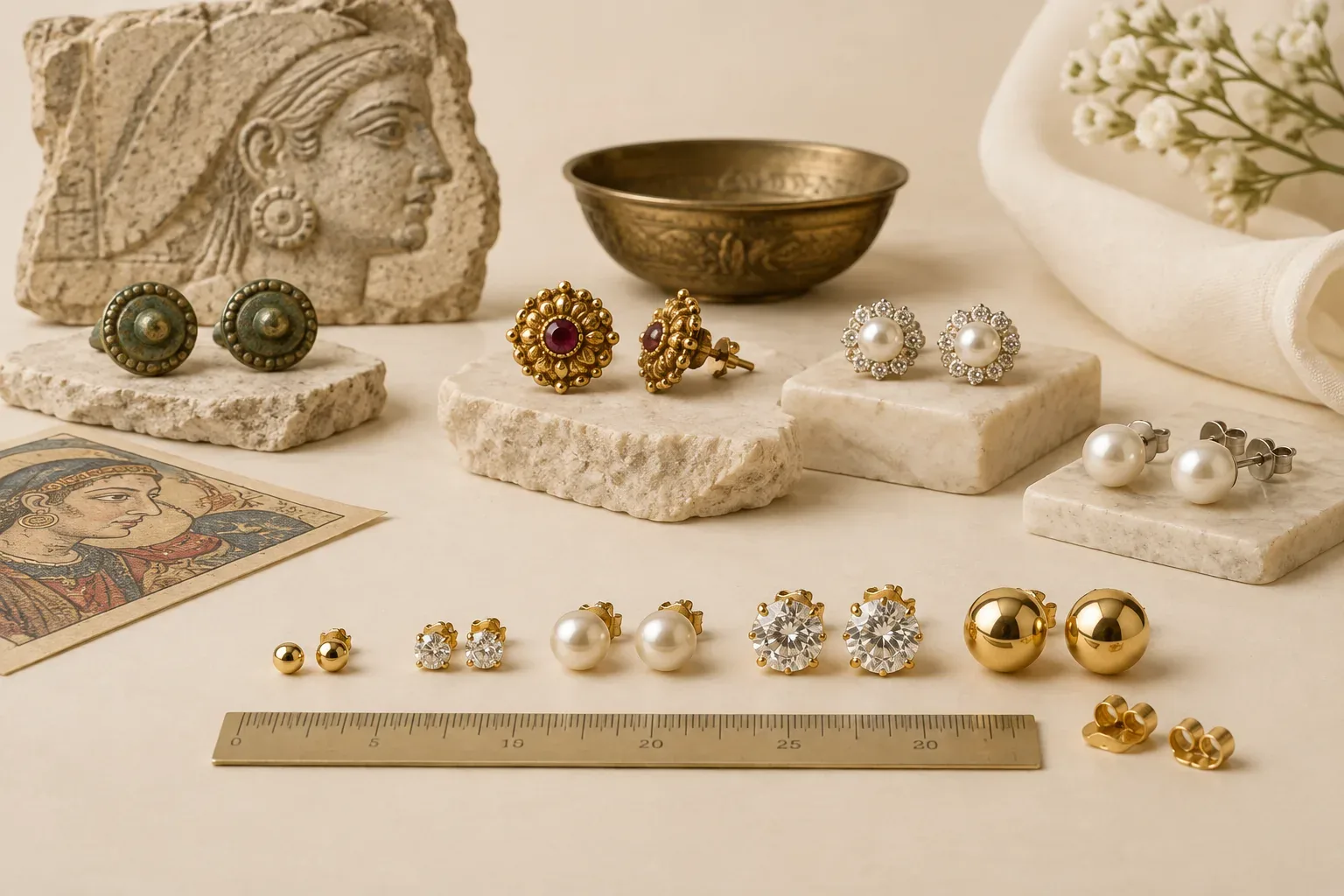
The essential measurements for stud earrings are the visible face diameter (or overall length for decorative studs), the post length, post thickness (gauge), the weight of the earring, and the type of back. These dimensions determine how a stud will sit on an earlobe, how comfortable it will be for long wear and how it will visually balance with a wearer’s features and other jewelry. Historical and cultural meanings around studs are documented separately from modern personal or commercial interpretations, and practical selection should combine measurable fit with respect for cultural contexts.
Documented historical evidence and cultural contexts
Stud-like earrings and small single-point ornaments have appeared across many cultures, and museums document how their functions and meanings have changed. The Victoria and Albert Museum (V&A) presents jewellery history as a record of changing social values and uses, showing that what jewellery signified in one era or place could change in another. The V&A’s resources discuss the presence of jewellery in ancient Egypt and classical Mediterranean environments, in South Asian traditions, and in later European fashions, illustrating shifting functions such as status display, religious or ritual roles, trade commodities and personal adornment.
Because the V&A treats jewellery as an evolving social object, it is possible to trace how a simple stud—a small, anchored ornament—could operate differently: as a marker of wealth when set with a rare stone, as a ritual object in rites of passage, or as an everyday fastener worn for comfort. The museum frames these changes as part of broader shifts in taste, technology and social structure rather than consistent, universal meanings.
Separating documented historical meanings from modern interpretation
Historical meanings that are documented in museum collections and scholarship tend to be tied to clear contexts: for example, the presence of precious metals and gemstones in burial jewellery can indicate status in a specific society, and the use of certain motifs in court jewellery can be read as political or dynastic symbolism. The V&A’s survey of jewellery history stresses such context-dependent interpretations rather than one-size-fits-all symbolism.
Modern interpretations—such as marketing claims that a particular stud size denotes maturity, purity, or commitment—often reflect contemporary fashions or brand narratives rather than continuous historical practice. Many personal meanings attached to studs today are intimate and individual: a pair of small pearl studs may represent a family heirloom for one person and a minimalist aesthetic for another. It is important to keep historically documented uses and the personal or commercial meanings of the present separate when choosing or gifting studs.
How motifs, gemstones and traditions appear in stud jewellery
Motifs in studs are typically simplified due to the small scale of the piece. Floral, heart, religious and geometric motifs are common because their essential shapes read at small sizes. When museums like the V&A catalog jewellery, they note that the same motif may serve different roles: a floral pin might be a fashionable accent in one century and a coded sentimental emblem in another.
Gemstones in studs are selected both for optical effect at small scale and for cultural value. The V&A’s A–Z of Gemstones explains historical associations and technical properties of stones used in jewellery across cultures, and it is a useful reference for how different gems have been valued and worked. In modern studs, gemstones are often cut and set to maximize sparkle within a limited surface area; bezel and flush settings are common for durability and comfort, while prong settings maximize light return for faceted stones.
Traditions such as ear-piercing rites appear in collections and ethnographic records as culturally specific practices. Museums emphasize that rituals around wearing earrings are varied: some societies use ear adornment to mark age or status; others emphasize protection or beauty. The same small stud can be embedded in very different ritual frameworks depending on place and era.
Measurements that determine fit and appearance
Face diameter or visible size is the most immediate factor for appearance. Smaller studs read as discreet and are often used for everyday wear; medium sizes are classically versatile; larger diameters read as statements or as pieces intended for occasions. Choose a visible size that balances with the wearer’s earlobe size and facial proportions. For multi-pierced ears, keep scale consistent or intentionally graduated for a curated look.
Post length and thickness control how the stud sits. Post length must be long enough to pass through the earlobe and accommodate the chosen back without pinching. Post thickness affects comfort; some people find very thin or very thick posts uncomfortable depending on their piercing. Many contemporary studs use standard lengths and gauges, but individuals with thicker earlobes or with thicker cartilage piercings should confirm measurements before purchase or ask a jeweller to fit a custom post.
Back type affects both security and comfort. Friction (butterfly) backs are common and quick to remove, while screw-backs and locking backs provide greater security for valuable stones or for children’s studs. Larger decorative backs can stabilize heavier studs and also affect how the piece hangs. Consider the wearer’s daily activities—sports, sleep habits, and occupational safety—when selecting a back.
Weight and construction influence comfort over long wear. Even relatively small studs can feel heavy if built on a dense mount or set with larger stones. Solid metal and substantial settings add weight; hollow or bezel-set designs can reduce it. For sensitive ears or for long shifts of wear, prioritize lighter constructions.
Setting style changes both the look and the practical fit. Bezel settings hug the stone and sit flush against the skin for a neat, protective edge, while prong settings lift a stone slightly for more sparkle at the expense of a slightly taller profile. Flush or gypsy settings are compact choices for minimal projection and for situations that require safety and low snagging risk.
Gemstone treatment, disclosure and buyer safeguards
Materials and gemstone treatments matter for long-term satisfaction and value. The Federal Trade Commission advises buyers to ask about treatments, imitations and any enhancement that affects durability or care. Sellers are expected to disclose such information, so always confirm whether a stone is natural, treated, lab-grown or synthetic and whether the metal is solid or plated. Treatment information can affect cleaning methods, exposure limits and the piece’s market value.
When buying heritage-style studs or stones described with historical associations, use museum resources such as the V&A’s A–Z of Gemstones to understand traditional uses and how historical contexts might differ from modern claims of symbolism. If a seller attributes a broad, cross-cultural meaning to a small decorative detail, treat that claim cautiously and ask for references.
Practical selection and respectful gifting guidance
Measure and try: If possible, try studs on or compare photos showing scale on a real ear. If ordering online, check the seller’s millimeter dimensions, ask about post length and back type, and request images or return options so the recipient can exchange if fit differs from expectations.
Match the recipient’s lifestyle and sensitivities: Choose secure backs and lower-profile settings for active wearers. For daily wear and those with metal sensitivity, select high-quality metals such as solid gold, platinum, or titanium and confirm nickel-free claims. For children or new piercings, prefer screw-backs or locking backs and confirm that the seller follows safe piercing recommendations.
Be culturally informed and respectful: If a motif or gemstone has a specific religious, ethnic or ceremonial meaning, research that association before gifting. The V&A’s historical framing shows that meanings are often context-specific. If you want your gift to acknowledge a culture’s tradition, seek guidance from people of that community or choose a neutral motif to avoid inadvertent appropriation.
Consider maintenance and disclosure: Ask sellers for care instructions and for full disclosure of treatments or imitation materials. Keep receipts and any certificates of authenticity for future care and valuation. For heirloom gifting, document provenance and care suggestions to preserve the item’s history for the next owner.
When to consult a professional
If a stud requires resizing, a custom-length post, or a change of back, a qualified jeweller can modify the piece for comfort and security. For valuable gemstones, request a written disclosure of treatments and consider an independent appraisal. For historically specific or ritual pieces, consulting a museum curator, ethnographer or knowledgeable community member can clarify whether a design is appropriate to wear or give.
Closing guidance
Stud earrings are deceptively simple objects with long histories and varied meanings. Use measurement-focused selection—face size, post length and gauge, weight and back type—to ensure a comfortable fit, and use museum and consumer protection resources to separate documented historical evidence from modern interpretations or marketing claims. Combining careful measurement with respectful cultural awareness produces choices that are both comfortable and considerate.
Frequently asked questions
What stud size is best for everyday wear?
Everyday studs are typically on the smaller to medium end of visible sizes so they sit close to the earlobe and do not snag. Choose a size that balances with the wearer’s earlobe and activity—discreet studs work well for sleeping, sports and work environments, while slightly larger studs may suit office or social wear. When in doubt, check the millimeter dimensions and, if possible, view photographs of the piece on a real ear or order from a retailer with a flexible return policy.
How do I know if a post is the right length or thickness?
Confirm the seller’s post length and gauge before buying. The post must be long enough to pass through the earlobe and allow the intended back to sit comfortably without pinching. Gauge affects how the post feels in a piercing; people with sensitive or recently pierced ears should use the post thickness recommended by their piercer. If you are unsure, consult the jeweller for custom posts or adaptors.
Should I be concerned about gemstone treatments in studs?
Yes. The Federal Trade Commission advises purchasers to ask whether gems have been treated, dyed, heat-treated, filled or are lab-grown or synthetic. Treatment disclosures affect care, durability and value. Always request full disclosure and a receipt or certificate when purchasing valuable stones.
What earring back should I choose for a child or active wearer?
For children and very active wearers, opt for secure backs such as screw-backs or locking backs to reduce the risk of loss and to keep the stud stable. Low-profile bezel or flush settings and smooth backs also reduce snag risk. Verify that the back is comfortable and appropriate for the wearer’s activities.
How do I gift studs respectfully when they have cultural motifs?
Research the motif’s meaning in its cultural context using reliable sources, and, where appropriate, consult members of the community. The Victoria and Albert Museum’s work on jewellery history shows that motifs carry context-specific meanings. If uncertain, choose a neutral or universally appropriate motif rather than one tied to a particular religious or ceremonial practice.
Can a jeweller adjust studs if they don’t fit well?
Yes, many jewellers can alter post length or swap backs to improve fit and comfort. For valuable stones, request that any alteration be performed by a qualified professional and keep documentation of the change for provenance and insurance purposes.
Sources and further reading
- Bedazzled: A History of Jewellery — Victoria and Albert Museum
- An A-Z of Gemstones — Victoria and Albert Museum
- Buying Gemstones, Diamonds, and Pearls — Federal Trade Commission