Meaning at a glance
Document the ring’s construction, stone security and provenance, wearer comfort, and serviceability; relate the form to documented historical uses and modern personal meanings; and follow practical buying and gifting steps that respect cultural or religious values.
Direct answer: what an eternity ring quality checklist must cover
An effective eternity ring quality checklist focuses on three concrete areas: construction (metal, setting type, soldering and hallmarks, stone security and certification), comfort (fit, profile, edge finishing and compatibility with other rings), and durability (stone choice and treatments, metal hardness and wear points, and repairability). Verify gemstone treatments and disclosure with the seller, confirm fitting and sizing options, and, when gifting, respect any cultural or personal meanings attached to the band.
Historical evidence and the motif’s changing contexts
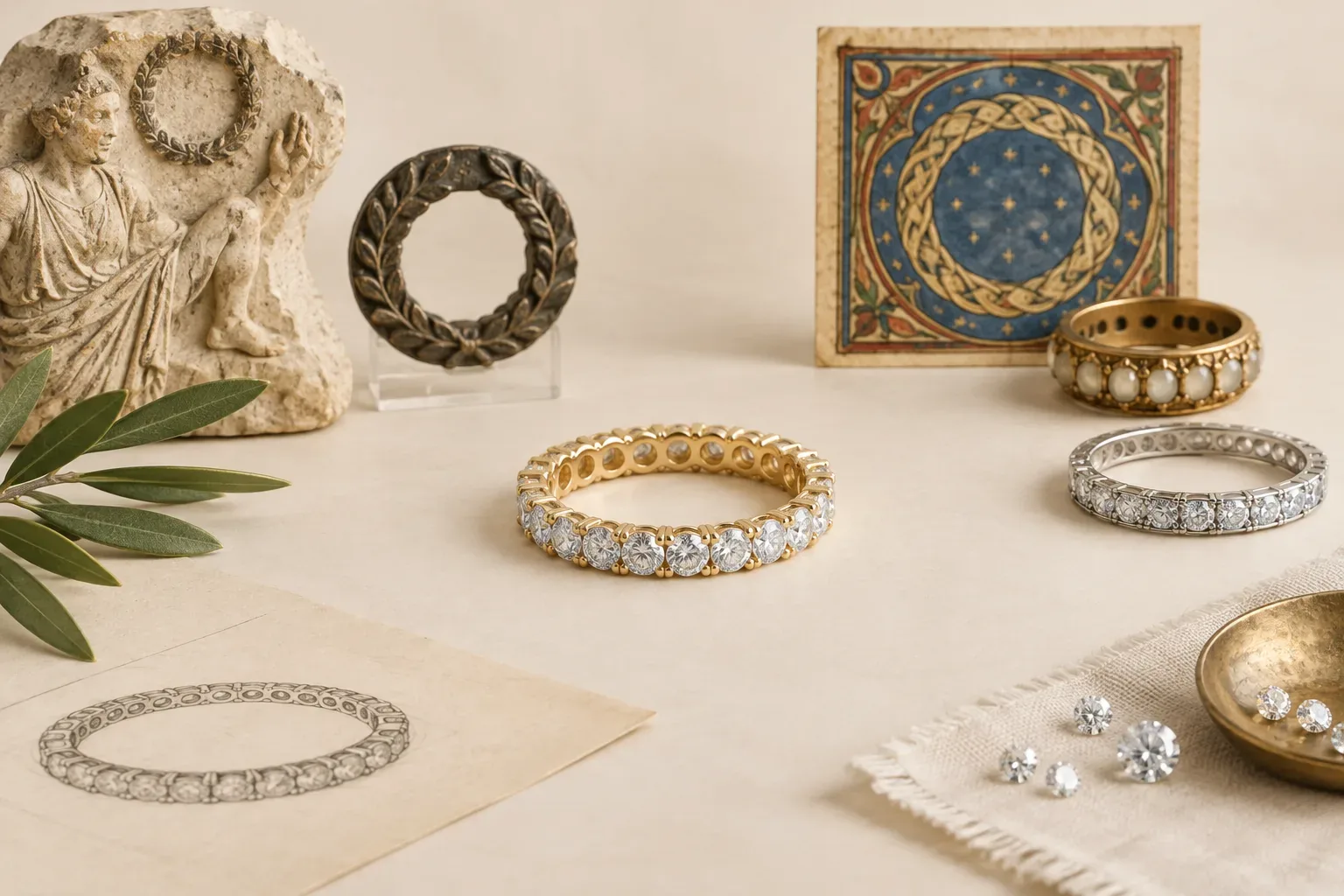
Museum scholarship traces the simple band and continuous-circle motifs across many times and places rather than to one single origin. The Victoria and Albert Museum documents how rings and bands appear in ancient Egyptian, Classical (Greek and Roman), medieval European, and later Victorian collections as objects of status, identity or remembrance rather than as a single symbolic “eternity ring” concept.
In ancient Egypt and the Classical world, examples preserved in museum collections show that plain bands and rings featuring continuous forms were associated with status, office or exchange rather than the modern anniversary practice that developed later. The V&A records medieval European rings used as tokens of oath, betrothal, or guild identity with varied decorative treatments. In 19th-century Britain, as part of a broader revival of sentimental jewellery, continuous bands set with repeated gemstones became popular in new social contexts, and collectors and curators at institutions such as the V&A identify these changes as tied to evolving social rituals and display practices rather than unchanging religious doctrine.
Documented historical meanings versus modern personal interpretations
What is documented in the historical record differs by culture. The V&A describes rings as material expressions of social roles, memory, and wealth across periods. Those documented roles are specific to time and place: for example, rings used as signet or exchange tokens in one period are not identical in meaning to Victorian sentimental bands in another.
Contemporary meanings often layer on additional personal or popular interpretations. In modern Western practice, an eternity-style band—particularly one given on an anniversary or after the birth of a child—has come to signify continuity, a milestone or ongoing commitment. That modern symbolism is a relatively recent social usage and not a universal historical fact. Treat historical uses and modern personal meanings as distinct: the museum record shows material functions; present-day interpretations are shaped by modern customs, marketing, and individual sentiment.
How the motif, gemstone, and tradition appear in jewelry
The continuous circle motif appears most commonly as a plain band or as a ring set all the way around with repeated elements: faceted stones, cabochons, beads or engraved motifs. Jewelers use full-eternity (stones around the entire band) and half-eternity (stones set along the top half) formats to balance aesthetics, comfort and serviceability.
Gemstones feature differently depending on hardness, cost and style. The Victoria and Albert Museum’s A–Z of Gemstones explains that certain gems have long been used in rings for their durability or color, and historical collections show a wide variety from diamonds and sapphires to pearls and glass. Today, diamond or sapphire eternity rings are common for everyday wear because these materials are generally more resistant to abrasion, while softer gems are often chosen for occasional wear or for a specific color or meaning.
Traditions around presentation vary. In some modern customs an eternity ring is given on an anniversary or after childbirth; in others, similar styles appear as stackable bands, wedding bands, or as part of a cluster of sentimental jewels. The same continuous motif can therefore function as a wedding band, an anniversary gift, or a personal memento depending on cultural practice and personal intent.
A practical eternity ring quality checklist: construction
Ask to see or confirm metal hallmarks and purity marks and confirm whether the piece is sold as solid metal or plated, particularly for gold and platinum alloys. Look at solder seams where the shank is joined: a high-quality maker will hide and polish the join thoroughly so it does not catch or show as a weak spot.
Examine the setting type and stone security. Bezel and channel settings typically protect edges better than exposed claws, while shared prongs can be economical but need precise work to avoid stone movement. Inspect the back of the settings where stones meet the metal to ensure consistent spacing and secure seats.
Request documentation on gemstones. For diamonds or higher-value gems, ask for any available certification, and for any gem ask whether heat treatment, fracture filling, dye or other enhancements have been applied. Under U.S. consumer rules, sellers should disclose treatments and imitations; federal guidance on buying gemstones, diamonds and pearls explains the importance of disclosure for treated or imitation stones.
A practical eternity ring quality checklist: comfort
Check the ring’s profile and internal finish. Comfort-fit bands have a slightly domed inner surface that can reduce rubbing and improve daily wearability. Edge finishing should be smooth with no sharp bezel rims or prong points that could catch on clothing.
Try the ring in the context it will be worn. If it will be stacked with a wedding ring, test how the profiles sit together. Consider the wearer’s activities and whether a low-profile design or bezel setting would suit an active lifestyle better than high-set stones.
Confirm sizing and long-term fit. Full-eternity rings can be more difficult to resize because of the continuous setting; if future resizing is likely, half-eternity or designs with a plain metal portion give more flexibility.
A practical eternity ring quality checklist: durability and maintenance
Consider gemstone hardness and toughness relative to intended wear. The V&A’s gemstone guides note that different gems weather wear differently; choose harder stones for everyday bands and be mindful of softer or brittle gems that chip more easily.
Ask about routine maintenance and repair options. Reputable jewellers will offer cleaning, stone tightening and re-tipping of prongs as part of an aftercare program. For full-eternity pieces, ask how the jeweller will handle stone replacement and whether the design allows straightforward repairs.
Confirm disclosure on treatments and imitations. The Federal Trade Commission advises buyers that sellers must disclose treatments and whether a gem is synthetic or an imitation. Knowing this helps set realistic expectations for longevity and care.
Respectful selection and gifting guidance
Before giving an eternity ring, ask discreetly or research whether the motif or the act of gifting a band at a particular time has cultural or religious connotations for the recipient. Some communities have specific traditions around rings, and a thoughtful approach avoids unintended offence.
Match form and function to the recipient’s lifestyle and existing jewelry. If the wearer already uses a wedding band, choose a profile and width that stack comfortably. If the ring marks a life milestone, consider personalisation such as a discreet engraving rather than assuming a single ‘universal’ meaning.
Choose reputable sellers and obtain clear documentation about metal content, stone treatments and warranty terms. If you are buying on behalf of someone, retain receipts and certification in case future resizing or repairs are needed. Where appropriate, discuss sizing and options in advance or choose an exchangeable or resizable design to allow for life changes.
Closing note
An eternity ring quality checklist combines practical construction, comfort and durability checks with an awareness of historical context and contemporary meaning. Use museum resources to ground your understanding of the motif’s history, ask sellers for transparent disclosure about gemstones and treatments in line with consumer guidance, and select a style that respects the wearer’s culture, personal taste and daily life.
Frequently asked questions
What is an eternity ring and how does it differ from a wedding band?
An eternity ring typically features a repeating decorative element—often gemstones—around the band, symbolically suggesting continuity; a wedding band is traditionally the unbroken metal ring exchanged at marriage. Historically, museums record both plain and decorated bands with different social functions, so modern uses can overlap and vary by culture.
What are the most important construction checks for an eternity ring?
Inspect metal hallmarks and soldering, examine setting type and stone security, and request documentation for gemstone treatments or certifications. Ensure the join and setting work are neat and that stones sit securely with even spacing.
Is a full-eternity ring harder to resize than a half-eternity ring?
Yes. Full-eternity rings with stones set continuously around the shank leave little plain metal for cutting and re-sizing, so half-eternity or designs with a plain segment permit easier future resizing.
Which gemstones are best for everyday eternity rings?
Choose harder, tougher gemstones for daily wear; museum guides identify materials commonly used for rings because of these properties. Always verify whether a gem has been treated and ask the seller about long-term care and likely wear.
How should I care for and maintain an eternity ring?
Obtain aftercare guidance from the seller and arrange periodic checks to tighten settings and clean the piece. Full-eternity pieces can require more careful handling if stones need replacing; reputable jewellers will describe their repair and cleaning services.
What should I consider before gifting an eternity ring?
Respect any cultural or religious traditions that might be associated with rings, consider the recipient’s daily activities and existing jewelry for stacking, and ensure clear documentation about metal and gemstones is provided to the recipient for future care or resale.
Sources and further reading
- Bedazzled: A History of Jewellery — Victoria and Albert Museum
- An A-Z of Gemstones — Victoria and Albert Museum
- Buying Gemstones, Diamonds, and Pearls — Federal Trade Commission