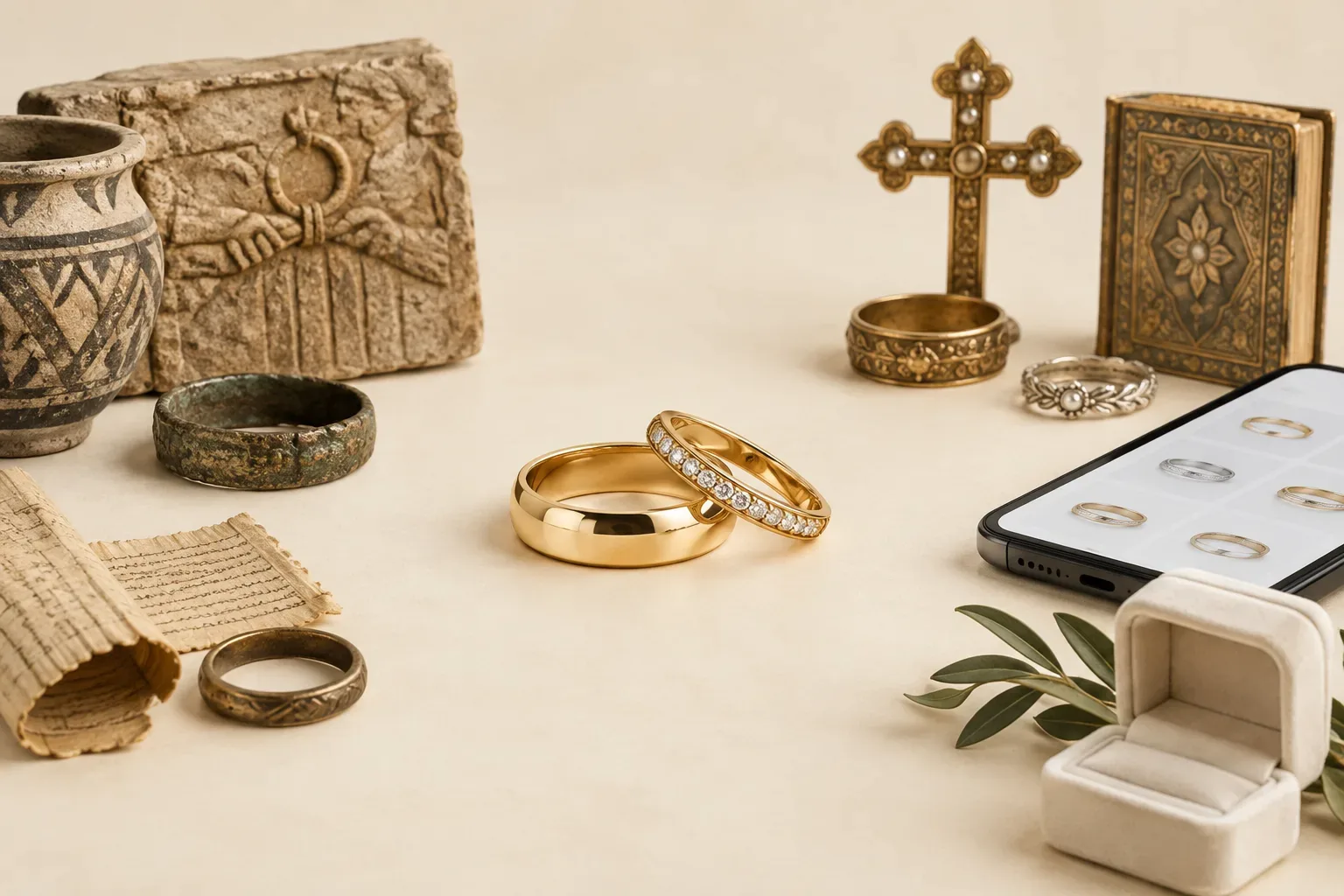
Meaning at a glance
This guide explains the documented history and shifting meanings of the wedding band using museum evidence, distinguishes historical and cultural meanings from modern personal interpretations, and gives clear, practical advice on evaluating photos, seller policies, and red flags when buying bands online.
Historical evidence and cultural contexts
The use of rings as tokens and markers of social relationships is documented in museum scholarship. The Victoria and Albert Museum describes how rings and other jewelry have appeared in many cultures and have taken different social meanings at different times, reflecting status, legal bonds, and personal identity rather than a single fixed meaning.
Ancient Egypt and ancient Rome appear in museum records as early cultures where finger rings played roles in identity, status, and sealing documents. In these contexts, rings could function as signets or status markers rather than what we now think of as romantic tokens, a distinction emphasized in the Victoria and Albert Museum’s historical overview.
Medieval and early modern Europe show further shifts. Rings were used in betrothal and marriage ceremonies in Christian practice, but museum evidence shows these practices were embedded in legal and communal arrangements as much as private sentiment. The Victoria and Albert Museum presents jewelry from medieval through Victorian collections to illustrate how form and function changed with social norms.
From the 19th century into the 20th century, industrial production, changing gender roles, and fashion transformed wedding jewelry again. Museum documentation highlights how bands moved between being a visible social marker, a fashion choice, and, in many contexts, a symbol of personal commitment. The V&A’s coverage underscores these changing social contexts rather than asserting a single universal meaning.
Documented historical meanings versus modern personal interpretations
Documented historical meanings are the roles and uses recorded by curators and historians. According to the Victoria and Albert Museum, those documented roles include practical functions like seals and status indicators, legal and ceremonial uses such as betrothal and marriage contracts, and fashion or display of wealth. These are observable in collections and in surviving records, and they vary by place and period.
Modern personal interpretations—what a wearer believes a band signifies today—are different in kind. Today many people treat a wedding band primarily as a symbol of romantic commitment, equality, or personal identity. These are contemporary meanings shaped by recent culture, media, and individual choice rather than uniform historical fact.
It is important not to conflate museum-documented roles with modern sentiment. A plain gold band may historically signal durability and visible status in one period, while in a different setting the same form may be chosen for minimalist aesthetics or ethical metal sourcing today. Both readings are valid in their contexts, but one is historical evidence and the other is a personal or cultural interpretation.
How the wedding band motif appears in jewelry
The simplest and most persistent form of the band is a plain metal ring. Museum collections documented by the Victoria and Albert Museum show many plain bands and metal hoops that served a range of functions through history. The plain band’s ubiquity owes to its manufacturability and adaptability to different uses and meanings.
Decorative variations appear as engraving, milgrain edges, inset gemstones, channel-set stones, and applied motifs such as knots, hearts, or regional symbols. Historical collections demonstrate that added decoration often communicated status, fashion or family identity; today similar details communicate aesthetic preferences or personal symbolism.
Gemstones may be set into bands as accents or as principal elements. When gemstones are present, provenance and treatment matter for value and appearance. The Victoria and Albert Museum’s reference on gemstones explains how different stones carry styles and associations through time, and the Federal Trade Commission provides current regulatory guidance about disclosures for gemstone treatments, imitants, and grading.
Photos: what to demand from an online listing
High-quality, multiple-angle photos are essential. Ask for at least three clear images: a full band shot, a close-up of hallmarks or engraving, and a macro image of any gemstones. Lighting should be neutral; ask for photos on a plain background and, if color is important, a photo that includes a neutral white reference so you can judge true color.
Avoid listings that use only one photo, heavily edited images, or obvious stock images without a direct statement that the picture is representative of a made-to-order item. If the seller cannot provide close-up photos or refuses measurements, consider that a warning sign.
Policies: what you must confirm before buying
Confirm metal and hallmark information and ask for a photo of the hallmark. Sellers should identify the metal type explicitly and disclose alloy composition when relevant. The Federal Trade Commission’s guidance on buying gemstones, diamonds, and pearls emphasizes that sellers must disclose treatments, imitations, and material substitutions, so ask directly whether stones have been heat-treated, filled, lab-grown, or simulants.
Check return, resizing, and warranty policies. Many vendors offer returns within a specified window, and policies on resizing can differ. Ask whether resizing is free, whether resizing affects warranties, and whether custom engraving voids returns. Confirm shipping insurance and the seller’s policy for loss or damage in transit.
Documentation and certification are important for gemstone-set bands. If the item includes a diamond or larger colored stone, request a grading report or details about who graded the stone. For smaller accent stones, ask what tests the seller performs to verify identity and treatment.
Red flags to watch for
Vague or missing material information. If a listing does not state the metal type or simply says 'gold plated' without karat or thickness, it is a red flag. Lack of clear hallmark photos is also suspicious.
No disclosure of gemstone treatments or provenance. The FTC requires disclosure of treatments and imitations in many cases; a seller who avoids the question or offers evasive answers about treatments should be treated with caution.
Only stock photos and no measurement or hallmark images. If a seller uses only generic images and cannot supply photos of the actual piece, the risk that you will receive a different item is higher.
Too-good-to-be-true pricing without explanation. Extremely low prices for precious metals or large gemstones should prompt extra verification and, if necessary, an independent appraisal after purchase.
Pressure to bypass documented payment or shipping channels. Sellers who insist on unconventional payment or refuse insured shipping or tracking should be avoided.
Practical and respectful selection and gifting guidance
Talk before you surprise with a wedding band that carries cultural or religious symbolism. For example, bands that include explicit religious icons, clan symbols, or culturally specific motifs may be deeply meaningful in one tradition and potentially inappropriate in another. Ask or research respectfully before presenting such a gift.
Prioritize fit and comfort. A band that looks beautiful but is the wrong width or profile will not be worn consistently. If you cannot measure the recipient’s ring finger, choose a jeweler with a flexible return or resize policy and consider a temporary placeholder until sizing is confirmed.
Decide between tradition and personal preference. A plain metal band has a long historical pedigree documented by the Victoria and Albert Museum and remains a durable, low-maintenance choice. Alternately, a band with gemstones or personalized engraving offers modern personal meaning; neither choice is inherently superior, but align the design with the wearer’s lifestyle and tastes.
When engraving, keep wording and symbols personal and unambiguous. Engraved phrases, dates, or initials become part of the ring’s story. Consider the permanence of engraving and confirm the policy on returns after engraving.
Verify ethical and practical expectations. If ethical sourcing of metal or gem origin matters to you or the recipient, ask the seller for declarations or certifications and be prepared to pay a premium. For everyday wear choose metals and settings suited to the recipient’s activity level; lower-profile bezels and sturdier metals are better for active hands.
Frequently asked questions
How can I verify the metal of a wedding band sold online?
Request a clear photograph of the ring’s hallmark and a written statement of metal type and karat. If the seller cannot provide a hallmark image, treat the listing with caution. For higher-value purchases, consider asking for a written guarantee or independent assay after purchase.
What should I ask about gemstones in a wedding band?
Ask whether any stones have been treated, whether they are natural, lab-grown, or simulants, and whether a grading report exists for larger stones. The Federal Trade Commission advises buyers to request disclosure of treatments and imitations.
What return and resizing policies are important?
Confirm whether the seller accepts returns for fit or if custom work voids returns. Ask whether resizing is offered, how long it takes, who pays, and whether resizing affects warranties or return eligibility.
Are seller photos enough to trust an online listing?
High-quality photos are necessary but not sufficient. Photos should include multiple angles and close-ups of hallmarks and any stones. If a seller provides only one or heavily edited image, request additional unedited photos before buying.
How do I handle gifting a culturally specific band?
Research the symbol’s cultural meaning and, when possible, ask the intended recipient or someone knowledgeable about that culture. Avoid gifting religious or clan-specific symbols without confirming the recipient welcomes such a gift.
Sources and further reading
- Bedazzled: A History of Jewellery — Victoria and Albert Museum
- An A-Z of Gemstones — Victoria and Albert Museum
- Buying Gemstones, Diamonds, and Pearls — Federal Trade Commission