Meaning at a glance
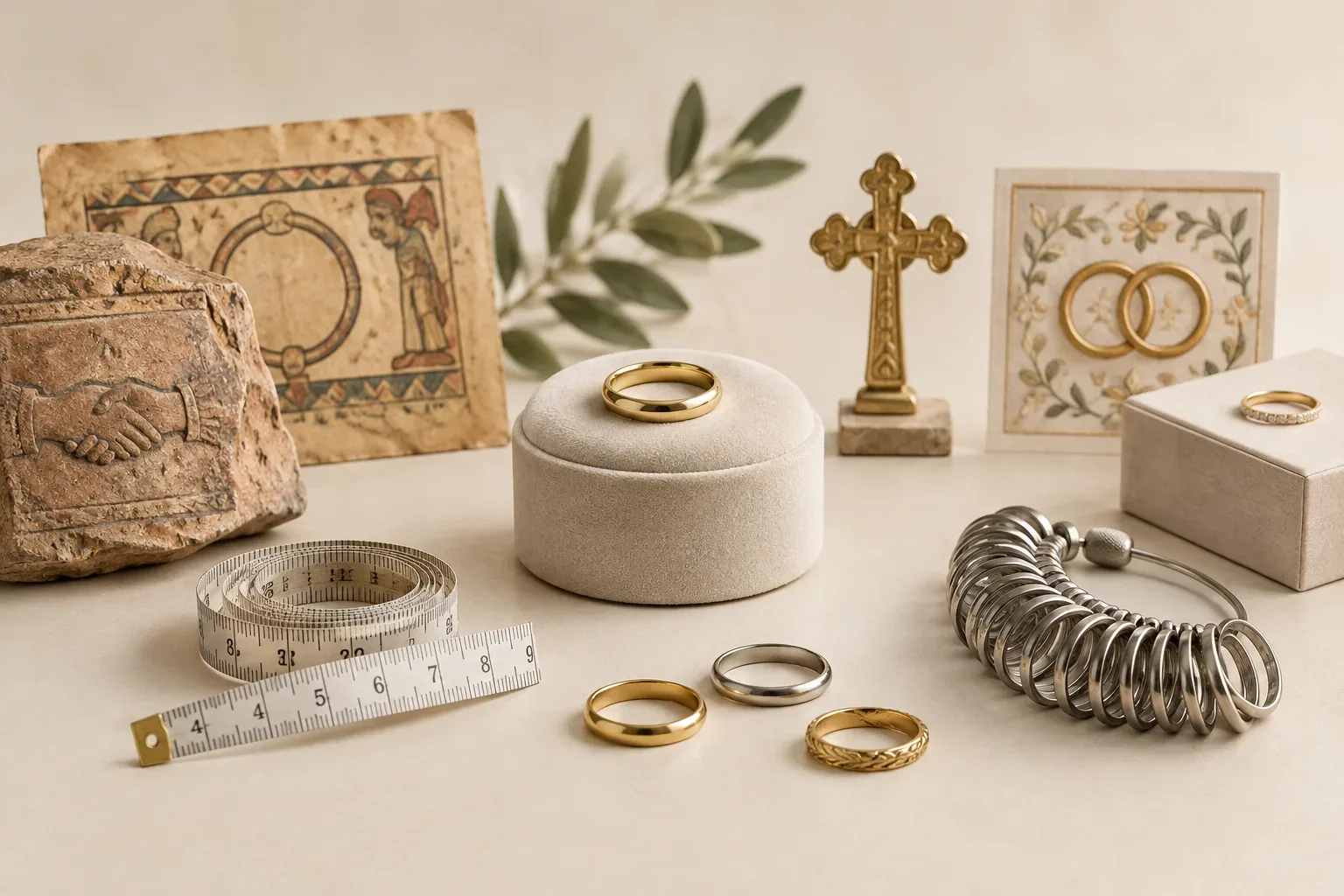
Measure the finger at the right time, choose band width and profile with fit in mind, allow for resizing limits and material choices, and respect documented historical uses while treating modern symbolism as personal interpretation.
What the historical evidence shows — cultures and periods
Museum scholarship collects objects and documents to show how rings and bands have changed meaning across time. The Victoria and Albert Museum presents jewelry as a continuously evolving craft and social practice, with examples from ancient civilizations through the medieval and modern periods that show different uses, materials and decorations (Victoria and Albert Museum).
Across cultures and periods represented in museum collections, rings have served varied roles. Examples in museum displays and catalogues include rings worn as personal ornaments, markers of social rank or office, tokens exchanged in legal or contractual contexts, and objects with sentimental decoration. The material and manufacture of bands — from simple metal hoops to gem-set rings and engraved bands — shifted with technological, economic and cultural changes (Victoria and Albert Museum).
These documented roles are distinct from later popular narratives that present a single, universal meaning for wedding bands. The historical record in museum collections demonstrates diversity: the same object type could mean status, legal commitment, protection, memory, or fashion at different times and places (Victoria and Albert Museum).
Separating documented historical meanings from modern interpretations
Documented meanings come from the objects themselves, the contexts in which they were used, and contemporary texts or inventories that refer to them. Museum research establishes those meanings by linking rings to burial goods, legal texts, workshop records and portraits. Those records show that rings sometimes served as dowry items, tokens of office, seals, or adornment rather than exclusively as a sign of romantic marriage (Victoria and Albert Museum).
Modern interpretations — for example, the idea that a plain metal band has always symbolized romantic eternal love — are often retrospective and culturally specific. Contemporary meanings are valid as personal, cultural or religious expressions, but they are not universal or necessarily continuous with every historical use. Treat historical claims as evidence-laden and context-dependent, and treat modern symbolic meanings as personal or community-based choices.
How the motif, gemstone, or tradition appears in wedding bands
The physical language of a wedding band — its width, profile, surface treatment, engraving, or gemstone set — communicates style and function. Museum collections illustrate that plain metal hoops, engraved bands, and gem-set rings appear repeatedly, but with different emphases in different periods. For example, engraved bands or bands with milgrain decoration may reflect fashionable motifs of a period, while gem-set bands demonstrate both available techniques and shifting tastes (Victoria and Albert Museum).
Gemstones in bands bring additional considerations. Historical and modern practice both use durable stones in frequently worn rings, and different gems carry different associations in particular times and places. For technical and consumer protection reasons, the Federal Trade Commission recommends that sellers disclose material treatments, enhancements and imitations when selling gemstones or diamonds today; that disclosure helps buyers understand what they are purchasing and how the piece will behave over time (Federal Trade Commission).
The Victoria and Albert Museum’s A–Z of Gemstones gives context for how particular stones were valued, worked, and set historically, and can help buyers connect a stone’s appearance and durability with its documented uses by earlier makers (Victoria and Albert Museum).
Measurements and fit that matter: practical guidance
Timing matters. Measure a finger when it is at a normal temperature and size — not right after exercise or in very cold weather — because fingers swell and shrink. For most people, the end of the day will show slightly larger measurements than early morning. Measure both hands: some people have noticeable size differences between the dominant and non-dominant hand.
Band width changes perceived fit. Narrow bands (2–4 mm) sit differently from medium (4–6 mm) and wide bands (8 mm and above). Wider bands typically feel tighter; many jewelers recommend choosing a half size larger for bands wider than 6 mm. If you prefer a wider band for appearance, consider ordering a comfort-fit profile to reduce pressure.
Profile and comfort-fit. A comfort-fit interior is slightly rounded and often more comfortable for continuous wear because it reduces contact on the sides of the finger. Flat-profile bands present a different aesthetic but can feel snugger. Try both profiles when testing sizes.
Material choice, hardness and resizing. Harder metals are more scratch-resistant but harder to resize. Softer metals or elaborate gem settings limit resizing options. Ask the jeweler how many sizes a specific metal or construction can be safely altered. For gemstone-set bands, resizing can affect settings; confirm whether stones will need to be reset.
Stacking and paired rings. If the band will sit next to an engagement ring or other rings, measure with those rings in place because the combined thickness can change comfort and fit. Some couples test the stacked combination for a week to ensure daily comfort.
Resizing and return policies. Because bodies change over time, confirm the jeweler’s resizing policy before purchase. Choose a retailer with clear resizing terms, and keep original receipts and any sizing guarantees. For surprise gifts, pick a jeweler who offers discreet resizing or an exchange period.
Skin reactions and surface finishes. If the wearer has a metal sensitivity, choose hypoallergenic metals or platings and test finishes before committing. Matte and satin finishes can show wear differently from polished surfaces, so discuss expected maintenance with the jeweler.
Verify treatments and authenticity. If a band includes gemstones, ask for written disclosure of treatments, enhancements or whether stones are laboratory-grown or imitations. The Federal Trade Commission advises sellers to disclose such treatments and imitations so buyers can make informed choices (Federal Trade Commission).
Selection and gifting guidance — practical and respectful
Respect personal and cultural meanings. Before selecting or gifting a wedding band, consider the wearer’s cultural, religious, and personal preferences. A band that is appropriate in one tradition may carry different expectations in another. When in doubt, ask respectfully or involve someone close to the recipient who understands their customs and taste.
If you want the element of surprise, still gather reliable size information. Borrow a current ring from the intended finger (if possible) and take it to a jeweler for sizing, or trace the inner circumference on paper and compare with a sizing chart. If those options are not possible, purchase from a jeweler with an accommodating return or resizing policy.
Choose a reputable jeweler and request documentation. For precious metals and gemstones, ask for grading reports or material disclosures and for the jeweler’s recommendations on care and resizing. Use museum resources such as the Victoria and Albert Museum’s articles to inform aesthetic and historical choices, and consult the Federal Trade Commission’s consumer guidance on gemstone purchases to understand disclosure norms (Victoria and Albert Museum; Federal Trade Commission).
Think long-term. A wedding band is often worn daily for years. Prioritize comfort and durability alongside style. Consider how ring width, finish, and gemstone choices will interact with daily tasks, work environments and personal hobbies. If long-term wear and minimal maintenance are critical, lean toward simpler profiles and harder metals with secure settings.
Final thoughts
Historic evidence collected and presented by museum collections like the Victoria and Albert Museum shows that rings and bands have served many roles: ornamental, legal, commemorative and fashionable. Modern wearers are free to adopt historical motifs or create personal meanings, but these contemporary choices are not the same as documented uses in every culture or period (Victoria and Albert Museum).
For the practical side of fitting a wedding band, measure carefully, match band width and profile to comfort and lifestyle, confirm treatment disclosures for gemstones, and pick a jeweler with clear resizing and return policies. That combination of historical awareness and careful measurement will keep the band meaningful and wearable for years to come.
Frequently asked questions
When is the best time of day to measure a finger for a wedding band?
Measure at a normal temperature, preferably in the late afternoon or evening when fingers are near their average daytime size. Avoid measuring immediately after exercise or in very cold conditions because temporary swelling or contraction can mislead the size.
How much larger should I size for a wide ring?
Wider bands generally feel tighter than narrow ones; many jewelers recommend going up about a half size for bands over 6 mm. Test the exact band width you plan to buy when possible before finalizing the size.
What is a comfort-fit band and who should choose it?
A comfort-fit band has a slightly rounded interior that reduces pressure on the sides of the finger. People who wear rings continuously, have larger knuckles, or prefer a less snug feel often choose comfort-fit profiles.
Can all rings be resized?
Not all rings can be resized easily. Detailed settings, channel-set stones, or certain metals may limit resizing. Ask the jeweler about the number of sizes a ring can safely be altered and whether stones will need resetting.
Should I worry about gemstone treatments when buying a gem-set wedding band?
Yes. The Federal Trade Commission advises that sellers disclose treatments, enhancements and imitations. Request written disclosure so you can understand durability, care needs and any long-term implications.
How do I measure anonymously if I want to surprise someone?
Borrow a ring they already wear on the intended finger and have a jeweler measure its inner diameter, or trace the ring’s inner circumference on paper. If that isn’t possible, buy from a jeweler with a flexible resizing or exchange policy.
Do finger sizes change over time?
Yes. Weight changes, pregnancy, temperature, and aging can alter finger size. Confirm the jeweler’s resizing policy and keep receipts and documentation in case an adjustment is needed later.
How should I choose band width and finish for daily wear?
For daily wear, balance aesthetics with comfort and durability. Simpler profiles and harder metals require less maintenance, while ornate finishes or delicate settings may need more care. Try on similar widths and finishes during real activities before buying.
Sources and further reading
- Bedazzled: A History of Jewellery — Victoria and Albert Museum
- An A-Z of Gemstones — Victoria and Albert Museum
- Buying Gemstones, Diamonds, and Pearls — Federal Trade Commission