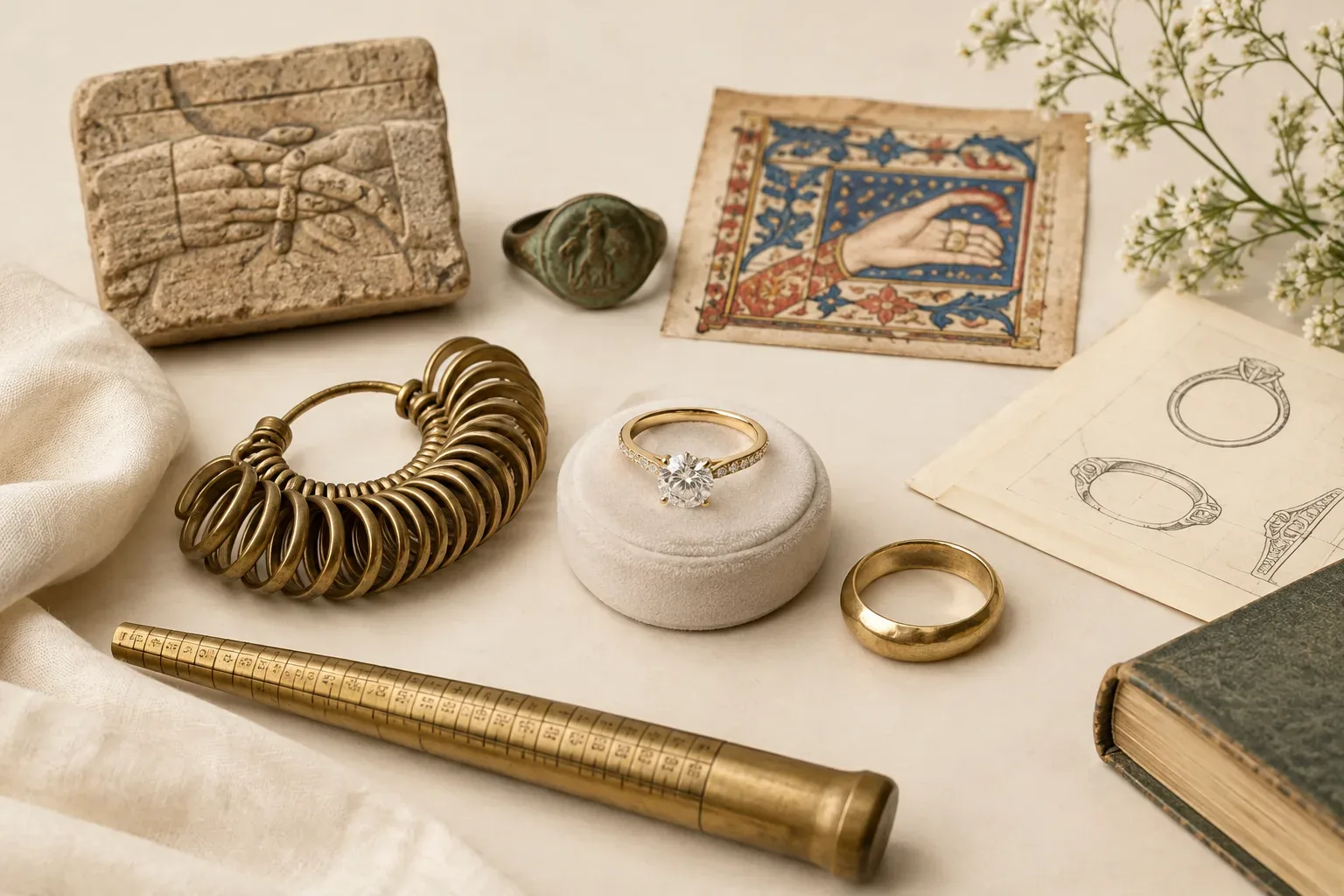
Meaning at a glance
Accurate ring size and a comfortable fit are essential for wearability, safety, and the long-term meaning a ring carries; documented museum research shows ring styles and social uses have changed over time, while modern choices mix personal interpretation with technical concerns about stone setting, treatments, and resizing—this guide separates historical evidence from modern practice and gives clear, respectful selection and gifting guidance.
Why size and fit matter
Beyond aesthetics, size and fit affect how a ring performs over time. A too-tight band can be difficult and unsafe to remove if the finger swells; a too-loose band risks loss or damage. Band width, interior profile, and the choice of setting all change how a given numeric size feels on the finger. Practical decisions about fit also influence long-term meaning: a ring that cannot be worn comfortably will be worn less, changing the way it functions as a visible sign of relationship or memory.
Documented historical evidence and changing contexts
Museum research demonstrates that rings and their social roles have varied greatly. The Victoria and Albert Museum (V&A) frames jewelry as an object type whose form and social uses have shifted with changing taste, technology, and social organization. The V&A collection and interpretation track how finger ornaments that served as tokens, status markers, or contractual devices in various European contexts evolved in style and manufacture across centuries, and how those shifts altered how rings were worn and sized.
This institutional scholarship shows that what we now call an 'engagement ring'—a ring given at the promise of marriage and later worn as a public sign of engagement—has not existed in a single fixed form across all places or times. Crafts, metals, and gemstones changed with technology and fashion, and wearing practices (which finger, how tightly a ring was worn) varied with local custom and personal choice. Treat these documented changes as specific to the cultures and periods the V&A and similar collections study rather than as universal facts about human behavior.
Separating historical meanings from modern interpretations
Museum documentation supports claims about historical forms and their social contexts, but it does not necessarily translate directly into modern symbolic meanings. For example, the presence of a ring in an historical collection may indicate status, contractual promise, or ornamentation depending on the object’s provenance and period; those are documented cultural meanings reported by the V&A. In contrast, the contemporary idea that a particular cut or setting 'means' a specific emotion or guarantee is usually a modern personal or marketing interpretation rather than a continuance of a single, documented historical meaning.
When you evaluate a ring’s symbolic weight today, clearly distinguish documented cultural context—what a ring represented in a particular time and place as shown in museum scholarship—from modern personal meanings or commercial narratives that assign new symbolism to styles and gemstones.
How motifs, gemstones, and traditions appear in rings
Motifs and gemstones turn up in ring design in three overlapping ways: as structural choices that affect fit, as surface decoration or emblem, and as material choices that bring their own histories. The V&A’s A–Z of Gemstones provides context for how particular stones have circulated in jewelry collections and how their availability, color, and perceived properties influenced design decisions. A heavy or high-set stone affects balance and may require a snugger fit to prevent spinning; a wide band carries differently on the finger than a thin band; and certain decorative motifs—such as signet shapes or lockets incorporated into a ring—change both the ring’s feel and its social reading.
Traditional practices also shape how rings are made to fit. Some historical rings were crafted to be adjustable or to stack with other rings, while other ceremonial pieces were custom-made to a specific wearer’s hand. Those structural and stylistic choices are visible in museum collections and inform how makers today design rings to sit, move, and wear.
Practical measurement guidance
Professional sizing remains the most reliable starting point. A trained jeweler measures finger circumference and converts to a size using standardized charts; they will evaluate knuckle width and recommend a size that balances passage over the knuckle with a secure fit at the base. If measuring at home, do so at the end of the day when fingers are at their warmest and avoid cold conditions that make fingers temporarily smaller.
Consider the band width and interior profile. Wide bands typically require a slightly larger size for comfort because they cover more of the finger. Rings marketed as 'comfort fit' have a rounded interior that can feel looser than a flat interior at the same numeric size. Try on similar-width bands when possible to judge how numbers translate into feel.
Account for potential changes in the wearer’s finger size. Weight fluctuation, pregnancy, and medical conditions can alter finger dimensions. If you expect change, prioritize a ring that is easily resized or choose a design with a lower-set stone and a plain shank that can be adjusted without disrupting the motif.
Gemstone and material considerations
Ask about gemstone treatments and disclosure. The Federal Trade Commission provides guidance for consumers about disclosure of treatments, imitation stones, and other material issues; sellers are expected to disclose significant treatments and non-natural materials. Knowing whether a stone has been heat-treated, fracture-filled, or is an imitation affects value expectations and sometimes care and wear patterns, both of which tie back to how the ring should be used and sized.
Settings change how secure and comfortable a ring is. Prong settings raise a stone and may snag on clothing but allow visual lightness; bezel settings wrap the stone and can reduce the chance of catching while adding slight bulk. Both choices affect balance and may influence whether you choose a tighter fit to keep the ring from spinning or a slightly looser fit for daily comfort.
Choosing and gifting with cultural respect
When selecting or gifting an engagement ring, respect the recipient’s cultural, religious, or personal practices. Museum scholarship demonstrates variation in how different societies have used finger jewelry; today’s customs are similarly diverse. Ask about finger preference and any religious conventions that dictate which hand or finger is appropriate, and be open to non-traditional forms of promise jewelry if that better suits the recipient’s values.
If you choose to surprise someone, use practical strategies to reduce the risk of a poor fit: borrow a ring they already wear on the correct finger for discreet sizing; purchase from a jeweler with a fair resizing policy; or present a temporary surrogate such as a symbolic band with a plan to choose the final ring together. Communicate about resizing, return policies, and disclosure of treatments before purchase so the recipient has agency and information.
Resizing, repair, and long-term care
Many rings can be resized within a reasonable range, but the extent and cost depend on metal, design, and stone setting. Plain metal shanks are easiest to adjust; intricate pavé work or continuous settings may be more difficult or costly to resize without disturbing the motif. Routine maintenance—checking prongs, cleaning, and professional inspections—helps keep both fit and structural security in good condition.
Plan for safe storage and insurance if the ring contains valuable stones. A well-fitting ring reduces the chance of accidental loss, but no fit is a substitute for sensible care and appropriate coverage.
Summary and next steps
Measure professionally when possible, account for band width and interior profile, ask about treatments and disclosure, and respect the wearer’s cultural and personal preferences. Museum research from the Victoria and Albert Museum reminds us that ring form and social meaning change through time, so treat historical associations as contextual rather than prescriptive. The Federal Trade Commission’s consumer guidance supports asking about treatments and disclosure when evaluating gemstones and settings. Combining these evidence-led historical perspectives with careful practical choices will help you select or gift an engagement ring that fits both physically and meaningfully.
Frequently asked questions
How do I measure finger size accurately at home?
Measure at the end of the day when fingers are warm, use a narrow strip of non-stretch material to wrap around the base of the finger, mark where it overlaps, and compare that length to a sizing chart. For best accuracy, have a professional jeweler measure using a set of metal ring gauges.
Should I size up for a wide band or a comfort-fit ring?
Wide bands and rings with a rounded interior profile can feel tighter than thin, flat bands; many people choose a slightly larger size for a wide band. Try on similar-width rings when possible, or consult a jeweler for a personalized recommendation.
Can all engagement rings be resized later?
Many rings can be resized within a reasonable range, but complex settings, continuous pavé bands, or certain metals may limit resizing options or increase cost. Check the seller’s resizing policy and ask whether resizing will affect stones or the motif.
How do gemstone treatments affect ring selection?
Treatments such as heating or filling can change a gemstone’s appearance and durability. The FTC advises that significant treatments and imitations should be disclosed by the seller. Knowing treatment status helps set expectations for care, value, and long-term wear.
Is it disrespectful to give a ring that doesn't follow cultural convention?
Cultural and religious practices around rings vary widely. When in doubt, ask the recipient or their family about any conventions, or choose a design and gifting approach that prioritizes the recipient’s values. Respectful communication and willingness to adapt are the best safeguards.
What should I do if a surprise ring doesn’t fit?
Have a plan: buy from a jeweler with a fair resizing or return policy, present the ring in a way that allows for adjustment, or offer a symbolic temporary band with a later fitting. Borrowing a worn ring for discreet sizing can also reduce risk.
Sources and further reading
- Bedazzled: A History of Jewellery — Victoria and Albert Museum
- An A-Z of Gemstones — Victoria and Albert Museum
- Buying Gemstones, Diamonds, and Pearls — Federal Trade Commission