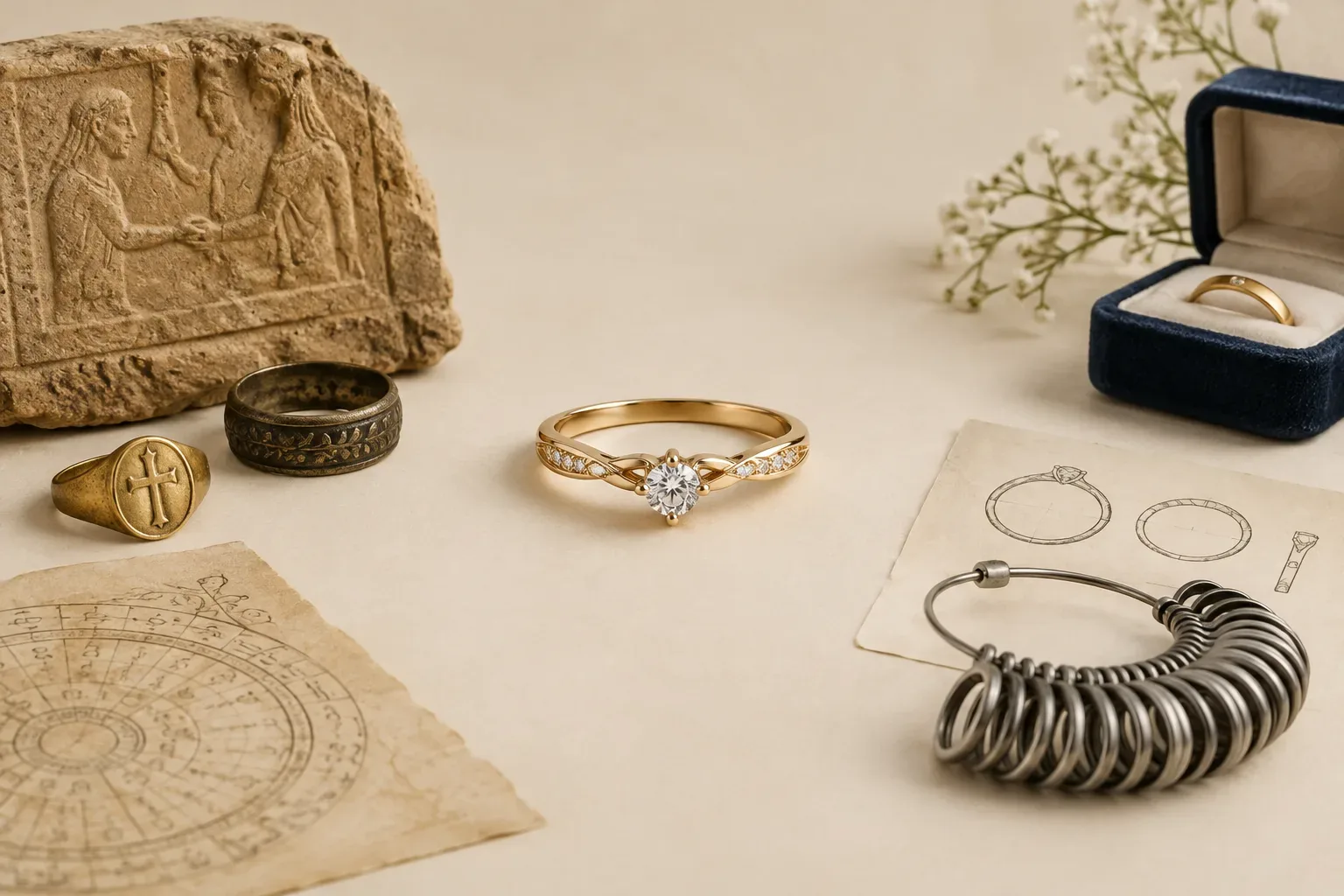
Meaning at a glance
This guide explains documented historical contexts for rings, distinguishes those from modern personal meanings, describes how motifs and gemstones appear in jewelry, and gives practical measurement and gifting advice so you can choose the right promise ring size and fit.
What the historical record actually shows
Museums and historians make a clear point: jewellery has served many social roles across times and places, and the meaning attached to a ring or pendant has changed with social context. The Victoria and Albert Museum (V&A) documents that examples in museum collections—lockets, portrait miniatures, engraved bands and other small wearable objects—have been used to mark commitments, memory, mourning and social status in different periods and cultures. The important lesson in the historical record is not a single, unchanging meaning but the way jewellery is re-used and re-interpreted as social needs and fashions change.
Separating documented historical meanings from modern interpretations
Documented historical meanings are the functions museums and archival evidence can verify: rings and small tokens have historically been exchanged as markers of betrothal, legal agreements, mourning, or social identity in specific social contexts, as described in museum catalogues and exhibitions such as those curated by the V&A. By contrast, the contemporary category called a “promise ring” is largely a modern, flexible social practice. Today people give promise rings for many reasons—pre-engagement commitment, friendship, chastity vows, or a private pledge—and these modern meanings are personal and variable rather than universally recorded in a single historical lineage.
When discussing or gifting a promise ring, treat historical examples as evidence of how jewellery has been used, not as proof that any one meaning is universal or original. The V&A’s work shows that context matters: a similar object can mean different things in different times and places.
How motifs, gemstones and traditions appear in rings
Motifs in rings—engraved messages, simple bands, interlocked forms or small set stones—function as visual shorthand for commitments or personal stories. Museums frequently catalogue such motifs alongside provenance and social context to show how symbols were employed. Gemstones also carry layered meanings both historically and in modern practice. The Victoria and Albert Museum’s A–Z of Gemstones explains how different stones have been used for decorative, symbolic and talismanic purposes across collections and how choices of stone affect color, durability and cost.
In practical jewellery design, motifs and gemstones appear in three typical ways: as the central visual cue (a single stone or motif that signals meaning), as part of an inscription or engraving, or as part of a matched set that indicates relationship or shared intent. Contemporary promise rings borrow freely from those approaches, combining sentimental engraving, modest stones, or plain bands depending on taste and budget.
Material, treatment and disclosure to check
When selecting a promise ring, ask about material composition, gemstone treatments and disclosure. The U.S. Federal Trade Commission advises consumers to request clear information about whether gems are natural, treated, synthetic, or imitation, and to expect sellers to disclose known treatments and enhancements. That information affects long-term care, value and how a recipient might perceive the gift. Always ask for written confirmation of material and treatment when these factors matter to you or the recipient.
Measurements that matter: how to size a promise ring
The right fit is functional first: a ring should slide over the knuckle with gentle resistance and then sit comfortably against the finger without cutting circulation. Essential measurements to consider are the wearer’s finger circumference or diameter, the knuckle circumference, and the planned band width. Wider bands feel tighter; when a band is substantially wider than a thin band, most jewellers recommend sizing up by up to half a size or discussing comfort-fit profiles.
Best-practice sizing steps: have the recipient professionally sized at a jeweller when possible; measure at the end of the day when fingers are warm; if you must measure in private, use a strip of paper or a soft measuring tape to measure the finger at several times during the day and over the knuckle, then average the measurements and consult a jeweller. If the knuckle is larger than the base of the finger, choose a ring size that allows the ring to pass over the knuckle without forcing, then consider comfort-fit designs that taper inside to reduce tightness.
If professional sizing is not possible, it's safer to err slightly larger than smaller when buying as a surprise, because most rings can be resized up or down within a range; discuss the seller's resizing policy before purchase.
Practical fit details to remember
Band width: narrow bands (1–3 mm) feel looser than wide bands (6 mm and above). When in doubt, move up a quarter- or half-size for wider bands. Temperature and activity: fingers swell with heat, exercise and during the day; size measurements taken in the morning or in cold weather will understate the true daytime fit. Comfort-fit profiles: interior rounding (comfort-fit) can make a ring feel looser than a flat interior at the same nominal size.
Materials and allergic reactions: choose hypoallergenic metals or confirm base metal composition if the wearer has a known allergy. If the ring will carry a gemstone, check the stone's hardness and durability—softer stones need more protective settings for daily wear.
Respectful selection and gifting guidance
Treat a promise ring as a gift that carries meaning only insofar as the giver and recipient agree. Ask about cultural and personal boundaries: some faiths and cultures use specific rings for formal betrothal or matrimonial purposes; others may have no tradition of exchanging rings. The historical record (as discussed by the V&A) shows that similar objects have held different meanings depending on local custom, so seek to understand whether a ring carries particular significance for your recipient’s community before presenting it.
Practical courtesy: if you can’t discuss size directly, consider buying a plain or adjustable ring that can be resized or exchanged, include a gift receipt and a written note about the intent to support a later exchange or resizing, and choose a jeweller with a reasonable return and resizing policy. For engraving, prefer short, private inscriptions rather than public declarations unless you know the recipient welcomes that visibility. Finally, be explicit about what you intend the ring to mean—open communication reduces the chance of misunderstanding and honors both historical complexity and modern personal values.
Care, certification and long-term considerations
Ask your jeweller for care instructions tied to the metal and gemstone. Request any available certificates or written descriptions of treatments. The FTC recommends clear disclosure about whether gems are genuine, treated, lab-created, or imitations; keep that paperwork with the ring for future resale, repair, or appraisal.
If the ring is intended as a step toward engagement, discuss resizing plans ahead of time. If it’s intended as a symbol of friendship or a private vow, consider low-profile designs and durable settings that tolerate everyday wear.
Final takeaway
A well-chosen promise ring combines a comfortable, appropriate fit with respectful attention to the recipient’s cultural and personal expectations. Museums such as the V&A remind us that jewellery meanings change with context, so treat historical examples as instructive rather than prescriptive. Use careful measurement, professional sizing where possible, and clear disclosure about materials and treatments to ensure the ring fits physically and fits the intention you want to convey.
Frequently asked questions
How tight should a promise ring be?
A promise ring should be snug enough that it will not fall off easily, but loose enough to slide over the knuckle with gentle resistance and not restrict blood flow. If unsure, have the recipient professionally sized or err slightly larger and confirm the jeweller’s resizing policy.
Can I size a promise ring later if I guess wrong?
Most rings can be resized within a range, though the extent depends on metal, design and whether stones are set around the band. Confirm the seller’s resizing policy and keep the receipt and any documentation for easy exchange or resizing.
Does band width affect ring size?
Yes. Wider bands feel tighter than narrow bands at the same nominal size, so many jewellers recommend increasing the size by a quarter- to half-size for wider rings, or choosing a comfort-fit profile.
Which finger should a promise ring be worn on?
There is no universal rule. Many people wear promise rings on the left ring finger, right ring finger, or a finger chosen for comfort or symbolism. Cultural and personal preferences vary, so ask the recipient about any customs that might apply.
How do gemstone treatments affect a promise ring purchase?
Treatments and synthetic or imitation stones affect durability, care and value. The Federal Trade Commission advises buyers to request disclosure about whether gems are natural, treated, lab-created, or imitations, and to keep written documentation for future care or appraisal.
What if the ring carries cultural or religious meaning?
Because rings have different meanings in different cultures, research or ask respectfully before gifting. The V&A’s work shows that similar objects can carry different social meanings across times and places, so confirm that the intended gift will be appropriate for the recipient’s cultural or religious context.
Sources and further reading
- Bedazzled: A History of Jewellery — Victoria and Albert Museum
- An A-Z of Gemstones — Victoria and Albert Museum
- Buying Gemstones, Diamonds, and Pearls — Federal Trade Commission