Meaning at a glance
This stacking ring buying guide explains the documented history and changing social contexts of stacked rings (as described by the Victoria and Albert Museum), distinguishes historical meanings from modern personal interpretations, outlines how motifs and gemstones appear in stacked rings, and gives practical guidance on materials, quality checks, price trade-offs, and respectful gifting.
Direct answer — what this guide will do
Concise answer: This stacking ring buying guide will explain the documented historical and social contexts for stacked rings using museum evidence, separate those historical meanings from later popular interpretations, describe how common motifs and gemstones appear in stacked-ring designs, and offer practical, respectful advice for choosing quality, materials, and price points when buying or gifting stacking rings.
What we mean by 'stacking rings'
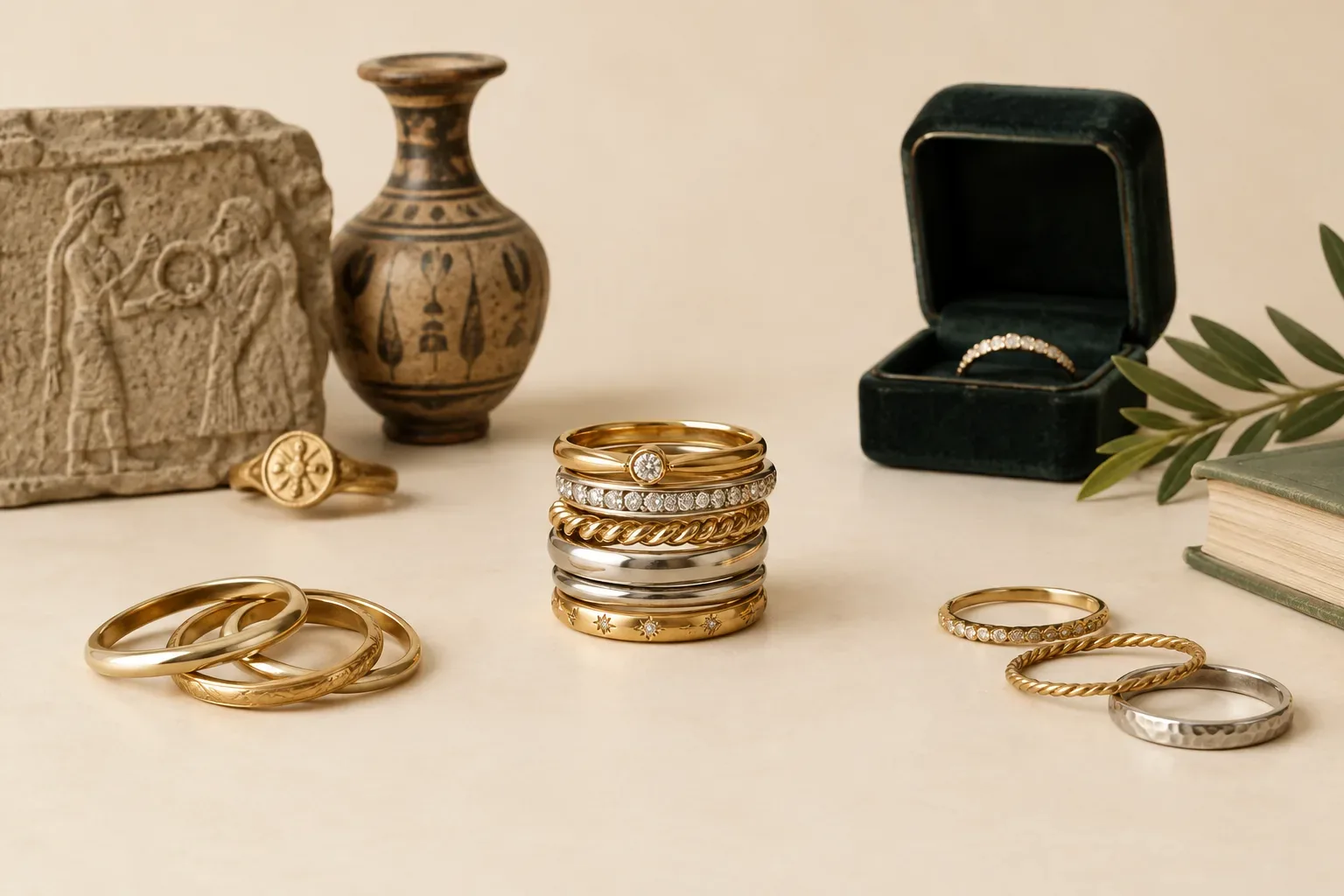
In contemporary jewelry, "stacking rings" refers to the practice of wearing two or more rings together on one finger or across several fingers so they visually complement or layer. Stacking designs range from simple thin bands to small motif rings, gemstone signets, or delicately set eternity bands intended to be combined. People stack rings for aesthetic variety, to mix metals, or to combine sentimental elements such as birthstones, engraved messages, or anniversary bands.
Documented historical evidence and changing contexts
Museums like the Victoria and Albert Museum (V&A) emphasize that jewelry’s meanings and uses shift over time and across societies. The V&A’s coverage of jewellery history highlights how rings served both practical and symbolic roles, and how changing tastes, technologies, and social practices altered how people wore multiple rings. The evidence in museum collections and scholarship shows that wearing more than one ring has appeared in many different periods and cultures, and its social significance has depended on context rather than representing a single universal meaning.
When using historical evidence it is important to attribute specific claims to the source. The V&A frames ring-wearing practices as part of broader fashions and social signals, not as a single, unchanging symbolism. Where the historical record documents particular uses—such as signet and seal rings for identification or mourning rings for remembrance—those are distinct practices recorded by curators and historians at museums like the V&A, whose collections and interpretive materials show how meanings evolved.
Separating documented historical meanings from modern interpretations
Documented historical meanings are those supported by museum records, archaeological finds, or contemporary written sources and interpreted by curators. Examples in the V&A collections include rings that functioned as seals, signifiers of status, or tokens of remembrance. These documented uses are specific to particular cultures and time periods and should not be generalized.
Modern personal interpretations—such as wearing a set of thin bands to mean "self-care," to represent social identities, or to signal relationship status—are contemporary and often subjective. People now freely repurpose historical forms and adapt them to their personal narratives. This guide distinguishes museum-documented roles from today’s personalized symbolism: the former are historical facts supported by institutional research, while the latter are valid personal meanings that emerged more recently through fashion and social practice.
How motifs, gemstones, and traditions appear in stacked-ring jewelry
Motifs, gemstones, and traditional techniques commonly used in other ring types also appear in stacking sets. The Victoria and Albert Museum’s A–Z of Gemstones provides context for how particular gems have been used historically—their physical properties, past popularity, and traditional attributions—and that information is useful when choosing stones that will be worn together. Gemstones commonly selected for stacking rings include small cabochons or faceted stones set in narrow bezels, tiny brilliant-cut diamonds in pavé bands, and birthstones set in signet-style stacking rings.
Motif-wise, manufacturers and designers adapt classical symbols—such as knotwork, hearts, florals, or geometric bars—into slim profiles suitable for stacking. Techniques like milgrain, bezel setting, channel setting, and low-profile prongs are often used to keep stacked rings comfortable and to allow multiple bands to sit flush. Historically rooted motifs can be included for aesthetic or commemorative reasons, but whether a motif carries a particular cultural meaning today should be assessed by consulting historical sources, museum interpretations, or the wearer’s community.
Materials, treatments, and transparency: what to ask and expect
Quality and longevity depend first on material choice. Common metals for stacking rings are solid gold (in various karats), sterling silver, platinum, and plated base metals. Each has trade-offs in hardness, wear resistance, and price. For gemstones, stone type, cut, setting, and size determine durability and cost. The Victoria and Albert Museum’s A–Z of Gemstones is a useful reference for understanding the physical characteristics of stones when choosing ones that will be worn daily in a stack.
Ask whether a gemstone has been treated, filled, dyed, or otherwise enhanced, and whether a plated metal is solid underneath or only a thin layer. The U.S. Federal Trade Commission requires sellers to disclose common treatments, imitations, and synthetic stones; it is good practice to request written information on treatments and to buy from sellers who provide clear disclosure. If the seller cannot or will not explain treatments, certification, or metal content, treat that as a red flag for any mid- to high-value purchase.
Price considerations and how to balance budget with quality
Price varies with metal purity, gemstone quality, artisan labor, and brand markup. If you plan to build a stack over time, consider starting with a durable base metal such as 14k gold or a well-finished sterling silver band and add accent rings as budget allows. Mixing metals is a common and acceptable aesthetic choice that can reduce cost while increasing visual interest.
For gemstone stacking rings, smaller stones reduce cost more than lower-quality stones do; choosing modestly sized, well-set gems often gives better long-term satisfaction than oversized, fragile stones. When comparing price and quality, prioritize secure settings, good joins between ring parts, and accurate disclosure of treatments. For high-value stones, ask about certificates or independent testing when appropriate.
Practical selection and respectful gifting guidance
Selection: Start by deciding the wearer’s lifestyle and the ring’s intended role in a stack—daily wear, occasional styling, or commemorative additions. For everyday stacks choose low-profile settings and harder stones (for example, diamonds or sapphires) or protective bezel settings to reduce snagging. Consider finger size variability across seasons and advise sizing that allows comfortable stacking without pinching.
Gifting: Respect personal and cultural meanings. If a motif or gemstone has a specific cultural, religious, or familial significance, check with the recipient or someone they trust about appropriateness. When gifting a ring intended to be combined with others, consider giving a flexible size (or a resizing option) and include documentation on metal content and gemstone treatments. Provide care instructions and, if possible, the seller’s return policy so the recipient can exchange the ring if it doesn’t integrate with their existing stack.
Care, repair, and building a long-term stack
To preserve a mixed stack, clean rings according to metal and stone guidelines and avoid ultrasonic cleaning for certain treated or filled gemstones. Inspect thin bands and settings periodically for wear; because stacked rings rub together, thin metal can thin further over time. Choose reputable jewelers for sizing and repair. If you anticipate frequent changes, select rings designed to be reworked or resized without losing structural integrity.
When building a stack over years, document the provenance of higher-value pieces and keep any certification or treatment disclosures with the jewelry. This practice helps maintain value and ensures future buyers or appraisers understand what they are assessing.
Final recommendations
Use museum-based historical resources, such as the Victoria and Albert Museum’s material on jewellery history and gemstones, to inform how motifs and gems were used historically and what meanings are documented. For material or treatment disclosures rely on consumer-protection guidance like the U.S. Federal Trade Commission’s advice on buying gemstones, diamonds, and pearls. Prioritize clear seller disclosure, comfortable design for stacking, and respectful attention to any cultural associations when choosing or gifting stacking rings.
A carefully chosen stack balances personal meaning, practical wearability, and transparent information about materials and treatments. That approach honors both historical awareness and modern interpretation while helping you make thoughtful purchases.
Frequently asked questions
How should I size rings for a stack?
Size for comfort and circulation: because multiple rings sit together, avoid a fit so tight that bands press into the skin. If unsure, choose a slightly looser size or ask the seller about in-store trial policies and resizing options. Seasonal swelling of fingers is normal, so consider how the ring will feel throughout the year.
Which metals are best for daily-wear stacking rings?
Durable options for daily wear include higher-karat gold alloys (such as 14k for a balance of hardness and purity), platinum for its strength and hypoallergenic properties, and well-finished sterling silver for budget-minded buyers. Each metal wears differently; discuss care recommendations with the seller.
How can I tell if a gemstone has been treated or is synthetic?
Ask the seller for written disclosure and any gemstone reports. The U.S. Federal Trade Commission recommends that dealers disclose common treatments and imitations. If a stone is high-value or you suspect treatment, request independent testing or certification.
Are certain gemstones or motifs inappropriate to gift?
Some symbols and stones have cultural or religious significance. If a motif or gem is associated with a culture or faith, check with the recipient or a knowledgeable intermediary to avoid unintended offense. When in doubt, choose neutral designs or ask about preferences.
How do I mix metals in a stack without it looking mismatched?
Mixing metals is an accepted contemporary aesthetic. Balance warm and cool tones by repeating a metal across the stack or by adding a unifying element such as a thin neutral band. Prioritize visual weight and proportion to create a cohesive look.
What should I expect to spend on a good-quality stacking ring?
Prices vary widely by metal, gemstone, and maker. A basic sterling silver or plated band will be affordable, while solid gold or platinum with precious stones increases cost. Decide what elements matter most—metal durability, gemstone quality, or artisan craftsmanship—and allocate budget accordingly.
How do I keep stacked rings from rubbing and wearing each other down?
Choose low-profile settings, bezel or flush settings, and properly finished edges to reduce friction. Periodic jeweler inspections can detect thinning metal early; avoid wearing delicate settings constantly if you want to minimize wear.
Can I combine vintage and new rings in a stack?
Yes—many people mix vintage and contemporary pieces. When including vintage rings, confirm metal karat and gemstone condition, and consider professional cleaning or minor restoration to ensure they sit comfortably with newer bands.
Sources and further reading
- Bedazzled: A History of Jewellery — Victoria and Albert Museum
- An A-Z of Gemstones — Victoria and Albert Museum
- Buying Gemstones, Diamonds, and Pearls — Federal Trade Commission