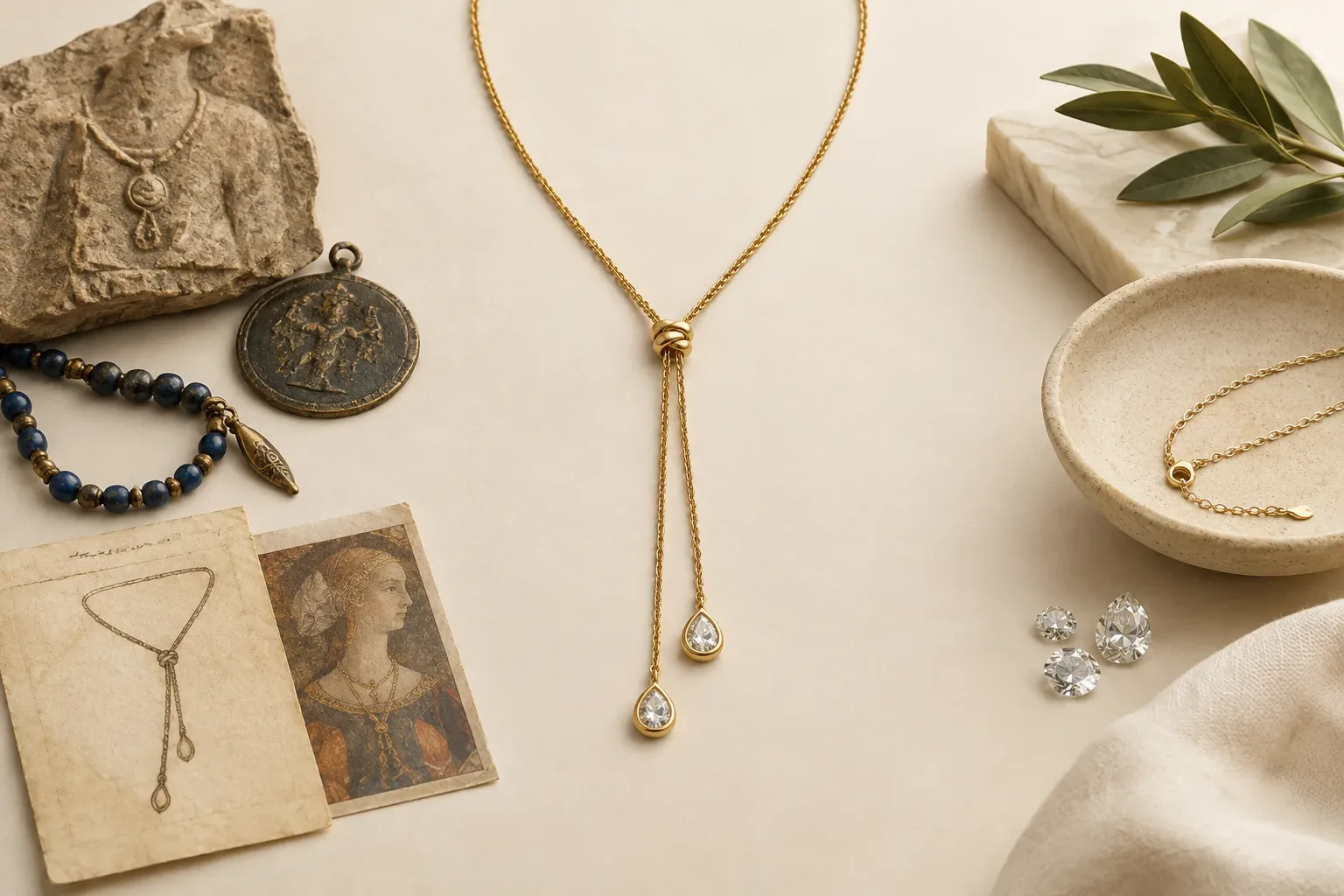
Meaning at a glance
Check chain and clasp construction, closure and end-weight security, materials and gemstone treatments, comfort of length and edges, and ease of repair; understand the lariat’s documented place in jewelry history separately from modern symbolic readings and follow FTC guidance on gemstone disclosure when buying.
Quick answer
A reliable lariat necklace quality checklist focuses on three things: well-made construction (secure joins, sturdy end elements, and quality chain), wearer comfort (appropriate length, smooth edges, and balanced weight), and long-term durability (metal choice, gemstone toughness, and disclosed treatments). This article explains those practical checks, places the lariat in documented historical context using museum scholarship, separates historic meanings from later personal interpretations, and gives respectful guidance for choosing or gifting a lariat.
Historical evidence and where the lariat appears
Large museum surveys document that necklace styles evolve with changing fashions, technologies, and social meanings rather than originating as single, immutable symbols. The Victoria and Albert Museum’s exhibition and interpretive materials describe jewellery’s shifting social functions and forms across periods, and show how open-ended, rope-like and adjustable neck ornaments recur in different contexts as design and taste change. Use the Victoria and Albert Museum as a general, authoritative source for how forms reappear and are repurposed rather than as a single origin story.
Specific cultures and periods each had their own ways of wearing rope-like or flexible neck ornaments. For example, museums catalogue ancient necklaces made from cords, beads, and metal links that could be adjusted or draped. In later centuries European and American fashion also experimented with long, looped chains and ties as part of trends that emphasized versatility. The museum perspective is useful because it stresses how design, technology, and social use determine a piece’s form and meaning; it does not support treating one style as having a single, universal symbolic origin.
Documented meanings versus modern personal interpretations
Museum documentation, such as the interpretation framework used by the Victoria and Albert Museum, tends to record how jewelry was used, who wore it, and how styles changed with social context. Those records can sometimes identify documented meanings, for example when a piece is clearly linked to mourning, marriage, status, or craft traditions in a particular time and place. When no direct documentary link exists, museums describe social context and likely functions rather than asserting a single symbolic meaning.
Modern buyers and wearers commonly assign new meanings to the lariat’s adjustable, looping form—ideas such as freedom, sensuality, or personal adaptability. These contemporary readings are valid as personal or cultural interpretations, but they are not the same as documented historical meanings unless primary sources directly link that symbolism to a specific time or community. Treat historical evidence and modern symbolism as complementary: the first tells you what can be shown, the second tells you how people use and feel about an object today.
How the motif, gemstones, and traditions appear in lariat jewelry
The lariat necklace motif is defined by its open-ended, often looped construction that can be adjusted or tied rather than closed with a fixed clasp. Designers realize this form with delicate chain, rope chain, leather, silk cord, or combinations of metal and textile. Decorative end-elements such as pendants, bars, beads, or gemstone drops are common because they provide weight and a visual terminus for the adjustable loop.
Gemstones and other materials are used both for ornament and for functional weighting. The Victoria and Albert Museum’s resources on gemstones explain the historical and material properties of common stones and how their durability and treatments affect use in jewellery. Gemstone choice influences wearability and care: hard stones like sapphires and diamonds tolerate daily wear, while softer materials require more protection. Sellers should disclose treatments and imitations; the Federal Trade Commission provides clear guidance that buyers must be told about enhancements, synthetics, and simulated gems.
Construction: what to inspect on a lariat necklace
Begin by evaluating the chain or cord and the method used to make the lariat adjustable. When metal chain is used, check the soldered links or welded rings for consistent workmanship. Unsoldered or poorly finished joins are common failure points. If a sliding mechanism is used, test it for smooth operation and reliable friction; it should hold position under a small downward tug but still be adjustable by hand.
Examine end elements and connectors. Drop pendants, beads, or bars should be securely attached with closed jump rings or solid caps. Where small pins or glue are used, look for clean application and, if possible, ask the maker how the element is secured. Pay attention to the way knots or loops are finished on textile lariats; ends should be bound, capped, or sealed so threads do not unravel.
Comfort and fit considerations
A lariat’s open-ended design can be more comfortable than stiff collars when its weight, length, and edges are appropriate for the wearer. Select a length that suits the intended wear style: shorter drops sit near the collarbone, while longer drops may reach the sternum or waist. Try the lariat in the same clothing type you plan to wear it with because fabrics and necklines change how it drapes.
Check edges and contact points for smoothness. Metal bars and gemstone settings should have rounded edges and secure bezels or prongs that do not catch hair or clothing. If the piece will be worn during active days, choose a slightly lighter weight and a flexible chain to reduce movement-related wear and to keep the necklace from shifting uncomfortably.
Durability: materials, gemstones, and disclosure
Choose metals and chains appropriate to daily use. Solid precious metals such as gold or sterling silver will age differently but generally are repairable; gold plating will wear and needs thicker plating or periodic replating for longevity. Inspect chain gauge and link type: rope and curb chains offer different strengths, and finer chains show more susceptibility to breakage. Ask the maker whether links are soldered or welded at stress points such as split rings and end fittings.
For gemstones and pearls, consult reliable guides on hardness and care. The Victoria and Albert Museum’s gemstone resources provide context on stone properties and historical use that helps you evaluate suitability for the intended wearing frequency. Always ask about treatments, enhancements, and whether a stone is natural, synthetic, or simulated. The Federal Trade Commission requires that sellers disclose treatments and imitations; request written confirmation if a piece’s value depends on an untreated, natural gem.
Repairability and long-term care
Prefer designs that a local jeweler can repair. Avoid custom or integrated constructions that cannot be reopened without damaging the design. Solid jump rings, standard soldered chain types, and removable pendants make future repair and restringing more straightforward. Ask the maker what parts are replaceable and whether end beads or clasps are standard sizes.
Consider maintenance needs when buying. Metal polishing, re-plating, restringing for textile cords, or re-securing prongs are foreseeable services. If a piece uses fragile inlays or glued elements, accept that it will need more careful handling. Request care guidance from the seller and follow it to extend the necklace’s life.
Selection and gifting guidance
When choosing a lariat as a gift, match the piece to the recipient’s typical clothing, activity level, and jewelry preferences. Respect personal and cultural meanings: do not assume that a lariat’s modern symbolic readings are appropriate for every recipient. If you want the piece to carry a specific message, choose a maker who will engrave, custom-design, or provide a note explaining the intended sentiment.
Be transparent and practical about purchase details. Ask the seller for metal purity, gemstone identification and treatment disclosures, and a return or repair policy. For higher-value purchases, request a written description or certificate. Use the Victoria and Albert Museum’s resources to understand the historical context if the piece references a traditional form, and use the Federal Trade Commission’s guidance to make sure you receive full disclosure about material treatments.
Final practical checklist (summary)
Inspect chain construction and soldered joins, test sliding or adjustable mechanisms for secure hold, confirm end-element attachment, choose metals and stones suited to intended wear, request treatment and origin disclosure for gemstones, evaluate comfort in clothing you will wear, and verify repairability and seller policies before purchase. Keep historical context and personal symbolism separate: museums document how forms were used and changed, while modern wearers assign contemporary meanings that are personal rather than universal.
Frequently asked questions
What is the most common failure point on a lariat necklace?
The most common failure point is an unsoldered or poorly finished join in the chain or at the end fittings. Check soldered links, closed jump rings, and how pendants are attached. A small downward tug will reveal weak joins.
Are gemstone drops safe for everyday wear on a lariat?
It depends on the stone’s hardness and how securely it’s set. Hard stones like sapphires and diamonds tolerate daily wear better than softer stones or beads. Ask the seller about setting type and any treatments, and follow care recommendations.
How should a sliding mechanism on an adjustable lariat perform?
A sliding mechanism should move smoothly when adjusted by hand and hold its position under gentle downward tension. If it slips easily, it will not stay in place during wear and may require professional adjustment.
What disclosures should I ask for when buying a lariat with gemstones?
Request information on whether stones are natural, synthetic, or simulated and whether they have received treatments or enhancements. The Federal Trade Commission requires that sellers disclose such treatments and imitations.
Is a plated metal lariat acceptable for regular wear?
Plated metals can be suitable for regular wear if the plating is thick and the wearer understands it will wear over time. For pieces intended as heirlooms or for heavy daily use, solid precious metals or heavier gauges are a better long-term choice.
Sources and further reading
- Bedazzled: A History of Jewellery — Victoria and Albert Museum
- An A-Z of Gemstones — Victoria and Albert Museum
- Buying Gemstones, Diamonds, and Pearls — Federal Trade Commission