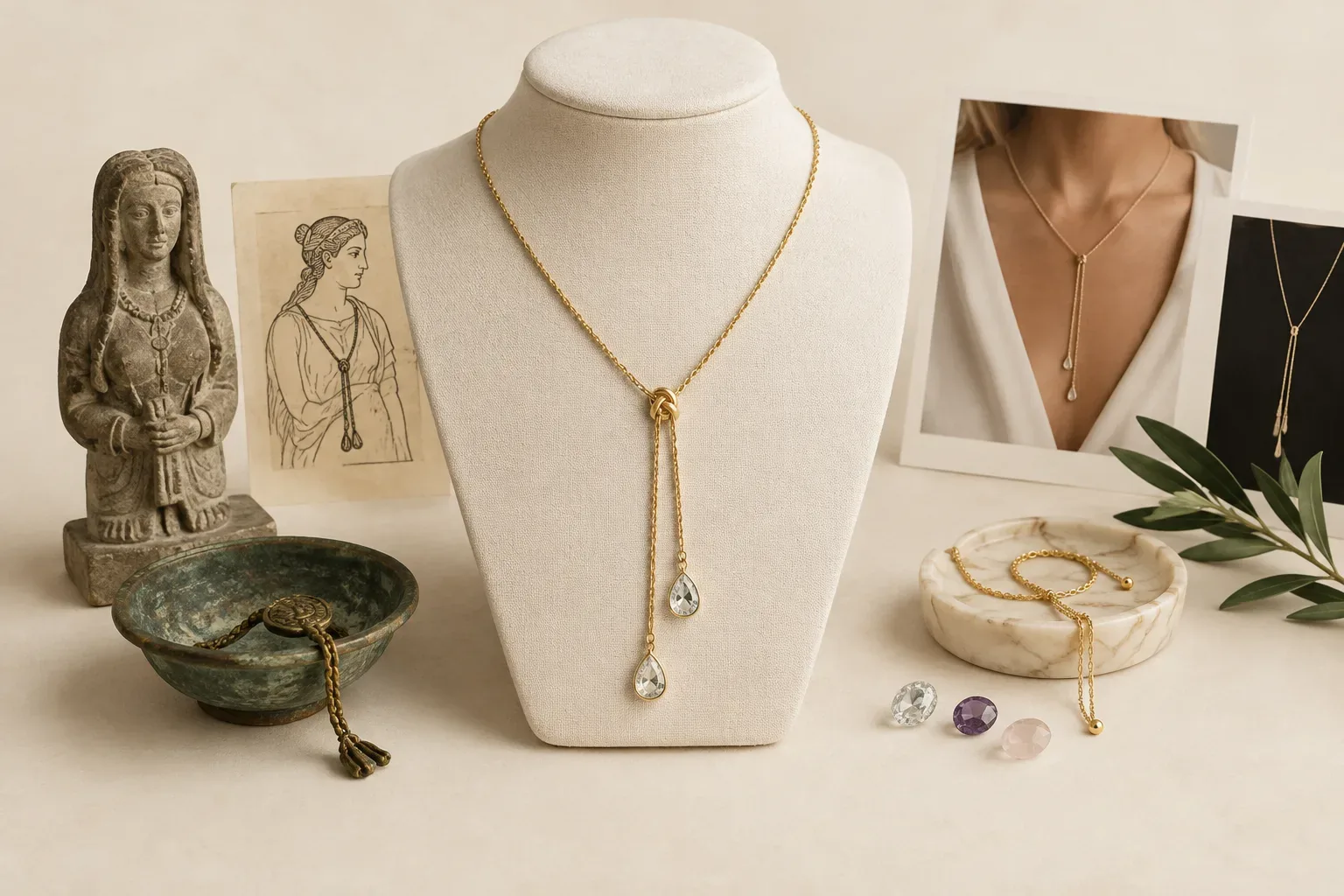
Meaning at a glance
This guide explains documented historical context for long, flexible necklaces using museum research, distinguishes historical meanings from modern personal interpretations, and gives practical steps for choosing, evaluating photos, checking shop policies, and spotting red flags when buying lariat-style necklaces online.
What the historical record actually shows
When researching jewellery motifs and forms it helps to distinguish what is documented by curators and historians from later popular or marketing interpretations. The Victoria and Albert Museum frames jewellery as an artefact whose form and social meanings change over time; their exhibitions and essays trace how long necklaces and ‘flexible’ jewellery have appeared in different periods as fashion and technology evolved. Use that type of museum documentation to anchor claims about the past rather than assuming a single, continuous meaning for a style.
Identifying cultures and periods precisely
Museum catalogues and historical surveys typically record specific examples with dates, makers, materials and the social context in which they were worn. When a museum like the Victoria and Albert Museum discusses jewellery history it attributes particular shapes and uses to named periods and cultures rather than asserting a universal symbolism. If you find a claim that a long, open-ended necklace was worn by a named culture or in a specific era, check whether that claim cites a dated object or a documented custom in a museum collection or publication.
Documented meanings versus modern interpretations
Historical documentation often records occasions and status associated with a piece—such as marital, funerary or fashion uses—rather than a single symbolic meaning. The V&A’s approach to jewellery history emphasizes changing social context rather than fixed symbolism. By contrast, modern sellers and wearers frequently ascribe personal meanings—romantic freedom, bohemian style, or sexual undertones—to contemporary lariat-style designs. Those modern interpretations are valid personal or marketing meanings but should be presented as contemporary, subjective readings rather than established historical facts.
How the motif and gemstones appear in jewellery
Descriptions of gemstones and how they were used historically are documented in museum resources such as the Victoria and Albert Museum’s A–Z of Gemstones. Museums record examples of gemstones set in long chains, pendants, and flexible assemblies and note how their perceived value and uses shifted with trade, lapidary technology and taste. In contemporary jewellery, the lariat format is usually defined by length and an open-ended or adjustable construction that allows looping, tying or sliding elements. Gemstones may appear as terminal beads, drop pendants, or as set accents along a long chain; the choice of gem affects perceived formality and price but not an inherent symbolic meaning.
Practical online-shopping steps: photos and product detail
High-quality photos are the most important tool for judging a lariat-style necklace online. Look for clear, well-lit images that show the full length of the chain, close-ups of terminal fittings or gemstones, and photos of the necklace worn at different lengths. A scale reference or ruler and a description of chain thickness, clasp type, and bead or pendant dimensions are especially useful. If the seller omits close-ups of the finish or the area where a gemstone is set, request additional images before buying.
Policies to read before you buy
Check the seller’s shipping, return and repair policies before checkout. A reputable seller will state processing times, international shipping rules, and how they handle returns for fit, damage or misrepresentation. For items that claim to be gemstones, diamonds or pearls, the Federal Trade Commission requires truthful disclosure about treatments, enhancements and imitations; consult FTC consumer guidance when a listing is vague about whether a stone is natural, lab-grown, heat-treated or a simulant.
Red flags and authenticity checks
Major red flags include listings with only a single small photo, vague material descriptions, inconsistent measurements, or price points that seem unrealistically low for described materials. Watch for sellers who avoid answering questions about metal purity, gemstone treatment or hallmarking. The FTC guidance recommends that consumers ask for documentation or lab reports for high-value stones and confirms that sellers should disclose treatments and common imitations.
Choosing and gifting respectfully
If you are selecting a lariat-style necklace as a gift, consider the recipient’s style habits and practical needs: preferred metal (hypoallergenic options if needed), typical necklace lengths in their wardrobe, and whether they value a bold statement or a subtle adjustable piece. Respect cultural meanings by researching any specific motifs, symbols or materials that have cultural or religious significance; rely on museum sources or community experts for historical context rather than generalized marketing copy. When in doubt, present the piece as a contemporary design inspired by historical forms rather than an authentic cultural relic.
Care, sizing and aftercare
Long, delicate chains used in lariat styles can be prone to tangling and wear at terminal fittings. Ask about chain gauge, soldering quality and whether the seller offers restringing or repair. For gemstone terminals, confirm bezel or prong security and whether the stone is treated; the V&A’s resources on gemstones explain that historical and modern stones vary widely in hardness and toughness, which affects how they should be worn and cleaned. Keep care instructions and a record of communications and purchases in case you need a return or repair.
Final checklist before purchase
Verify exact length and how length is adjusted in practice, confirm materials and any hallmarking, request close-up and worn photos, check the return and repair policy, and ask explicitly about treatments for gemstones and whether an independent report is available for high-value stones. Use consumer-protection guidance such as the Federal Trade Commission’s advice on buying gemstones, diamonds and pearls to evaluate disclosure and authenticity claims.
Frequently asked questions
What is a lariat necklace and how is it different from other necklaces?
In contemporary jewellery terminology, a lariat typically refers to a long, often open-ended necklace that can be looped, tied or threaded through an opening to create different looks. This is a modern description of a style based on long, flexible necklace forms documented by museum historians; treat the term as a style name rather than a single historical artefact.
How can I tell whether gemstones in a listing are natural, treated, or simulated?
Ask the seller for explicit disclosure and, for high-value stones, request a laboratory report. The Federal Trade Commission advises sellers to disclose treatments and imitations; vague descriptions or evasive answers about whether a stone is natural, lab-grown, heat-treated or a simulant are a red flag.
What photos should I ask for when buying a long necklace online?
Request a set of images showing the full necklace laid flat with a scale, close-ups of the terminals and any gemstones, at least one photo of the necklace worn on a model or display bust, and a clear shot of any hallmarks or maker’s marks. If finishing or solder points are visible, ask for detailed images of those too.
Are there cultural or religious meanings I should be aware of before buying or gifting a lariat-style piece?
Meanings vary by culture and context. Museum resources can help explain documented historical uses of similar long-necklace forms, but many modern symbolic attributions are personal or commercial. If a specific motif, symbol or material has cultural or religious significance, research that motif using museum or community sources and, when appropriate, consult members of the culture to ensure respectful use.
What should I do if the necklace arrives damaged or different from the photos?
Document the condition with photos as soon as the package arrives and review the seller’s return and repair policies. If the seller misrepresented materials or treatments, you may be able to refer to consumer-protection guidance; keep your purchase records and communications in case you need to escalate the issue.
Sources and further reading
- Bedazzled: A History of Jewellery — Victoria and Albert Museum
- An A-Z of Gemstones — Victoria and Albert Museum
- Buying Gemstones, Diamonds, and Pearls — Federal Trade Commission