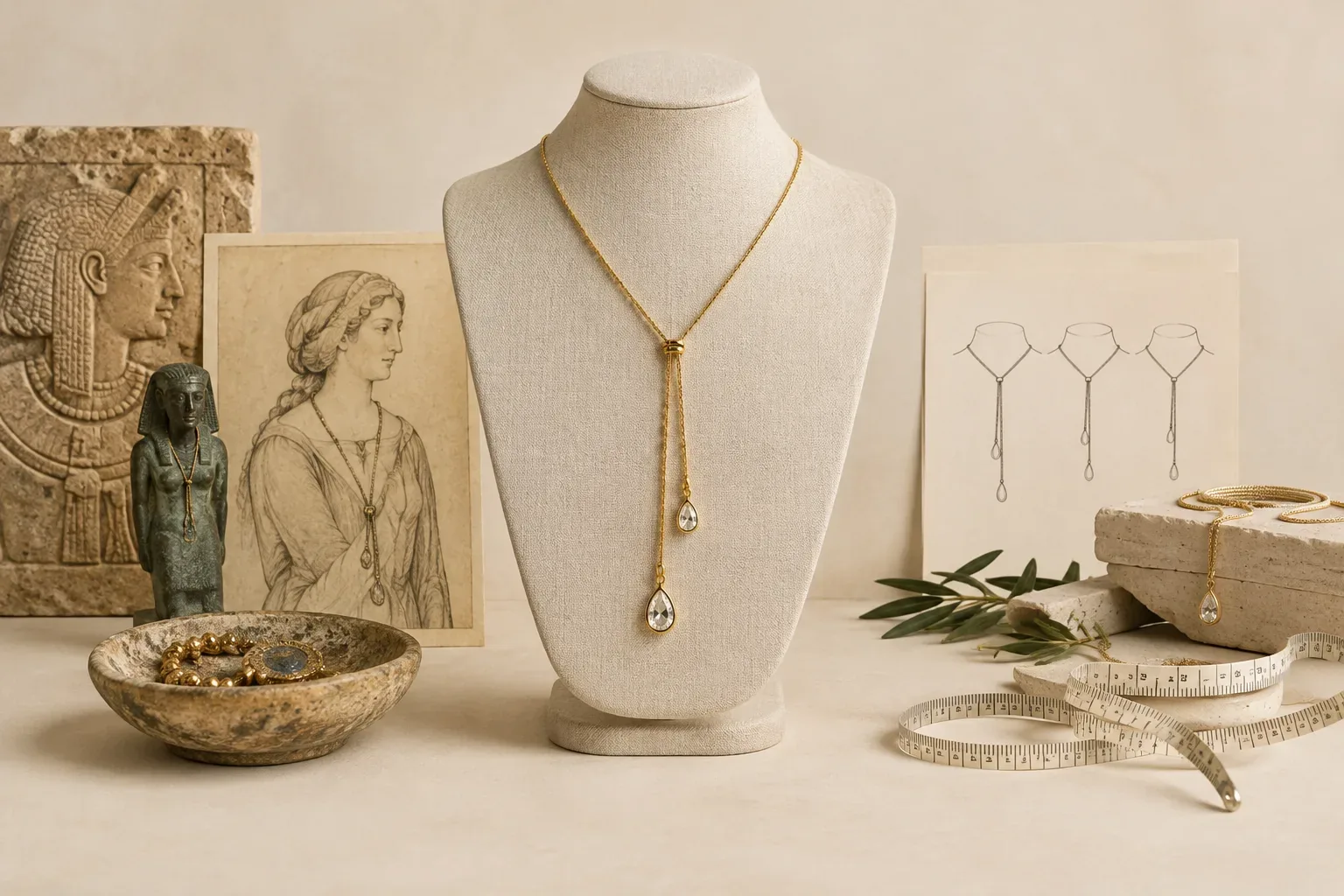
Meaning at a glance
This guide explains the documented history and changing contexts of the lariat necklace motif, separates historical evidence from modern personal meanings, describes how the motif and gemstones appear in jewelry, and provides practical measurement and gifting guidance to choose a well-fitting lariat.
What the historical record actually says
When researchers and curators present jewellery history they emphasize change over time: form, material and length have shifted according to social context and technology rather than fixed symbolic meaning. The Victoria and Albert Museum frames jewellery as an object whose size and appearance reflect changing use, status and taste across periods; their exhibition and writing point to evolving functions for necklaces rather than a single universal symbolism. The V&A’s materials show how jewel length, the use of long chains and the presence of pendants have appeared in many different periods and places, with meanings assigned by social context, not by a standard motif name.
The term "lariat" as a necklace label is a modern, descriptive borrowing from rope terminology rather than a name used in older inventories or museum catalogues. While long, looped, and rope-like necklaces have clear precedents in historical collections, the specific fashion category called a lariat—a necklace without a fixed clasp that relies on a loop or sliding knot to form a drop—emerges from twentieth- and twenty-first-century fashion practices that adapt older forms for new tastes. The V&A’s discussions of jewellery history emphasize these trajectories without presenting a single, continuous cultural meaning tied only to the lariat form.
Documented historical meanings versus modern personal interpretations
Documented meanings recorded by museums and historians are tied to context: who wore an object, what materials it used, and what social role the wearer occupied. The V&A’s resources explain that long necklaces have been used to display wealth, to bear amuletic or devotional objects, and to follow the silhouette of prevailing fashion. These are contextual, evidence-based observations rooted in provenance, inventories, and contemporary accounts rather than a universal symbolic dictionary.
Modern interpretations of the lariat are largely personal, stylistic, or marketing-driven. Contemporary consumers and designers often ascribe meanings such as sensuality, freedom, or bohemian chic to the lariat’s long, dangling line, but those are modern readings, not universal historical facts. Where a piece carries a particular religious, ethnic, or cultural meaning, that significance should be identified and respected on its own terms rather than assumed from the lariat shape alone.
How the motif, gemstone, and tradition appear in jewelry
Physically, a lariat necklace typically forms a Y-shaped silhouette created by a continuous length of chain or cord that threads through itself, through a loop, or is held by a sliding element so the wearer can vary the drop. Designers may finish the ends with beads, gemstones, metal bars, tassels or decorative findings. The defining feature is adjustability of the drop rather than a specific clasp type.
Gemstones appear as decorative terminals, focal points at the end of the tail, or as part of the sliding element. The Victoria and Albert Museum’s A–Z of Gemstones provides historical context for many stones that jewelers use; some gems have longstanding associations because of colour, rarity or use in particular eras, but those associations depend on culture and period. Where a gemstone carries culturally specific meanings, that history should be stated with care and traced to reputable sources rather than assumed.
Technically, many contemporary lariats combine delicate chainwork with heavier terminal elements so the piece slides well and hangs predictably. Materials range from fine precious-metal chains to leather or textile cords. Designers may treat or alter gemstones for colour and durability; the U.S. Federal Trade Commission explains that sellers should disclose treatments, imitations and any enhancements, so buyers can compare value and care requirements.
Measurements that matter: practical fit and proportion
Lariat fit depends on three basic numbers: the neck circumference of the wearer, the total length of the necklace laid flat, and the length of the tail or drop after the sliding element. To plan a purchase, start by measuring neck circumference with a flexible tape close to the base of the neck. This tells you whether a short lariat will sit at the collarbone or ride up.
Next consider the total length of the chain. For a continuous-loop or no-clasp lariat, the total length equals the full perimeter of the piece. How you wear it determines the final drop. Many people find it useful to imagine the necklace doubled once to form a loop and then to slide the tail to the desired point; others prefer a long single strand that threads through a decorative element. Because industry naming for lengths varies, ask a seller for the total chain length and the finished drop length in inches or centimetres rather than relying on naming alone.
Decide how much tail you want to show. A short, elegant drop will end just below the collarbone, framing the neck and upper chest; a longer tail can reach the sternum, mid-chest or even the waist on very long designs. Consider the wearer’s torso length and wardrobe: higher necklines reduce visible tail length, whereas low or open necklines show off longer drops. If you want versatility, choose designs with sliding elements that allow you to shorten or lengthen the tail easily.
Pay attention to terminal weight. Heavy beads or gemstones at the ends help the tail hang smoothly and prevent unwanted slippage. Conversely, a very light tail can ride up. Ask for the weight or feel of terminals if possible, and test how the piece holds its intended drop by trying similar forms in person or checking return policies when buying online.
Practical selection and gifting guidance (respectful and useful)
Match the design to the recipient’s typical outfits. For someone who wears tailored blouses and collars, a shorter, neat drop is likely to be more wearable. If the recipient favors dresses and layered bohemian styles, a longer lariat that can be doubled or worn at different lengths will offer more versatility. Respect personal and cultural preferences: some communities have specific expectations about materials, iconography or the wearing of certain symbols, so avoid assuming a lariat’s modern branding replaces those traditions.
Choose adjustable or demonstrably versatile pieces when you’re unsure of exact fit. Lariats that offer sliding closures, removable terminals, or the ability to knot at different points let the wearer adapt the piece to their body and wardrobe. When buying gemstones, ask the seller directly about treatments and enhancements; the Federal Trade Commission recommends disclosure of treatments, imitations, and any significant material facts so you can assess value and care needs.
Consider material sensitivities and longevity. If you know the recipient has metal allergies, choose high-karat gold, platinum, or nickel-free sterling. For everyday wearers, sturdier chain links and secure terminal attachments reduce the risk of breakage. If a piece includes cultural motifs or sacred imagery, learn the meaning and ask whether the recipient would appreciate or prefer that iconography before gifting.
When in doubt, include flexible photos and a generous return policy in the gift plan. Offer a gift receipt or an option to exchange for a different length or finish; the ability to adjust the piece afterward is a thoughtful complement to a meaningful present. For heirloom pieces or stones sold as rare, ask for provenance or certification to support the piece’s claims.
Care, verification and ethical reminders
Take care with cleaning and wear. Sliding elements and delicate chains can snag; advise the wearer to remove a lariat during heavy activity, before swimming, and when using strong chemicals. For gemstones, follow the care guidance appropriate to the stone in question; the Victoria and Albert Museum’s A–Z of Gemstones is a useful reference for historical context and different stones’ properties.
Verify seller claims. The FTC’s guidance on buying gemstones, diamonds and pearls stresses that sellers should disclose treatments, lab-created origins and imitations. Ask for documentation if price or rarity claims seem significant, and remember that disclosure is a consumer right and a sign of professional practice.
Respect cultural sources. If a design references a cultural or religious motif, seek to understand its meaning and provenance. Do not assume the lariat shape removes or overrides any historical or sacred significance connected to particular symbols or stones.
Final takeaway
The lariat necklace is a modern name for a form with long historical precedents: its meaning and use have shifted across eras and cultures, and documented historical claims about long necklaces emphasize context and social role rather than a single symbolic definition. Use careful measurement—neck circumference, total chain length and desired tail length—choose adjustable designs when possible, ask about gemstone treatments and materials, and respect cultural meanings where present.
Frequently asked questions
How do I measure for a lariat necklace?
Measure the base of the neck with a flexible tape to learn the wearer’s neck circumference, then ask the seller for the necklace’s total chain length and the expected drop length after the sliding element; compare those numbers to the wearer’s torso and typical necklines to predict where the tail will fall.
What length tail should a lariat have?
Tail length is a personal choice: a short tail ends near the collarbone for a refined look, while longer tails reach the sternum or lower for dramatic effect; choose adjustable styles if you want flexibility.
Are lariat necklaces adjustable?
Many lariats are intentionally adjustable through sliding elements, loops or knots so the wearer can alter the drop; when buying, confirm how the piece adjusts and whether terminals are secure.
Should I ask about gemstone treatments when buying a lariat?
Yes. The Federal Trade Commission advises buyers to ask sellers to disclose treatments, enhancements, or imitations so you can judge value, care requirements, and authenticity.
Is a lariat necklace appropriate to give as a cultural or religious gift?
Only if you understand the specific symbol’s meaning and know the recipient welcomes such imagery. Do not assume the lariat form itself carries or replaces cultural or religious significance; research and sensitivity are essential.
Sources and further reading
- Bedazzled: A History of Jewellery — Victoria and Albert Museum
- An A-Z of Gemstones — Victoria and Albert Museum
- Buying Gemstones, Diamonds, and Pearls — Federal Trade Commission