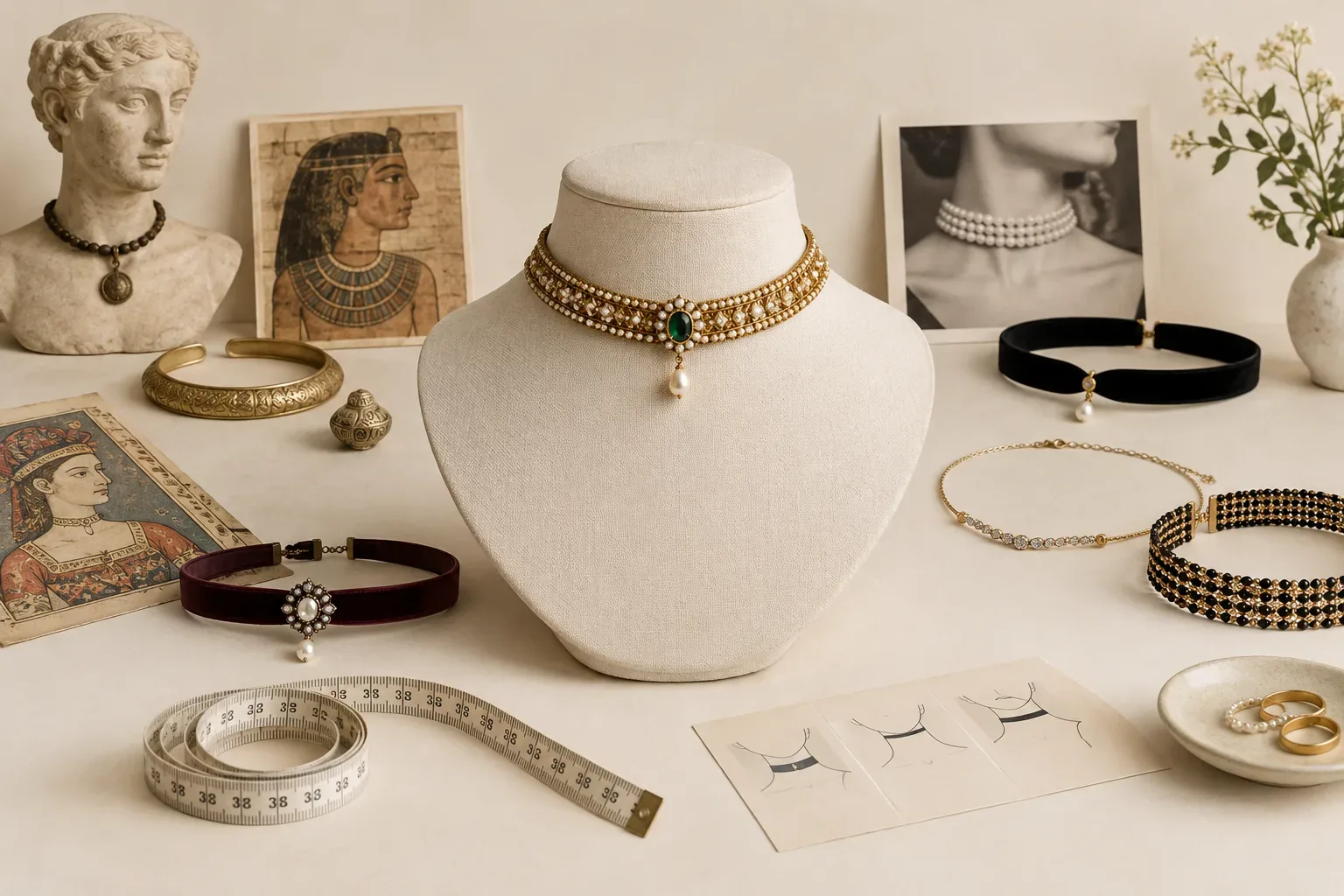
Meaning at a glance
This guide explains the documented history and changing contexts of chokers, separates recorded cultural meanings from modern personal interpretations, describes how motifs and gemstones appear in choker jewelry, and gives step-by-step, respectful, practical guidance for measuring, choosing, and gifting a well-fitting choker.
What the historical record shows
Museum and curatorial research traces neck ornaments, including chokers or high necklaces, across many times and places. The Victoria and Albert Museum (V&A) presents choker-like necklaces as part of a long history of jewellery where form and social meaning changed across cultures and periods. The V&A collections and exhibitions document examples from pre-modern societies through European 18th and 19th century fashions to 20th century revivals, demonstrating that tight or high necklaces have recurred for different reasons—status, protection, court fashion, or simple ornamentation—rather than carrying one single meaning.
Documented historical meanings versus modern interpretations
What is recorded by museums and curators is evidence of how people used and perceived neck ornaments at particular times. The V&A's work locates chokers within social and fashion histories: some periods used high necklaces as elite dress, others as practical or ritual objects. Those documented contexts are distinct from later or contemporary interpretations. Modern meanings—personal style, sexual or subcultural signals, or revival fashion trends—are contemporary layers of significance that people assign today. These modern interpretations can be meaningful to wearers but should not be treated as universal historical facts.
How motifs, gemstones, and traditions appear in choker jewellery
Chokers can carry motifs from heraldry, floral carving, religious symbols, or purely decorative patterning. Gemstones and pearls are set into tight necklaces in many styles: simple single-stone settings, rows of stones, seed pearls on ribbon, or gem-studded metal collars. The V&A's A–Z of Gemstones describes how different gems have been used in historical jewellery and how stylistic treatments change with fashion and technology. When a choker uses a motif or a particular stone, that choice usually reflects manufacture techniques, the wearer's social context, and contemporary aesthetic preferences rather than a single fixed meaning.
Key measurements and how to take them
Use a soft fabric tape measure for best results. Measure the neck where the choker will sit: for a high choker this is just above the collarbone and around the base of the throat; for a looser collar measure a little lower. Have the wearer stand naturally and relax the shoulders. If you don’t have a tape, use a string, mark it, and measure the string against a ruler. Record the neck circumference precisely; this is the baseline from which you will determine finished choker length.
Choosing finished length and allowance
Chokers are defined by where they sit rather than a single length, but finished lengths commonly fall in a range that keeps the necklace high on the neck. As a practical rule, use the actual neck measurement plus an allowance for comfort and movement. For a very snug, close-fit choker add a small allowance; for a comfortable choker that allows breathing and swallowing add a larger allowance; and for a loose collar-style necklace add still more. Build adjustability into the closure by choosing a clasp with a short extender chain, a tie, or a gently elasticated band so a single piece can be adjusted by a few centimetres or an inch or two.
Fit types and what they feel like
A snug, near-skin choker sits tightly and moves minimally; some wearers like this formal, trim look but others find it restrictive. A classic choker fits close but allows easy swallowing and breath; this is the most commonly comfortable choice for daily wear. A loose collar sits lower on the neck with visible gap between choker and throat; this is more relaxed and may be preferable for layering. Always check the wearer’s comfort and ask whether they prefer more or less movement at the throat.
Materials, gemstones, and disclosure considerations
Choose materials with skin sensitivity and long-term wear in mind. Metals labelled as hypoallergenic, plated pieces with high-quality base metals, fine silver or gold, and ribbons or soft leathers can be good options depending on wearer preferences. For gemstones and treatments, consult the V&A’s guidance on gem context and the Federal Trade Commission’s recommendations: sellers are required to disclose treatments, synthetics, or imitations when relevant. When a choker uses precious stones, ask the seller about treatments, origin information if available, and how the piece should be cared for.
Practical selection and respectful gifting guidance
When choosing or gifting a choker, measure or discreetly obtain the recipient’s neck circumference. If that isn’t possible, pick a design with an adjustable closure so the piece can be resized. Consider the recipient’s everyday clothing (high collars, open necks), style preferences, and occupational needs. Be sensitive to cultural uses: chokers in some cultures or communities can carry ritual or historic significance, so avoid appropriating traditional designs without understanding and acknowledging their origins. For a meaningful gift, pair the choker with a short note explaining why you chose that motif or material and include care and sizing information so the wearer can adjust it.
Care, safety and wearability
Check weight and balance: heavy gemstones or metal collars can fatigue the neck and are less comfortable for prolonged wear. Avoid wearing tight chokers while sleeping, during intense exercise, or when the skin is irritated. Clean and maintain materials according to the maker’s instructions; when buying gemstones and finished jewellery, ask about cleaning methods and any treatment disclosures, following the Federal Trade Commission’s advice to get material and treatment information in writing where possible. If a wearer develops skin redness or irritation, remove the piece and consult a professional for allergy advice.
Putting history and meaning into practice
Use historical knowledge as enrichment rather than prescription. Museum documentation (for example, work by the Victoria and Albert Museum) helps us see chokers as objects with changing social roles. When you select or wear a choker today, you bring your personal meaning to it. A respectful approach honours recorded histories, avoids assuming a single interpretation, and prioritizes comfort, disclosure about materials, and consent when borrowing or adapting designs associated with a specific culture or tradition.
Where to read more
For wider context on historical jewellery and gemstones consult museum resources such as those produced by the Victoria and Albert Museum and practical consumer guidance about gemstones and disclosure from the Federal Trade Commission. For related practical articles on choosing and gifting meaningful jewellery, see our Jewelry Guides and How to Choose Meaningful Jewelry pages.
Frequently asked questions
How do I measure for a choker?
Use a soft tape measure around the neck where you want the choker to sit. Record the exact circumference. If you don’t have a tape, wrap a string and measure it against a ruler. Use this number to choose a finished length or to add the desired allowance for fit.
What finished length should a choker be?
Chokers are defined by where they sit rather than a single universal number, but finished lengths designed to sit high on the neck commonly fall within a modest range. Decide if you want a snug or more comfortable fit, then add the appropriate allowance to the wearer’s neck measurement. When in doubt, choose an adjustable closure so the piece can be modified.
How much extra room should I allow for comfort?
Allow a small additional measurement for a snug choker and more for a comfortable or loose collar. The exact allowance depends on personal preference, breathing and swallowing comfort, and whether the piece will be layered. An adjustable closure can accommodate differences without needing precise guesswork.
Are there materials to avoid for chokers?
Avoid very heavy pieces for prolonged wear, and be careful with plated metals if the wearer has sensitive skin. Choose hypoallergenic metals or soft ribbons for sensitive necks. For gemstones, ask sellers about treatments and imitations; the Federal Trade Commission advises buyers to request disclosure of treatments and synthetic materials.
How do I gift a choker respectfully?
Try to measure or choose an adjustable design, consider the recipient’s style, and be mindful of any cultural or ritual significance associated with the design. Include care and sizing information and a brief note explaining why you selected that motif or material.
How should I care for a choker with gemstones?
Follow the maker’s care guidance. Ask the seller for information about any treatments the gems have undergone, and clean materials according to recommended methods. If you are uncertain, consult a professional jeweller before cleaning.
Sources and further reading
- Bedazzled: A History of Jewellery — Victoria and Albert Museum
- An A-Z of Gemstones — Victoria and Albert Museum
- Buying Gemstones, Diamonds, and Pearls — Federal Trade Commission