Meaning at a glance
This guide explains documented history and changing contexts for chain necklaces, distinguishes historical meanings from modern personal interpretation, explains how chains and gemstones appear in jewelry, and gives practical advice for choosing or gifting a chain necklace while citing museum and consumer-protection guidance.
What the historical evidence actually shows
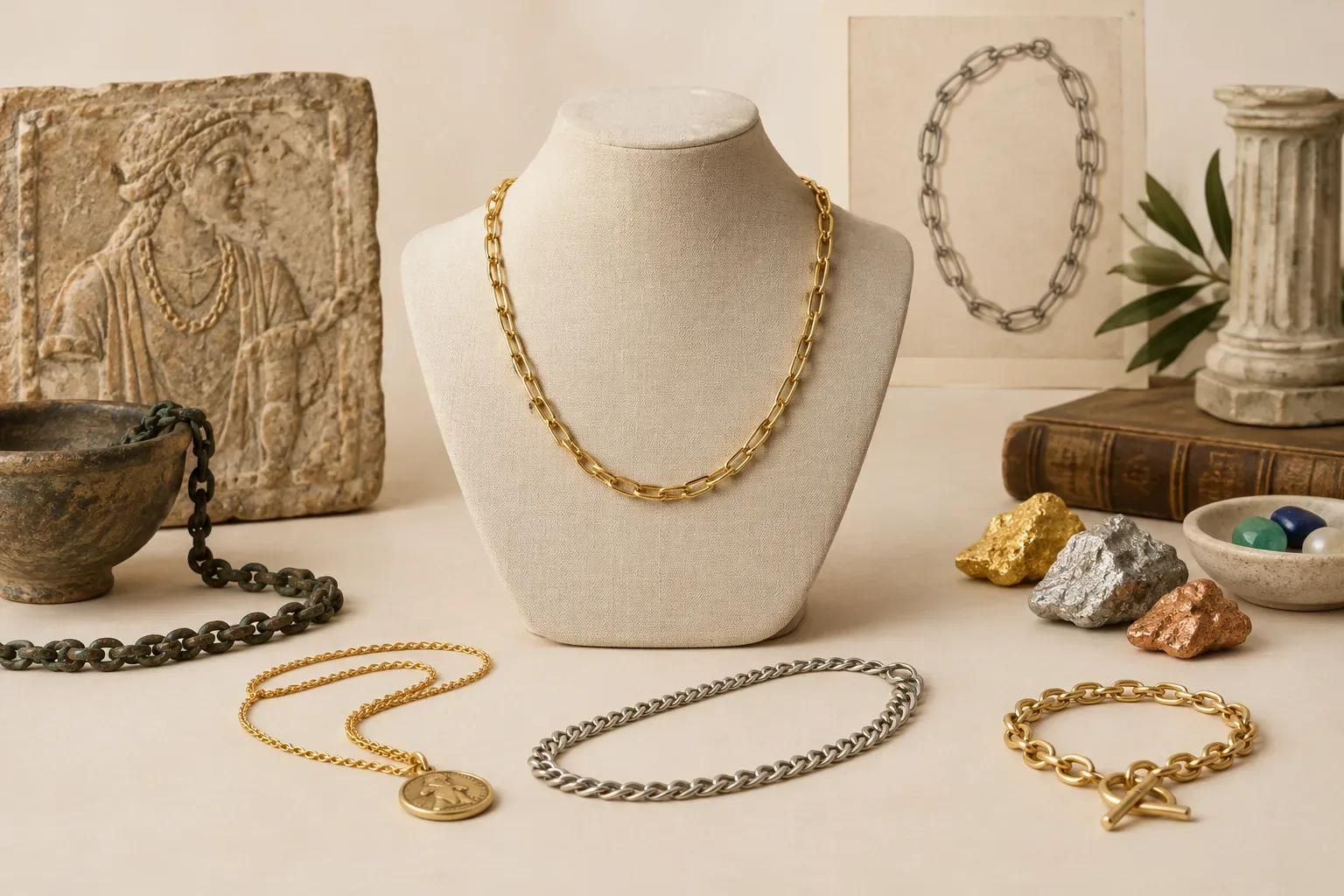
Surviving jewellery and museum research show that chains have been both functional and symbolic across many cultures and periods, changing form and social meaning over time. The Victoria and Albert Museum documents how jewellery's role shifted according to social context, from markers of status and identity to personal ornament and fashion, and it treats chains as one recurring form within that broader history. Examples in museum collections and exhibitions place chained necklaces among objects used in ancient Egypt, in classical Mediterranean cultures, throughout medieval and Renaissance Europe, and again in the 19th century when personal jewellery and sentimental objects became common.
Because the V&A frames jewellery as a social and artistic phenomenon, its material emphasizes that a chain’s form and finish change with technology, taste, and purpose. For instance, museum catalogues and displays explain how metalwork techniques and gemstone cutting influenced how chains were made and worn in different periods. These published collections and interpretive texts provide the documented, material evidence we rely on when discussing historical meanings for chains, rather than later popular retellings.
Documented historical meanings versus modern personal interpretations
Documented historical meanings come from the material record and contemporaneous sources catalogued by institutions such as the Victoria and Albert Museum. In some cultures and periods chains signalled rank, were components of devotional or funerary assemblages, or carried lockets and reliquaries. These are contextual, observable uses: a chain affixed to a pendant in a portrait, or archaeological finds showing chains placed with the deceased, are types of evidence curators rely on.
Modern personal interpretations—such as reading a simple cable chain as a symbol of commitment or a rope chain as a declaration of identity—are valid personal meanings but should not be conflated with universal or historical fact. Contemporary meanings are shaped by fashion, advertising, subculture, and individual sentiment. The V&A materials help trace how meanings shift; they do not prescribe a single, timeless symbolism for any chain style. Treat symbolic claims sensitively and attribute them clearly as contemporary or personal rather than historical when advising or gifting.
How chain necklaces, motifs, gemstones, and traditions appear in jewelry
A chain is a structural element and a visual motif. In practice it appears as a plain or decorated series of links that carries a pendant, frames the throat as a collar or choker, or stands alone as the main ornamental element. Chains may be simple and utilitarian, or they may be richly worked and integrated with other motifs such as medallions, lockets, or badge-like insignia. Museum collections documented by the Victoria and Albert Museum illustrate the wide variety of chain treatments and how they are combined with other jewelry forms.
Gemstones and other decorative elements are combined with chains in multiple ways. According to the V&A's overview of gemstones, particular stones were historically prized for optical qualities, color, and rarity, and were mounted into settings attached to chains. In modern jewellery the same stones may be used for aesthetic reasons or personal symbolism, and contemporary production includes natural, treated, and lab-created stones. The U.S. Federal Trade Commission explains that treatments, enhancements, and imitations must be disclosed to buyers, which affects how gemstones appear in present-day chain necklaces and what buyers should expect when comparing price and value.
Quality, materials, and price: what to ask and what matters
Start with metal type. Decide whether you want solid precious metal (such as gold, silver, or platinum), plated metal, or non-precious metal. Solid metals carry hallmarks that indicate purity and are generally more durable and valuable over time; plated items may wear and reveal base metal. Consider how often the wearer will wear the chain and whether they have metal sensitivities. A heavier, solid-gold chain of lower karat may resist wear better than a thin high-karat chain, but higher karat gold is softer.
Examine construction and craftsmanship. Link construction, soldering quality, and the design of the clasp determine longevity. A well-made chain will have uniform links, secure solder joints, and a clasp sized and shaped for the chain’s weight. For daily wear, prioritize chains with robust clasps and solid links rather than hollow tubing or fragile connectors.
Assess gemstone and setting claims carefully. The V&A's gemstone overview shows why some stones have been historically valued for hardness, color, or rarity. The FTC mandates disclosure about whether stones are natural, treated, or lab-created and whether items are filled, plated, or imitations. Ask the seller whether gemstones are natural or synthetic, whether they have been heat-treated or filled, and whether any coatings are present. Treatments affect both appearance and resale value.
Understand treatments, plating, and imitation rules. The FTC requires sellers to disclose artificial enhancements and the nature of plated or filled metals. That means you should receive clear information about karat weight for gold, whether vermeil standards are met for silver-gilt, and whether stones are backed or coated. If a price seems significantly lower than comparable items, ask what, if any, treatments or imitations are involved.
Match length, thickness, and style to the wearer and intended use. A delicate chain suits pendants and light, occasional wear; thicker chains hold heavier pendants and withstand daily wear. Think about clasp accessibility for the recipient and whether a longer chain will layer well with existing pieces. Ask the seller for ring sizes and clasp type to ensure the piece will be comfortable and functional for the wearer.
Practical and respectful selection and gifting guidance
Respect cultural and religious contexts. If a chain style or pendant has explicit religious or cultural meaning, research its use and provenance before buying it as a gift. Use museum resources and cultural guides to learn whether an object should be treated as a devotional item, ceremonial object, or secular ornament. When in doubt, choose neutral forms or ask the intended recipient about their preferences.
Consider the recipient’s lifestyle and maintenance preferences. For someone who exercises or swims often, choose corrosion-resistant metals and secure clasps. For someone who prefers low-maintenance jewellery, select harder metals and simpler settings that do not require frequent cleaning. Provide care instructions at gifting so the recipient can protect plating, prevent kinks, and clean gemstones safely.
Be transparent when gifting a significant purchase. If you expect the chain to have heirloom value, consider buying from a reputable seller who provides hallmarks, documentation of metal purity, and disclosure statements on gemstones. Keep receipts and any certification in case future servicing or insurance is needed.
When gifting a meaningful symbol, explain intent but allow the recipient to adopt their own meaning. If you intend a chain to mark an occasion or to carry a sentiment, say so directly. That makes the gift personal without asserting historical claims about the chain’s symbolism; allow the wearer to accept, adapt, or reinterpret that meaning over time.
Troubleshooting common buyer questions
If the seller cannot or will not disclose metal purity, treatments, or whether a stone is lab-created or natural, treat that as a red flag. The FTC's guidance on gemstones, diamonds, and pearls makes clear that sellers must accurately describe treatments and imitations. Ask for hallmarks, a written description, or a certificate, especially on higher-value pieces.
If you are balancing budget and durability, prioritize construction and clasp quality over ornament. A well-made lower-cost metal chain can outlast a poorly made higher-priced item. Conversely, if you plan to resell or pass a piece as heirloom, invest in solid precious metal and reputable documentation.
Frequently asked questions
How can I tell if a chain is solid gold or plated?
Look for hallmarks indicating karat weight and metal type; ask the seller for documentation. If there is no hallmark or paperwork, request a written description from the seller explaining whether the item is solid, filled, vermeil, or plated. The FTC expects accurate disclosure of metal type and plating.
What should I ask about gemstones set on a chain pendant?
Ask whether the stone is natural, lab-created, or treated, and whether any coatings or fillings have been applied. Request written confirmation of treatments and, for higher-value stones, independent certification. The Victoria and Albert Museum’s resources explain historical uses of stones, and the FTC requires sellers to disclose treatments and imitations.
Is a thicker chain always better for durability?
Not always. Heavier gauge links generally resist breakage better than very thin chains, but construction quality and link type matter too. A well-made thin chain with solid soldered links can be more reliable than a poorly made thick chain with weak joins.
How should I care for plated chains to make them last?
Limit exposure to water, sweat, and perfumes; remove the chain for sleep and exercise; clean gently with a soft cloth. For severe wear, consider professional re-plating or replacing the chain if the base metal is causing skin reactions.
Can I return a chain if I find later that gemstones are treated or the metal is not as described?
You should be able to return or obtain a remedy if the seller misrepresents materials. For significant purchases, keep receipts and written disclosures. The FTC’s consumer guidance covers disclosure responsibilities for gemstone treatments and imitations.
Sources and further reading
- Bedazzled: A History of Jewellery — Victoria and Albert Museum
- An A-Z of Gemstones — Victoria and Albert Museum
- Buying Gemstones, Diamonds, and Pearls — Federal Trade Commission