Meaning at a glance
This article explains the documented history and changing contexts of pendant necklaces, separates recorded cultural meanings from modern personal interpretations, and provides a clear, practical checklist for assessing construction, comfort, and durability when choosing or gifting a pendant necklace.
Historical evidence and cultural contexts
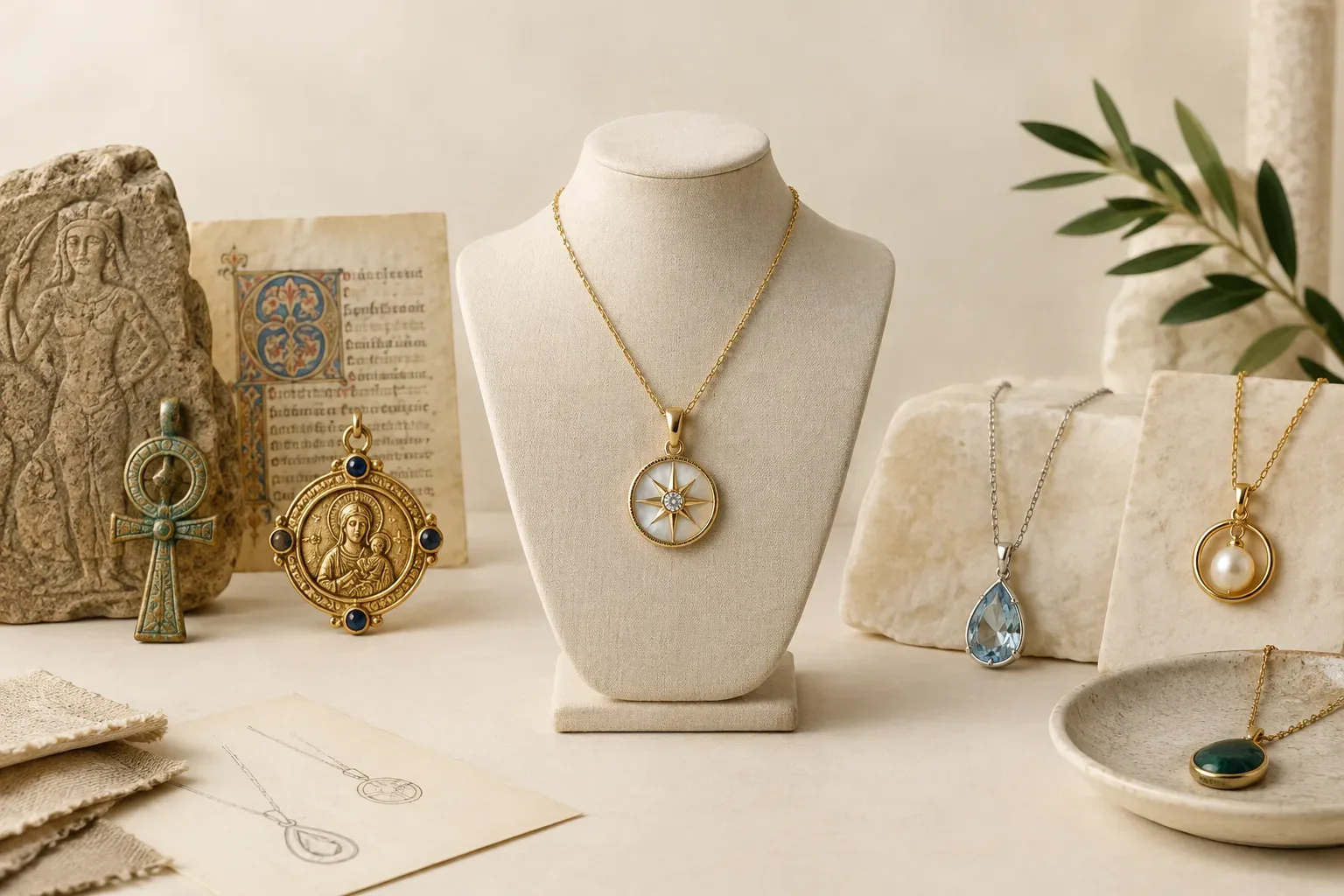
Museum scholarship shows that pendant-style ornaments have appeared in many cultures and periods with differing social roles and manufacturing techniques. The Victoria and Albert Museum records how personal ornaments changed in form and social meaning across eras, from amulets and devotional pendants to portrait lockets and fashion accessories, reflecting shifts in technology and taste rather than a single universal function. When considering history, identify the culture and period precisely: for example, a metal amulet from ancient Egypt, a classical Greek gem intaglio, and a nineteenth-century mourning locket each belong to distinct production practices and social meanings as documented by the Victoria and Albert Museum.
Where the V&A discusses gemstones and their historical context, it emphasizes that specific stones and settings were associated with different technologies and trade routes at various times. The physical evidence and cataloging housed by museums are the primary source for claims about how certain motifs and materials were made and used in particular places and periods.
Documented historical meanings versus modern interpretations
Separate the documented record from modern personal or commercial interpretation. Museum documentation can show that a certain pendant was used as a talisman or a sign of status in its original context, but it does not imply that meaning persists unchanged today. For example, a symbol worn as a protective amulet in one culture may later be worn in another context purely for aesthetics or personal symbolism. The Victoria and Albert Museum materials make clear that many meanings assigned to jewelry in contemporary marketing are modern overlays or revivals rather than continuous traditions.
Respectful attention means acknowledging what is historically attested (who made or wore an object, how it was used) and distinguishing that from contemporary uses or claims. Do not assume historic sacred or civic authority transfers automatically to a modern fashion item; instead, note both the documented provenance and the wearer's present intent.
How motifs, gemstones, and traditions appear in pendant jewelry
Motifs appear in pendants in several ways: as base-form metalwork engraved or pierced, as set gemstones or cameos, or as attached charms and lockets. The same motif—such as a heart, cross, or floral design—may be crafted through stamping, hand-carving, casting, or stone cutting, depending on available techniques in the maker’s time and place. Museum studies collected by the Victoria and Albert Museum illustrate that technique often determines the visual and tactile qualities of a pendant as much as the motif itself.
Gemstones are incorporated either as decorative centers, intaglios, or as part of symbolic programs. The V&A’s overview of gemstones explains differences in hardness, typical cuts, and historical uses—factors that affect how securely a stone can be set and how a pendant should be worn. The Federal Trade Commission’s consumer guidance adds that modern gemstones may be treated or imitated; sellers are required to disclose treatments and imitations, and buyers should ask about these facts before purchase.
Construction: a practical quality checklist
Start with the attachment points: the bail (the loop that attaches the pendant to a chain) should be solidly soldered or mechanically well-formed with no visible gaps. If the pendant relies on an open jump ring, check for proper closure and soldering. A well-made bail distributes the pendant’s weight and reduces wear on the chain.
Next inspect the setting and bezel work. Stones should sit flush, with prongs or bezels that are even and securely hold the gem without sharp points. Settings should allow for reasonable cleaning access but not leave stones exposed to easy knocks. Museum examples show that poorly set stones are a common cause of loss and damage over time.
Examine the clasp and chain. The clasp should match the chain’s strength and be accessible for the wearer to operate. Chains should have consistent link formation without thin or stretched areas. Consider the metal gauge, link type, and weld quality as practical indicators of how the chain will bear a pendant’s weight.
Comfort: fit, weight, and wearer experience
Comfort matters every time the necklace is worn. Assess the pendant’s weight relative to the chain: a heavy pendant on a delicate chain will pull and may unbalance the piece. Try the pendant at intended lengths against the wearer’s neckline and clothing to check for rubbing or catching. Edges around the pendant’s rim, bail, and any attached components should be smoothly finished to avoid skin irritation or fabric snags.
Consider the pendant’s profile and how it sits when the wearer moves. Low-profile settings hug the chest and are less likely to catch; three-dimensional drop pendants may swing and require a sturdier chain. If the pendant carries sentimental imagery or a photograph, check that the closure of any locket is secure but easy enough for the wearer to open without risking damage to the contents.
Durability: materials, treatments, and care
Material choice affects long-term durability. Harder gemstones and solid precious metals resist wear better than soft stones or plated base metals. The Victoria and Albert Museum’s resources on gemstones note differences in hardness and historical use that remain relevant for modern wear. Keep in mind that softer stones such as pearls and opals require gentler handling and may be better suited to occasional wear than daily use.
Ask the seller about treatments and imitations. The Federal Trade Commission advises that common treatments—such as heating, dyeing, or stabilization—should be disclosed and that imitations or simulants must be clearly identified. Treated stones can still be attractive and durable if you know how to care for them, but undisclosed treatments can affect value and cleaning methods. Establish a maintenance plan based on materials: periodic professional inspections for prongs and settings, and manufacturer or jeweler recommendations for cleaning and storage.
Selection and gifting guidance: respectful and practical choices
When choosing a pendant to gift, consider both the documented history of the motif and the recipient’s relationship to that history. If a motif originates from a particular culture or tradition, acknowledge that provenance and avoid treating it as a generic fashion motif without context. The Victoria and Albert Museum’s catalogue approach—documenting provenance, technique, and usage—offers a useful template: learn where a motif comes from and whether the recipient would appreciate that background.
Match the pendant’s technical qualities to the recipient’s lifestyle: choose robust construction and a secure setting for everyday wear, and more delicate, historically faithful pieces for occasional, ceremonial, or display use. When gifting a gemstone pendant, request written disclosure about any treatments and insist on return or repair policies. If in doubt about cultural sensitivity, ask about the motif’s contemporary meanings with the recipient or select a neutral design that still carries personal significance for both giver and recipient.
Final checks and routine care
Before final acceptance or gift wrap, perform a last walkthrough of the checklist: inspect solder joints, the bail, the stone settings, clasp function, and chain integrity. Verify any seller-provided documentation about metal fineness, gemstone treatment, and whether the piece is solid metal or plated. Keep receipts and documentation for warranty, insurance, or future resale.
Establish a basic care routine suited to the materials: avoid chemical exposure for sensitive stones, remove pendants during high-impact activities, and consider professional cleaning schedules for pieces worn frequently. Museum collections’ long-term preservation practices are not directly the same as everyday wear guidelines, but the underlying principle—match care to materials and construction—applies whether an item is historic or contemporary.
Conclusion
A pendant necklace quality checklist blends technical inspection (bail, setting, clasp, chain and material disclosure) with wearer-centered checks for comfort and appropriate care. Use historical documentation, such as museum records, to understand the provenance and original uses of motifs and materials, and rely on consumer protection guidance for transparent information about gemstones and treatments. Distinguish documented historical meanings from modern personal interpretations, practice respectful selection when motifs carry cultural associations, and choose construction and materials that fit how the pendant will actually be worn.
Frequently asked questions
What are the top things to inspect on a pendant necklace?
Check the bail and its attachment to the pendant, the security and evenness of any stone settings, the chain’s link formation and clasp functionality, and whether the metal is solid or plated. Verify that edges are smoothly finished and that the piece sits comfortably at the intended length.
How can I tell if a gemstone has been treated or is an imitation?
Ask the seller for written disclosure about treatments and whether the stone is natural, treated, or a simulant. The Federal Trade Commission requires such disclosures. For valuable pieces, request a gemological report or an independent appraisal that states treatments explicitly.
What chain type is best for heavier pendants?
Choose a chain with a stronger link profile and appropriate gauge—styles such as curb, cable in heavier gauges, or a boxed chain often suit heavier pendants better than fine, delicate chains. Match the clasp strength to the chain and pendant weight.
Are some pendant motifs culturally sensitive to wear or gift?
Yes. Some motifs have specific cultural or religious significance. Research the motif’s provenance using museum or scholarly sources and consider the recipient’s background. When unsure, opt for neutral designs or discuss the motif’s meaning respectfully with the gift recipient.
How often should I have a pendant professionally inspected?
For pieces worn frequently, a professional inspection every 6 to 12 months is a reasonable guideline to check prongs, settings, and solder joints. Less-worn or costume pieces may need occasional checks, especially after any impact or visible damage.
What basic care keeps a pendant necklace durable?
Avoid chemicals and heavy impact, remove the pendant during sports or heavy work, store it separately to prevent abrasion, and clean according to the material: mild soap and water for many metals and hard stones, specialist care for pearls, opals, and certain treated gems.
Sources and further reading
- Bedazzled: A History of Jewellery — Victoria and Albert Museum
- An A-Z of Gemstones — Victoria and Albert Museum
- Buying Gemstones, Diamonds, and Pearls — Federal Trade Commission