Meaning at a glance
Wood jewelry can be very durable if you choose appropriate wood types and finishes and follow basic care; museum histories show organic materials have long been used in varied cultural contexts, but symbolic meanings differ by time and place and are often modern personal interpretations.
Short answer — the thesis in one line
Wood jewelry durability depends less on the material's inability to tarnish and more on its vulnerability to moisture, abrasion, and finish failure; properly selected woods and professional finishes can make wooden pieces long‑lasting, while historical evidence shows organic materials have been used in jewelry across many cultures and periods, with meanings that shift over time and between communities.
What the historical record shows (and where that evidence comes from)
The Victoria and Albert Museum’s survey of jewellery history describes how makers have repeatedly relied on a wide range of materials — from metals and gemstones to organic substances — across distinct periods and cultures. The V&A frames jewellery in time slices such as ancient Egypt, classical Greece and Rome, Medieval Europe, the Renaissance, Georgian and Victorian eras, and modern design movements, showing that materials and techniques change with social context and technology.
That museum-level perspective is useful because it locates wood and other organic materials within a larger story about access, status, craft and taste rather than demonstrating a single, enduring symbolic meaning for wood. The V&A’s material-based approach makes clear that the same type of object — a pendant, a bead, a carved amulet — can mean very different things in different places or eras depending on who made it, who wore it, and why.
Separating documented cultural evidence from modern interpretation
Documented evidence recorded by museums and historians typically focuses on provenance, technique, and social context. For example, the V&A documents changes in style and material choice across periods and regions; it does not assert a universal symbolic meaning for wood. Where a culture or period has a clear, recorded symbolism connected to a motif or material, that evidence should be referenced as specific and limited to that culture or time.
By contrast, contemporary sellers and wearers often attach personal or popular meanings to wood — ideas such as ‘‘earthiness,’’ ‘‘sustainability,’’ or ‘‘natural strength.’’ Those are valid personal symbols but they are modern interpretations rather than universal historical facts. Always treat symbolic claims about a material as culturally conditional: a motif or material that signified one thing in a particular religious or historical context may mean something entirely different today, or have no special cultural meaning at all for a given wearer.
How wood appears as a motif and as a material in jewellery
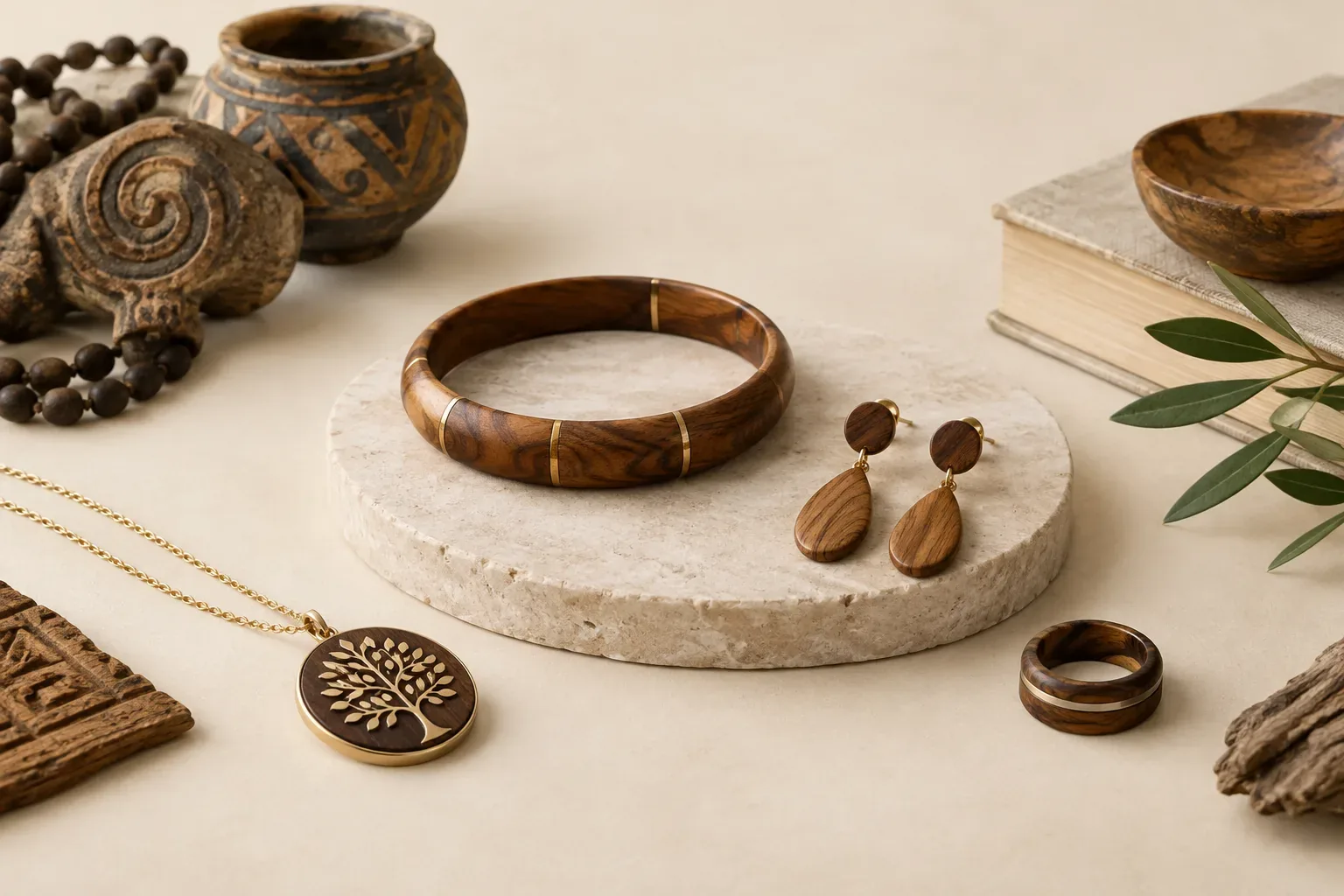
Wood shows up in jewellery both as a motif and as a structural material. As a motif, carved tree, leaf or grain patterns may reference growth, lineage, or landscape in specific cultural contexts; museum catalogues and exhibitions show how motifs circulate and are reinterpreted over time. As a material, wood is used for inlays, beads, carved pendants, earrings, brooches, and even rings and bracelets when stabilized and finished for wear.
Contemporary makers commonly combine wood with metal settings or inset gemstones to create contrast of texture and color. Museums and jewellery surveys note that makers historically exploited the visual appeal of organic materials alongside precious substances; modern designers continue that practice but with new stabilizing treatments and surface finishes not available to earlier makers.
Durability fundamentals: what ‘tarnish’ and ‘wear’ mean for wood
The term tarnish applies to metals, not wood. Wood will not oxidize to a patina of the kind silver or copper does, but it has its own failure modes: surface abrasion, finish degradation, staining from oils and cosmetics, swelling or shrinking with humidity changes, and cracking or splitting under strain. Because wood is porous and organic, exposure to water and solvents can cause lasting damage if the piece is not properly sealed.
A wooden bead or pendant with intact, high-quality surface finishing can resist daily handling for years, while an untreated carved piece worn daily will show wear much sooner. Makers often protect wooden jewellery with finishes — oils, waxes, lacquers, resins or modern polymer sealants — and by choosing dense, stable species of wood. The choice of wood species, the quality of finishes, and construction details (for example, how a wooden bezel is joined to metal) are the main predictors of real-world durability.
What to look for when choosing wood jewellery
Pick a species and construction suited to the intended wear. Hard, dense timbers and composite woods designed for jewelry are less likely to dent or scratch than soft, porous species when worn daily. Look for tight joinery, secure mounting of any metal components, and a finish that covers all exposed surfaces — edge protection is especially important for rings and bracelets.
Ask the maker or vendor whether the wood has been stabilized, dyed or sealed and what maintenance is recommended. Sellers should disclose treatments and enhancements; the Federal Trade Commission advises buyers to obtain clear information about material treatments and any imitations so you can make an informed choice. Disclosure is also essential for repair planning — stabilized wood and polymer‑filled woods are repaired differently from untreated pieces.
Gifting respectfully: cultural and ethical considerations
If a piece uses a design or technique associated with a specific culture, ask about its origins and whether the maker is part of or authorized to use that tradition. Museum studies emphasize that motifs have context: a symbol or style meaningful in one community may be sacred or proprietary in another. When gifting, consider whether the recipient values cultural specificity or prefers broadly 'nature-inspired' designs.
Also ask about provenance and sustainability. Ethical sourcing is part of responsible gifting: some woods are subject to legal protections or sustainability concerns, and many buyers prefer pieces made from reclaimed or certified‑sustainable materials. A respectful gift packet will include maker information, care instructions, and any relevant provenance details so the recipient can appreciate both meaning and material.
Care and repair recommended practices
Treat wooden jewellery as you would other delicate accessories. Store pieces in a dry, temperature‑stable place away from prolonged sunlight. Remove wood rings and bracelets for activities that would expose them to water, heavy abrasion, or harsh chemicals like household cleaners and perfumes, because finishes can be stripped or discolored by solvents and repeated wetting accelerates wear.
For routine cleaning, use a soft, dry cloth to remove dust and surface oils. For more significant maintenance, follow the maker’s instructions: some pieces respond well to a light application of a maker‑recommended wax or oil applied sparingly and buffed, while other pieces with modern polymer sealants require no conditioning. For structural damage, seek a jeweller or conservator experienced with wood and mixed‑media pieces rather than attempting aggressive home repairs.
When to choose wood jewellery and when to avoid it
Choose wood jewellery when you or your recipient prioritise natural texture, warm tones, and lightweight wear, and when the expected use matches the piece’s construction and finishing. A carefully sealed wooden pendant or stud earring is an excellent everyday piece; a wooden ring for a person who works with their hands may be a poorer choice unless the ring is made from a very hard stabilized wood with an extra protective bezel.
Avoid wood for jewellery that must withstand frequent, harsh exposure to water or chemicals unless you are certain the piece has been specifically treated and warranted for that use. When in doubt, consult the maker and match intended use to the construction and finish.
Closing summary
Wood jewellery durability is a function of species, construction, and finish rather than a fixed quality of the material; wooden pieces do not tarnish like metals but they do wear in other predictable ways. Museum scholarship such as the Victoria and Albert Museum’s surveys helps place wooden and organic materials within shifting cultural and technological contexts, and the Federal Trade Commission’s guidance reminds buyers to ask about treatments and disclosures. With thoughtful selection, transparent sourcing, and modest care, wooden jewellery can be both meaningful and long‑lived.
Frequently asked questions
Will wood jewellery tarnish like metal?
No. Tarnish specifically describes the chemical darkening of metals. Wood does not tarnish, but it can abrade, stain, swell, or crack. Long‑term appearance depends on species, finish and how you care for the piece.
Can I wear a wooden ring every day?
Possibly, if the ring is made from a dense or stabilized wood and has a durable finish and protective construction. For heavy manual work or frequent wet exposure, choose a piece explicitly made for daily wear or reserve wooden rings for lower‑impact use.
How do I clean and condition wood jewellery?
For routine care, wipe with a soft, dry cloth to remove dust and oils. Follow the maker’s specific instructions before applying any oil, wax or polish. If you do not have guidance from the maker, seek professional advice for significant cleaning or repair rather than using household solvents.
What questions should I ask a seller before buying wood jewellery?
Ask about the wood species, whether the piece is stabilized or sealed, what finish was used, how to care for it, and whether any dyes or treatments were applied. Sellers should disclose material treatments and any imitations or enhancements.
Are there cultural considerations when gifting wood jewellery?
Yes. If a design comes from a specific cultural tradition, ask about its provenance and whether the maker is from or authorized to use that tradition. Consider whether the recipient values cultural specificity and prefer pieces with clear provenance and respectful sourcing.
Sources and further reading
- Bedazzled: A History of Jewellery — Victoria and Albert Museum
- An A-Z of Gemstones — Victoria and Albert Museum
- Buying Gemstones, Diamonds, and Pearls — Federal Trade Commission