Meaning at a glance
This guide explains the documented history of colored-metal jewelry as recorded by museum scholarship, distinguishes historical meanings from modern personal interpretations, and gives practical advice on assessing quality, price, care, and appropriate uses when buying niobium jewelry.
Historical evidence and where niobium fits
The long story of metal and colour in personal ornament is well documented by museum research. The Victoria and Albert Museum describes a wide history of jewellery and changing social contexts that includes the use of coloured metals, inlaid surfaces, and surface finishes to alter appearance and status. Scholarship such as the V&A’s surveys and its A–Z of Gemstones places modern practices within that longer history: the desire to broaden a jeweller’s palette is not new, even if the specific materials and technologies are recent.
Niobium itself is a modern entrant into the repertoire of metals used by contemporary jewellers. While the V&A records centuries of metalworking and decorative finishes, specific technical developments and market adoption of newer metals belong to modern craft and design movements rather than to the historical periods documented by the museum. Treat statements about niobium as part of current jewellery practice rather than as a continuation of a single ancient tradition.
Documented historical meanings versus modern personal interpretations
Museum documentation records how particular materials, gemstones, and motifs acquired meaning in specific times and places. The Victoria and Albert Museum shows that gems and metals often carried social, economic, or symbolic weight within particular cultures and historical moments. Those meanings are attributable to those cultures and should not be assumed universal.
In contrast, modern meanings attached to niobium pieces are usually personal or contemporary cultural interpretations. Designers and wearers today may choose coloured-metal items for aesthetic reasons, subcultural identity, sustainability concerns, or perceived health advantages. Those modern interpretations are valid as personal or contemporary cultural expressions, but they are not the same as historically documented symbolic systems recorded by museum scholarship.
How the motif and material appear in jewellery
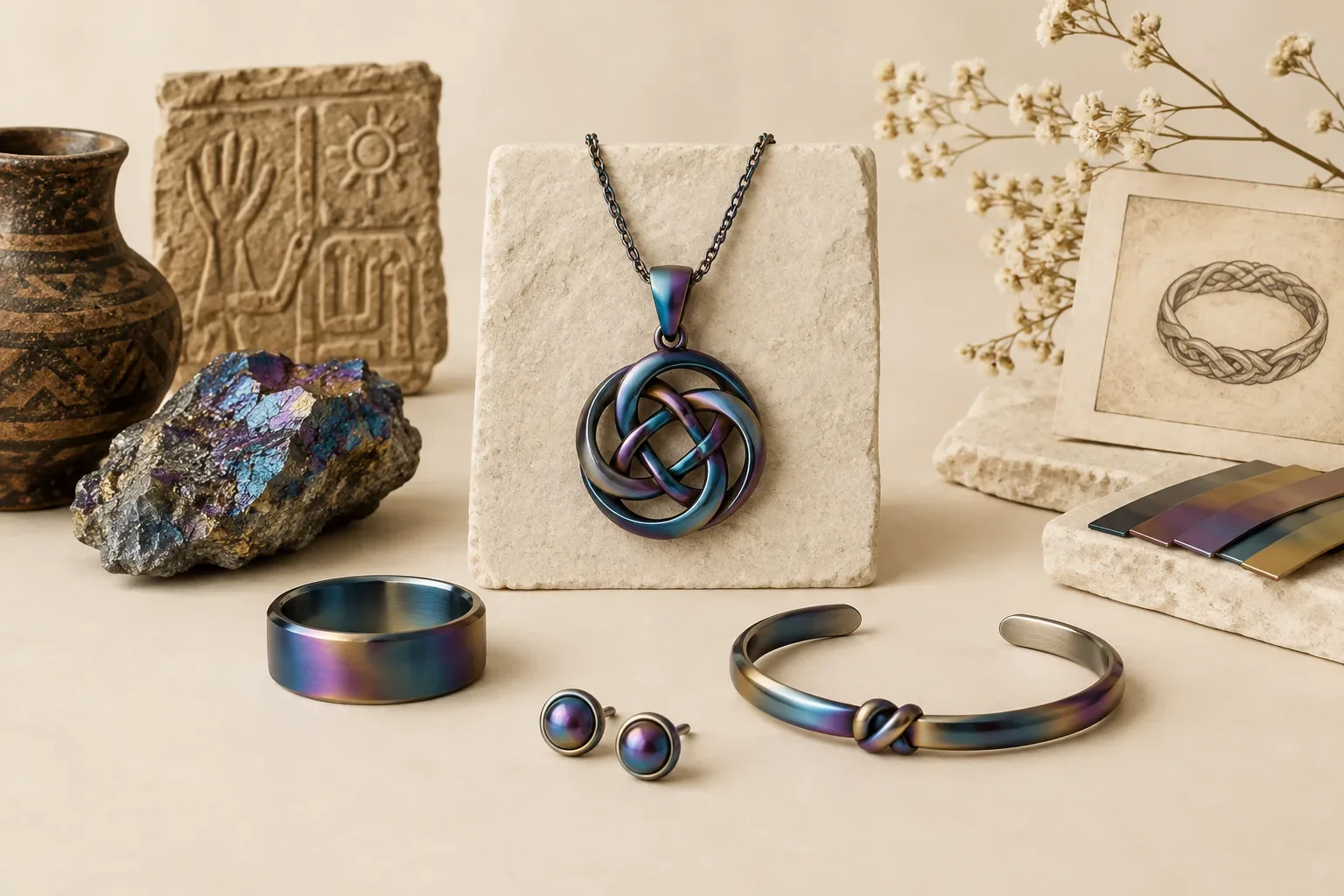
In contemporary jewellery the broader motif of coloured or treated metal appears as rings, earrings, pendants, cuffs, and mixed-media pieces combining metals and gemstones. Designers may emphasise surface colour, texture, or contrast with traditional gemstones, and they often present such pieces as design-focused alternatives to mainstream precious-metal jewellery.
When gemstones appear alongside modern metals they are handled as design elements and as traditional stones with long histories of use. The V&A’s A–Z of Gemstones is a useful reference for the historical context of particular gems and for distinguishing the ways gemstones have been used across different periods and cultures, while contemporary makers place modern metals and finishes in new aesthetic relationships with those stones.
Quality: what to look for when buying niobium jewellery
Assess workmanship first. Look for clean joins, secure settings, smooth finish transitions, and consistent surface treatment across the piece. Craftsmanship is the most reliable indicator that a jeweller understands both the base material and the surface finish being used.
Ask the maker or retailer about treatments and processes. The U.S. Federal Trade Commission advises that sellers disclose significant treatments, enhancements, and whether a material is an imitation or has been specially treated. Clear disclosure helps you compare comparable items and understand how a finish may behave over time.
Check stone settings and any soldered joins for durability. Even when the metal is the feature, poor setting work will cause problems in wear. If applicable, ask whether stones are natural, treated, or synthetic; the Victoria and Albert Museum’s guidance on gemstones helps show why provenance and treatment information matter for long-term value and care.
Consider maker reputation and warranty. Pieces made by experienced jewellers or studios that offer clear care instructions and repair policies are safer buys than items without provenance or after-sale support.
Price: what affects cost and how to evaluate value
Price reflects several interacting factors: the cost of materials, the labour involved in creating a finished surface, the presence and quality of any gemstones, the maker’s skill and reputation, and whether the item is mass-produced or a limited, hand-finished piece. Because niobium and similar modern metals are often marketed for their appearance rather than intrinsic metal value, workmanship and finish can be a larger portion of cost than the base-material value.
Compare like with like by asking for details. The FTC’s consumer guidance stresses the importance of disclosure so that buyers can make informed price comparisons. If two items share a similar appearance but one has a better-documented maker, clearer disclosure about treatments, or higher-quality gemstones and settings, that difference can justify a higher price.
Best uses: wear, styling, and occasions
Consider how a piece will be worn daily. Evaluate the finish and settings for activities the wearer commonly does. For example, if the wearer does heavy manual work, choose a design and finish known from the maker to stand up to abrasion and chemicals, or reserve bolder finishes for occasional wear.
Think about the recipient’s style and any cultural considerations. Modern coloured-metal jewellery is often chosen for contemporary or casual looks, for mixed-metal layering, or to provide a colour accent where traditional gemstones are not wanted. Respect the cultural meanings that certain motifs may carry for particular communities, and when in doubt, ask or choose an unmistakably neutral design.
Care, repair, and resale considerations
Ask the seller for written care instructions and for information about repair options. Well-documented pieces with available repair services and clear care guidance will last longer and retain more value. If a surface finish has been applied, the maker can tell you whether polishing, re-finishing, or specific cleaning agents should be avoided.
Retain receipts, maker information, and any treatment disclosures. These documents support future cleaning, repair, or resale and align with consumer-protection advice such as that provided by the Federal Trade Commission on disclosure of treatments and originality.
Practical selection and gifting guidance
When choosing a gift, prioritize the recipient’s known preferences over trend-driven attributes. A thoughtful niobium piece that matches a person’s colour palette, scale preference, and lifestyle will be better received than a striking piece that doesn’t fit their everyday life.
If you are uncertain about symbolic meanings, research before you buy. Use museum resources for historically documented meanings and ask contemporary makers about their intentions for a piece. Internal resources such as our guide on choosing meaningful jewellery and our history articles can help you separate historically grounded symbolism from newer, personal interpretations.
Finally, present the gift with information about care and provenance. Including a note from the maker or a copy of the seller’s treatment disclosures is both practical and respectful and helps the recipient make informed decisions about wear and care.
Frequently asked questions
Is niobium jewellery hypoallergenic?
Many contemporary makers market niobium as a metal that can be suitable for sensitive skin, but individual reactions vary. Ask the seller for information about alloys and any coatings used, and test wear in a small area if sensitivity is a concern.
How durable are coloured finishes?
Durability depends on the type of surface treatment and the quality of application. Ask the maker for care instructions and whether the piece is intended for everyday wear or occasional use, and retain documentation on treatments to inform future cleaning or repairs.
How can I verify what treatments or enhancements a piece has?
Request written disclosure from the seller about any treatments, coatings, or imitation materials. The Federal Trade Commission recommends that sellers disclose significant treatments and whether a material is an enhancement or an imitation, which helps you compare items accurately.
Should I pair niobium pieces with gemstones?
Yes. Contemporary designers frequently combine modern metals and gemstones for contrast. When gemstones are present, ask whether they are natural, treated, or synthetic and refer to authoritative gemstone references for historical and identification context.
What should I consider when gifting this kind of jewellery?
Consider the recipient’s everyday activities, aesthetic preferences, and any cultural meanings the design may carry. Include maker information, care guidance, and any treatment disclosures with the gift to respect the recipient and support long-term care.
Sources and further reading
- Bedazzled: A History of Jewellery — Victoria and Albert Museum
- An A-Z of Gemstones — Victoria and Albert Museum
- Buying Gemstones, Diamonds, and Pearls — Federal Trade Commission