Meaning at a glance
This bronze jewelry buying guide explains the documented history and changing contexts of bronze jewelry, distinguishes historical evidence from modern interpretations, describes how motifs and gemstones appear in bronze pieces, and gives practical advice for choosing, pricing, and gifting bronze jewelry.
Quick answer
A good bronze jewelry buying guide focuses on three things: documented history and context, objective quality markers, and respectful personal use or gifting. Museum collections show that bronze has been used across many cultures and periods for functional and decorative pieces, but meanings have changed over time. When buying, assess alloy composition and workmanship, check for treatments or plating, consider how any gemstone is set, and be mindful of cultural or symbolic motifs so you can wear or gift the piece thoughtfully.
What the historical evidence shows
Museum scholarship demonstrates that bronze has been a durable and versatile metal for jewelry for millennia. The Victoria and Albert Museum notes bronze objects and bronze-alloy jewellery across a wide sweep of history, with examples serving practical, decorative, and social-signalling roles in different places and periods. Collections and exhibitions document techniques such as casting, hammering and inlay as well as evolving fashions and functions.
Because museum collections gather material from many cultures, the V&A frames bronze jewellery as a material that appears in different contexts rather than a single, uniform tradition. In some periods bronze pieces are utilitarian fastenings or simple rings; in others they are refined ornaments or settings for stones. The museum’s coverage of gemstones also helps explain how stones were chosen and used in metal settings over time.
Documented historical meanings versus modern interpretations
Distinguishing what is documented from what is later interpreted or popularized is important. The archaeological and museum record documents how bronze was used and often records associations such as status, practicality, or regional fashion. For example, museum catalogues and exhibits attribute particular pieces to social roles or production techniques based on context and comparison of finds. Attribute this kind of claim to the Victoria and Albert Museum when citing those sorts of contexts.
Modern meanings—personal, spiritual, or trendy—are different. Contemporary sellers, designers and wearers may attach symbolic or emotional significance to bronze objects that is not recorded in the historical record. Those modern interpretations can be meaningful to the wearer, but they should not be presented as universal or as established historical fact.
How motifs, gemstones, and traditions appear in bronze jewelry
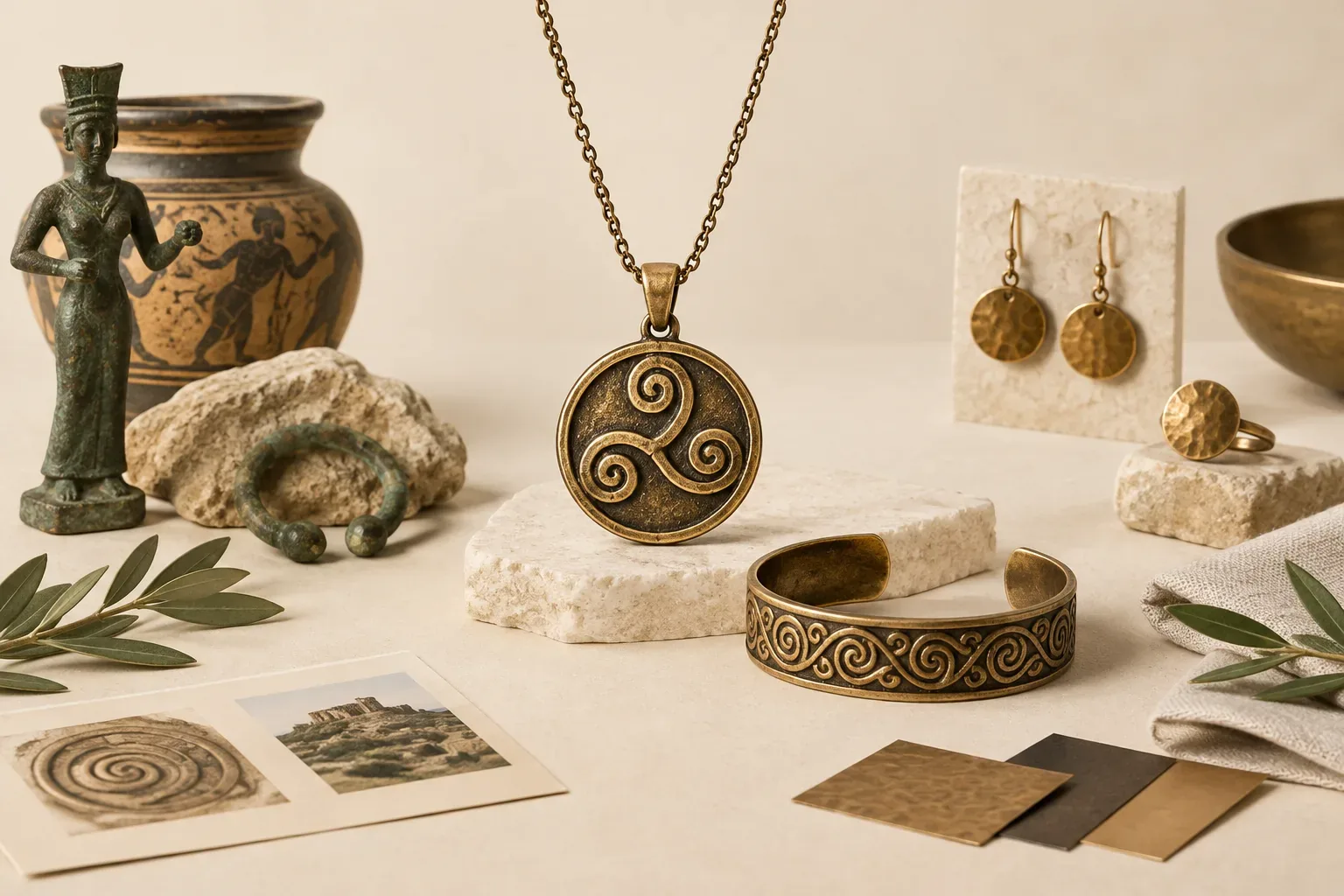
Motifs appear in bronze jewellery through several technical routes: directly cast shapes, repoussé (worked relief), engraving, filigree-like openwork, and application of separate decorative elements. Inlaid materials—glass, enamel, or stones—can be set into cast bezels or riveted settings. The visual language of motifs depends on technical possibilities (for example, the loss-wax casting process allows certain three-dimensional forms) and local aesthetic traditions.
Gemstones are documented as being set or mounted alongside bronze chiefly as cabochons, beads, or in simple bezel settings. The Victoria and Albert Museum’s resources on gemstones describe how different stones were chosen for hardness, color and availability and how they were shaped and mounted in metal settings. In bronze jewellery, you often find less elaborate faceting and more polished cabochon or bead work than in high-gold gem-setting traditions, although many exceptions exist depending on the maker.
How to judge quality and price
Start with the alloy and workmanship. Genuine bronze is primarily a copper–tin alloy, though historical and modern alloys vary. Quality markers are tight casting, crisp detail, even patina, and solid joins rather than visible gaps or weak soldering. Fine decorative work—well-executed relief, consistent thickness, and careful finishing—indicates higher craftsmanship and typically raises price.
Surface finish and patina matter for both aesthetics and durability. A stable, even patina that looks integrated with tooling is preferable to sudden flaky corrosion. Some contemporary pieces are intentionally patinated or lacquered to preserve color; others are gilt or plated. The Federal Trade Commission advises buyers to expect sellers to disclose plating, coatings, or treatments and to be transparent about imitation stones and enhancements, so ask for written disclosure if treatments are relevant to your decision.
Gemstones and inlays change price. If a bronze piece carries natural gemstones, the type, cut and condition of those stones will affect value in addition to the metalwork. Use the Victoria and Albert Museum’s guidance on gemstones to understand historical uses and typical stone forms, and rely on certified descriptions for contemporary purchases.
Provenance, rarity and maker also affect price. Museum-quality or historically significant items command higher prices because of age, provenance and rarity. Contemporary designer bronze that demonstrates exceptional technique or an artist’s reputation may also carry a premium.
Practical and respectful selection and gifting guidance
Match the piece to the wearer’s lifestyle and metal sensitivities. Bronze is robust and often suitable for everyday wear, but it can bind or discolor depending on skin chemistry and finishing. If the recipient has known allergies to copper alloys, choose pieces with protective linings or different metals. Test small, less expensive bronze items first if allergies are a concern.
Consider cultural and symbolic meanings carefully. Because bronze jewellery appears in many cultures, a motif that looks decorative to one person may carry cultural or religious connotations for another. If you are gifting a piece with a distinct motif, do a little research: consult museum references, reputable cultural sources or ask the maker about inspiration. The Victoria and Albert Museum’s contextual approach to jewellery history is a good starting point for understanding documented origins; do not assume that a motif’s modern interpretation is historically continuous.
Ask the seller about treatments and materials. The Federal Trade Commission recommends that sellers disclose plating, coatings, or simulated stones. Ask whether a bronze piece is solid alloy, plated over a base metal, or lacquered to preserve finish. Request condition notes and high-resolution images for vintage pieces, and ask for any available provenance for older work.
Think about occasion and longevity. For a daily-wear piece choose robust construction and a protective finish; for a sentimental gift select something with clear provenance or a maker’s mark and consider commissioning work from a known artisan if you want a meaningful bespoke item. For heirloom intent, choose higher-quality workmanship and documented provenance where possible.
Care and maintenance
Bronze can age attractively, but it can also develop uneven verdigris or surface deposits if left in moist or acidic conditions. Regular gentle cleaning with a soft cloth and dry storage will preserve finish; for stubborn deposits, consult a professional conservator for vintage or valuable items. For lightly finished contemporary pieces, a simple wipe and occasional re-lacquering by a jeweller can preserve appearance.
If a piece includes stones, enamel, or other inlays, follow the most delicate component’s care requirements. Always ask the seller about recommended maintenance and whether a piece has protective coatings that could be damaged by polishing.
Putting the guide into practice
When you are ready to buy, inspect photos and descriptions carefully and ask targeted questions: What is the alloy composition or hallmark? Is any part plated or coated? Are stones natural, treated, or simulants? Who is the maker, and is there any provenance? For vintage pieces ask about repairs and condition; for contemporary pieces ask about the maker’s techniques and production methods.
Use museums as context rather than prescriptive authority. The Victoria and Albert Museum provides invaluable documentation on how bronze jewellery was made and used in various contexts; use that information to inform respectful choices rather than to assume a single authoritative meaning. Keep personal meaning and wearability foremost for modern use.
Final thoughts
Bronze is a historically rich, technically varied, and accessible material. A careful buyer balances historical awareness, objective condition and craftsmanship, transparent disclosure about treatments, and sensitivity to cultural meanings. By combining museum-backed context with practical checks on alloy, workmanship and treatments, you can choose or gift bronze jewellery that is both beautiful and appropriate.
Frequently asked questions
How can I tell if bronze jewellery is solid bronze or plated?
Ask the seller for an alloy description or hallmark and for disclosure of any plating or coatings. The Federal Trade Commission recommends that sellers disclose plating and treatments. Visual clues include worn edges showing a different base metal and seams or flaking where a thin plate has worn away, but you should request written confirmation rather than relying on appearance alone.
Will bronze jewellery cause skin staining or allergic reactions?
Bronze can react with skin chemistry and cause temporary darkening or greenish stains because of copper content. Some people have sensitivity to copper alloys. If the wearer has known metal allergies, choose pieces with protective linings, different metals, or try a small test piece first. Protective lacquers can reduce skin contact but may wear over time.
Are gemstones in bronze jewellery less valuable than in gold settings?
The metal setting is only one factor affecting a stone’s value. Gemstone value depends on type, quality, cut and treatment. Bronze settings are common for cabochons and beads; check vendor documentation for whether stones are natural, treated, or simulants. The Victoria and Albert Museum’s resources can help you understand traditional stone types and forms used in bronze jewellery.
How should I care for vintage bronze jewellery?
Store vintage bronze in dry, stable conditions and avoid aggressive polishing that may remove patina or damage delicate inlays. For valuable or fragile items consult a professional conservator. For contemporary pieces follow the maker’s care instructions and avoid prolonged exposure to moisture and chlorinated water.
Is it culturally insensitive to wear motifs from other traditions?
Context matters. Some motifs have specific cultural or religious significance in their communities. Before wearing a clearly identifiable cultural motif, research its meaning and provenance—museum resources such as those from the Victoria and Albert Museum can provide context—and consider whether the item was made respectfully and with permission or collaboration when it reflects another culture.
How do I assess price fairness for a bronze piece?
Consider craftsmanship, condition, provenance, presence and quality of any stones, and whether the piece is designer or mass-produced. Compare similar items from reputable sellers and ask for documentation of materials and treatments. High-quality hand-made work and well-documented vintage or museum-provenance items will command higher prices.
Sources and further reading
- Bedazzled: A History of Jewellery — Victoria and Albert Museum
- An A-Z of Gemstones — Victoria and Albert Museum
- Buying Gemstones, Diamonds, and Pearls — Federal Trade Commission