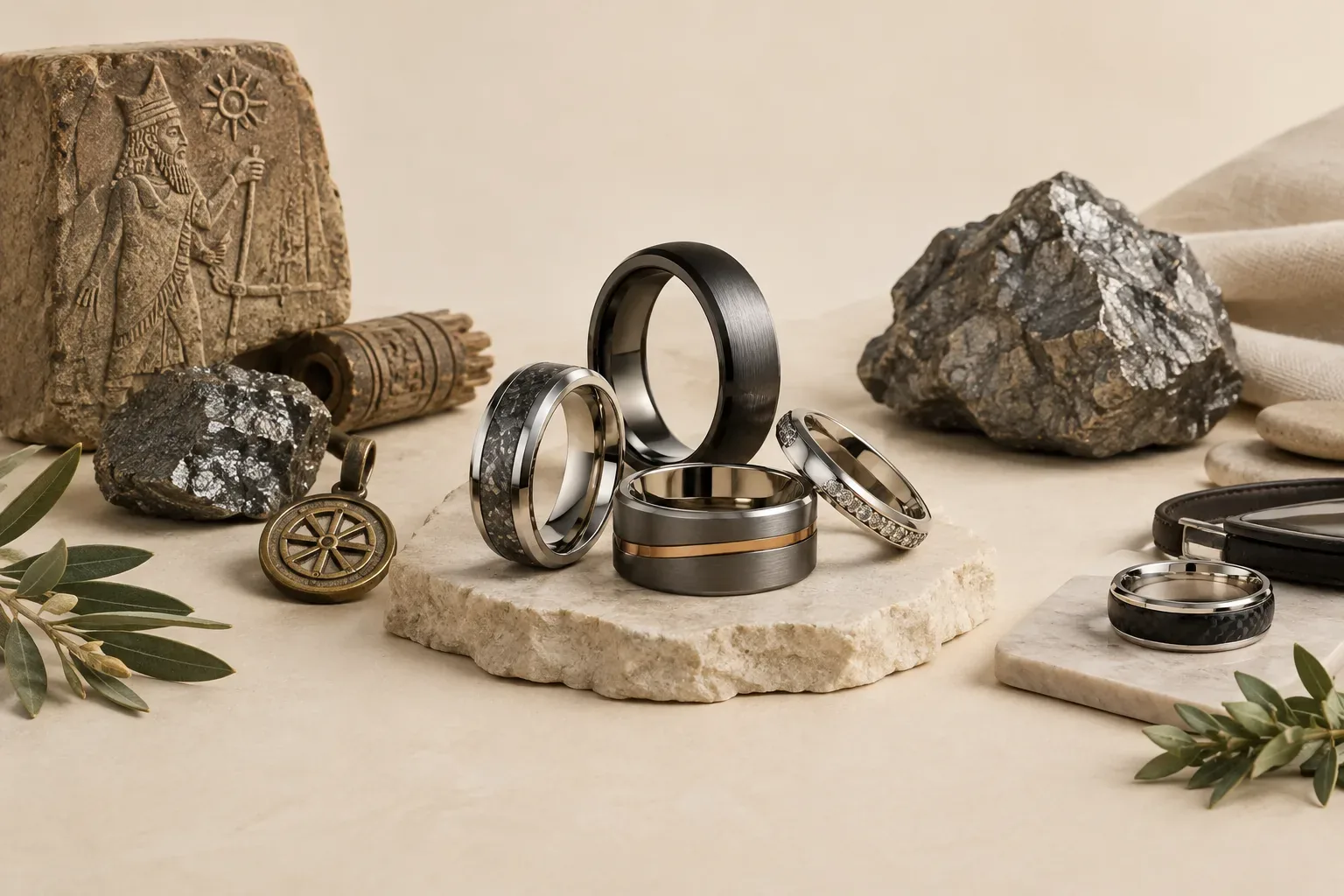
Meaning at a glance
Tungsten carbide is a modern material with no documented premodern cultural meanings in the standard museum histories; treat its symbolism as contemporary, verify material and treatment disclosures when you buy (per FTC guidance), and use practical checks—composition disclosure, return policy, warranty, sizing and finish—to choose pieces that fit your budget and life.
What the historical record shows (and what it does not)
Surveys of jewellery history stress how materials, techniques and meanings change through time and across societies. The Victoria and Albert Museum describes jewellery as a shifting field in which different metals, gemstones and motifs acquire social and personal significance in particular cultural moments. That body of museum scholarship documents centuries of use for precious metals and gemstones but does not record a premodern tradition or cultural symbolism tied specifically to modern industrial materials such as tungsten carbide.
Put plainly: authoritative museum overviews record how rings, stones and motifs carried meanings in particular cultures and periods, but they do not provide evidence that tungsten carbide had any symbolic role before it was used in modern manufacturing. Any claims that tungsten carbide carries a long cultural heritage should be treated as contemporary marketing or personal interpretation rather than documented history.
Documented historical meanings versus modern interpretations
When museums and scholars attribute meaning to a motif, they rely on dated, contextual evidence tied to a specific place and time. For example, the Victoria and Albert Museum’s collections and interpretation show how lockets, portrait jewellery and certain gemstones carried specific social or sentimental roles in Europe and elsewhere in particular centuries. That method requires primary evidence and provenance.
By contrast, modern pieces made from industrial materials can acquire meaning quickly through fashion, advertising, or individual sentiment. Those meanings are valid for the people who hold them, but they are contemporary, not archaeological. Distinguish between documented, culture-specific symbolism and recent, personal or commercial meanings when you interpret or present tungsten carbide pieces.
How modern materials and gemstones appear together in jewellery
The histories of jewellery show a long pattern: makers combine available materials and gem types to achieve visual effects and social signals. The Victoria and Albert Museum’s overview of gemstones explains how choice of stone and setting have long been central to design and meaning, and museum histories also trace how new materials and techniques alter style and social context.
In contemporary practice, designers often pair modern metals or composites with conventional gemstones or finishes to create contrast, durability, or lower cost. If a piece described as 'tungsten carbide with gemstone inlay' is offered, treat that as a design decision rather than a carryover of older symbolic meanings; the visual effect and the craftsmanship determine the piece’s appearance and how wearers perceive it.
Practical quality and disclosure checks (what to ask sellers)
Because modern jewellery relies on a mix of materials and treatments, insist on clear information from the seller. The U.S. Federal Trade Commission advises buyers to seek accurate disclosures about materials, treatments, imitation stones and enhancements. Ask the vendor to state the composition in plain language, list any coatings or plating, and declare whether gemstones are natural, treated or synthetic.
Request details about finish and wear: ask how the piece’s surface is achieved, what the seller’s experience is with that finish over time, and whether the finish is covered by warranty. Confirm practical policies: return period, resizing options, and what the warranty covers. If the seller cannot or will not answer these basic questions, treat the purchase with caution.
Price factors and comparing value
Price reflects a mix of material costs, craftsmanship, brand, design complexity and after-sale service. Because museum and consumer guidance show that context matters for perceived value, compare pieces by what the seller is offering in disclosure and service rather than by headline price alone.
When comparing similar-looking items, check composition statements, the presence of any gemstones and whether those gems are natural or synthetic, the seller’s return and warranty policies, and customer reviews about long-term wear. Transparent sellers who provide clear answers and good after-sales support usually represent better value than those offering lower prices but no information.
Choosing the right piece for use and gifting
Match the piece to how it will be worn. For everyday wear, prioritize clarity about durability, finish and warranty, and ask about maintenance recommendations. For a gift, consider the recipient’s style and practical needs: will they prefer a subtle band or a decorative piece that pairs with their usual jewellery? If you want the piece to have lasting sentimental value, attach your own meaning through inscription, presentation or pairing with a documented tradition.
Respect cultural and religious symbols when gifting. Because tungsten carbide does not have an established historical symbolism, avoid asserting an ancient cultural meaning for the material. If you wish to connect the gift to a cultural tradition or gemstone symbolism, consult reputable historical sources and be explicit about whether the association is historical or contemporary.
Care, maintenance and long-term considerations
Manufacturers and retailers vary in how they describe durability and care. Before purchase, ask for written care instructions and the seller’s recommendations for cleaning and storage. Confirm what the warranty covers and for how long, and whether routine maintenance is part of the service.
Because jewellery often becomes sentimental, document important purchase information: take photos, keep receipts and record any inscriptions or hallmarks. If you later want to trace provenance or confirm authenticity, these records will be useful to you or to a future buyer.
How to research meanings and provenance
If you want to attach historical meaning to any motif or stone, use museum resources and scholarly references to verify claims. The Victoria and Albert Museum provides accessible summaries of jewelry history and gemstone contexts that illustrate how meanings are grounded in evidence. For consumer protection questions about material disclosure and imitations, consult the Federal Trade Commission’s guidance on buying gemstones, diamonds and pearls.
When evaluating claims from sellers about historical symbolism, ask for documented sources. If a seller asserts that a material carries an ancient meaning, request the provenance or scholarly citation supporting that claim. If none is provided, treat the claim as a contemporary marketing story rather than established history.
Final takeaways
Tungsten carbide jewelry belongs to the recent history of material innovation in jewellery. There is no museum-documented premodern symbolism attached to it, so its meanings are contemporary, personal or commercial. Follow consumer-protection best practices: demand transparent disclosure about materials and treatments, compare service and warranty terms as part of value, and choose designs that fit the wearer’s lifestyle and aesthetic.
Frequently asked questions
Is there a long historical symbolism for tungsten carbide jewelry?
No reputable museum histories do not record a premodern cultural or symbolic tradition for tungsten carbide; its use and any symbolic associations are contemporary. For established historical meanings, consult museum sources that provide dated, contextual evidence.
How can I verify what I’m actually buying?
Ask the seller for clear, written disclosure of the item’s composition, any surface treatments or coatings, and the nature of any gemstones. The U.S. Federal Trade Commission advises buyers to obtain accurate disclosures about materials and treatments when purchasing jewellery and gemstones.
What should I check about returns and warranties?
Confirm the seller’s return policy, any time limits, and what the warranty covers in writing. Ask whether routine maintenance or finish renewal is included and whether resizing or repairs are offered, since these practical policies factor strongly into overall value.
Can I rely on marketing claims about ancient meanings?
Treat marketing claims that assign an ancient or cross-cultural history to modern materials with skepticism. If a seller asserts historical symbolism, request the specific scholarly or museum sources that verify the claim; without such evidence, consider the meaning contemporary or promotional.
Sources and further reading
- Bedazzled: A History of Jewellery — Victoria and Albert Museum
- An A-Z of Gemstones — Victoria and Albert Museum
- Buying Gemstones, Diamonds, and Pearls — Federal Trade Commission