Meaning at a glance
Stainless steel is a modern jewelry material whose social meanings have developed in contemporary contexts; this guide explains the documented history of jewellery as a changing art (per the Victoria and Albert Museum), separates historical meanings from modern personal interpretations, and gives actionable advice for choosing, valuing, wearing, and gifting stainless steel pieces while recommending buyers check seller disclosures about treatments and imitations (per the Federal Trade Commission).
Documented history and cultural context
Jewellery as an art and social practice has a long, documented history of changing materials and meanings. The Victoria and Albert Museum describes how communities across different periods adopted new materials and techniques and how those changes shifted what jewellery signified socially and economically. The V&A's overview supports the general point that when a new metal or finish becomes available, jewellers and wearers adapt it for both aesthetic and social uses rather than inheriting a single, fixed meaning.
Stainless steel itself is a twentieth-century industrial material. Because it arrived well after the historical periods that produced the ritual and symbolic uses of gold, silver, and gemstones, there is no documented premodern cultural or religious symbolism tied specifically to stainless steel in the sources used here. Any symbolic meanings that people attach to stainless steel today are therefore modern developments rather than continuations of an ancient tradition.
Separating documented historical meanings from modern interpretations
When assessing what a piece of stainless steel jewelry 'means,' it is important to distinguish two things: documented cultural meanings with historical evidence, and newer personal or fashion-based interpretations. The V&A documents long-standing meanings for certain objects and materials across historical periods, but it does not ascribe those meanings to stainless steel.
Modern associations—such as an industrial, minimalist, durable, or unisex aesthetic—are contemporary interpretations formed by designers, consumers, and subcultures over the last decades. These are legitimate and meaningful for individuals today, but they are not the same as historically attested cultural or religious symbolism. If you need a piece with a specifically recorded historical meaning, look to materials, motifs, and symbols that have documented histories in museum or scholarly sources rather than assuming that a modern metal inherits those histories.
How stainless steel appears in jewelry
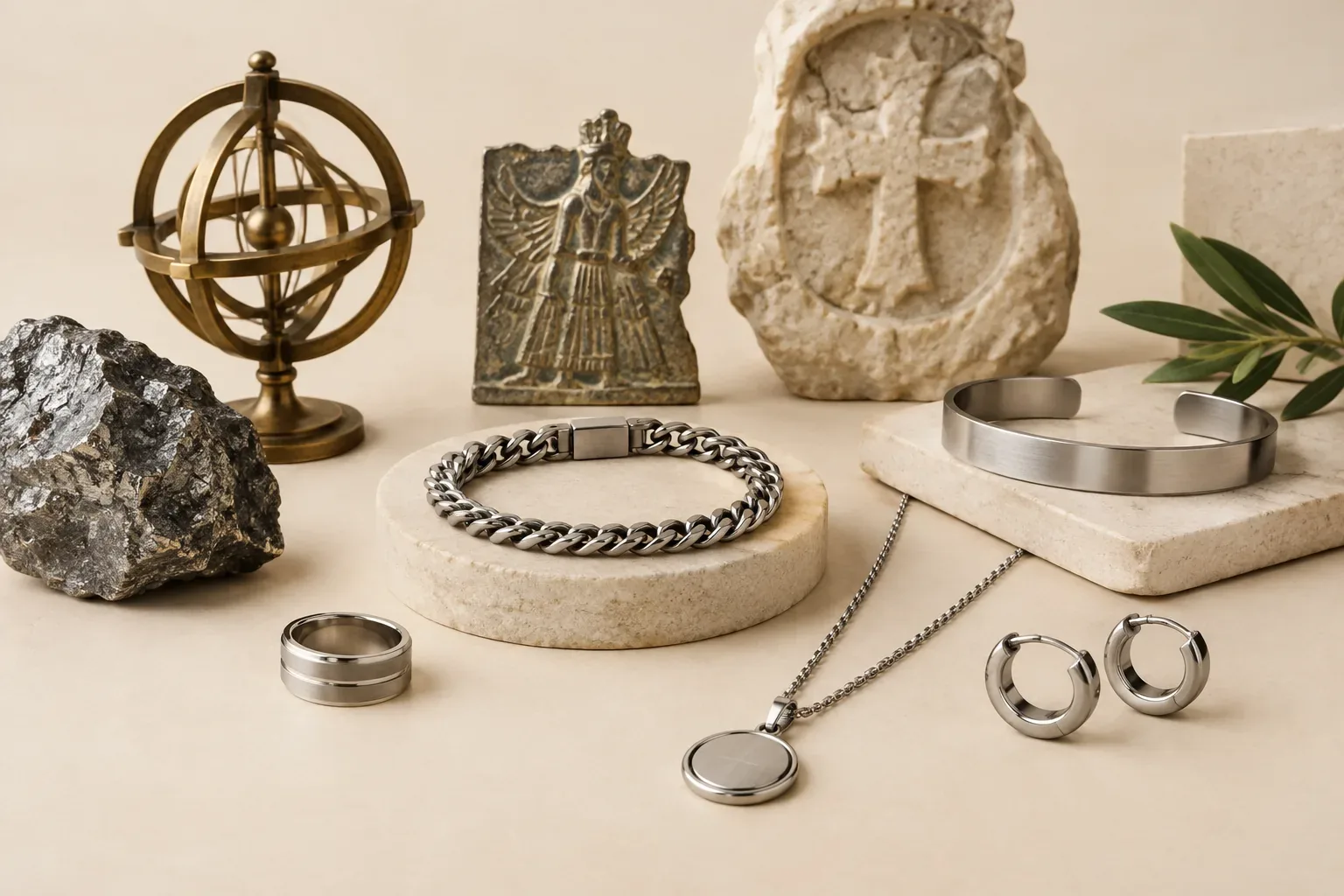
In contemporary jewelry, stainless steel is used across a variety of formats: chains and necklaces, rings, bracelets, bangles, earrings, watch cases and bands, and mixed-material pieces where steel frames or accents other metals and gemstones. Designers often use stainless steel for clean, geometric motifs and for pieces intended for daily wear because of its modern, low-ornament look.
Stainless steel can be combined with gemstones, enamel, inlays, and other metals. When gemstones appear in stainless steel settings, their selection and cut follow the same aesthetic and technical considerations as with any metal: proportion to the setting, secure mounting, and compatibility with daily wear. For historic gemstone meanings and identification, the Victoria and Albert Museum's resources on gemstones are helpful background, but note that the presence of a gemstone carries its own history independently of the metal used to set it.
Quality: what to inspect and ask about
Evaluate workmanship first. Look for a consistent finish, smooth edges, secure clasps and settings, and uniform links in chains. Rings should have an even profile and no obvious seams. Heft is a useful but not definitive cue; very lightweight pieces may be hollow or thinly made while overly heavy pieces can be uncomfortable.
Ask the seller for details about the stainless steel grade or alloy if available, the manufacturing process, and whether any surface treatments, coatings, or platings have been applied. The Federal Trade Commission emphasizes that sellers should disclose material treatments, imitations, or plating. When a piece is plated with another metal for color or finish, that should be clearly stated because plating affects durability and long-term appearance.
Check how gemstones, if present, are described. Clear identification—natural versus lab-grown, treatments, and whether stones are simulants—matters for both value and care. Refer to authoritative gemstone guides to understand basic distinctions and historical contexts for specific gems.
Price and value considerations
Stainless steel generally sits at lower price points than precious metals because its raw material value differs and because it is widely manufactured. However, price is not a reliable proxy for quality or suitability: well-designed stainless steel jewelry with superior finishing and sturdy construction can be worth a higher price than poorly executed pieces of a more expensive metal.
Factor in design complexity, brand or maker reputation, craftsmanship, presence of gemstones or inlay work, and any specialized surface treatments when judging price. Also consider long-term wearability: a well-made piece you will wear daily may represent better value than an inexpensive item that fatigues or discolors quickly. If a deal seems unusually cheap for what is claimed, request documented disclosure of materials and treatments from the seller, in line with consumer protection guidance.
Best uses and styling
Stainless steel is well suited to contemporary, minimalist, industrial, and unisex styles. It pairs easily with casual and smart-casual wardrobes and is often chosen for everyday pieces such as simple chains, signet-style rings, or cuff bracelets. Because of its aesthetic neutrality, it can be mixed with leather and textile accessories or layered with other metals for contrast.
For formal or highly traditional looks tied to historic symbolism—such as certain religious or ceremonial objects—precious metals and historically documented motifs may be preferable if the wearer seeks continuity with older traditions. If styling a stainless steel piece with gemstone symbolism, be clear whether the symbolic meaning arises from the stone's history or from contemporary styling.
Care, maintenance, and long-term considerations
Care needs depend on finish and any applied coatings. Some stainless finishes may resist everyday wear and water exposure better than plated alternatives. If a piece is treated or plated, learn how the surface behaves with soaps, perfumes, and abrasion, and whether re-plating or refinishing is needed over time. Ask the seller for care recommendations specific to the item.
If you have metal sensitivities, request clear information about alloy composition and any internal coatings. While many buyers find stainless steel comfortable for daily wear, individual reactions vary and should be checked with the seller or tested in person where possible.
Respectful selection and gifting guidance
When buying stainless steel jewelry as a gift, consider the recipient's style and whether they value traditional materials or prefer modern aesthetics. If the gift is meant to mark a formal milestone with historical or religious significance, verify whether stainless steel is an appropriate choice for the recipient's cultural or religious norms. For gifts intended as personal tokens rather than ritual objects, stainless steel can be an excellent, practical, and durable option.
Communicate meaning respectfully. If you intend a piece to carry symbolic weight—such as a promise or remembrance—explain the meaning in your own words rather than asserting that the metal itself carries a long historical meaning. If the recipient cares about provenance, provide documentation about the maker, materials and any gemstone authentication. For personalized or engraved pieces, prioritize secure engraving and comfortable fit, and ensure returns or resizing policies are clear before purchase.
Final checklist before purchase
Before you buy, confirm the seller’s disclosure about material composition and surface treatments, inspect construction and finish, ask about stone identification when applicable, and review the return, resizing, and care policies. Use reputable sellers who provide clear, written information and, when applicable, third-party or laboratory reports for gemstones. When in doubt about any claim, request documentation in writing.
Frequently asked questions
Is stainless steel jewelry hypoallergenic?
Allergy responses vary between individuals. Ask the seller for the alloy composition and any surface coatings; if you have a known sensitivity to certain metals, request that information in writing before purchase or test the piece briefly in person.
Does stainless steel tarnish or require special care?
Care depends on the finish and whether the piece is plated or coated. Untreated stainless finishes are commonly marketed for low maintenance, but plated surfaces can wear. Confirm care instructions and disclosed treatments with the seller to understand long-term maintenance.
Can gemstones be set in stainless steel and still be valuable?
Yes, gemstones can be set in stainless steel; the value depends on the stones themselves, the quality of the setting, and the overall craftsmanship. For gemstone identification and historical context, consult authoritative guides and request clear documentation from the seller.
How should I check a seller’s claims about material or plating?
Request written disclosure of material composition, treatments, and any plating. The Federal Trade Commission recommends sellers disclose treatments and imitations, so ask for clear statements and, where applicable, third-party test reports or detailed product descriptions.
Is stainless steel a good choice for a meaningful or symbolic gift?
It can be, depending on the recipient’s taste and the intended meaning. Because stainless steel lacks premodern religious or cultural symbolism, attach meaning through design, engraving, or the gift’s context, and ensure the choice respects the recipient’s cultural preferences for ceremonial or ritual gifts.
Sources and further reading
- Bedazzled: A History of Jewellery — Victoria and Albert Museum
- An A-Z of Gemstones — Victoria and Albert Museum
- Buying Gemstones, Diamonds, and Pearls — Federal Trade Commission