Meaning at a glance
Explain the documented history and changing contexts of the bivalve fossil jewelry buying guide motif, separate cultural or religious evidence from later popular interpretations, and give practical guidance for choosing and wearing the motif in modern jewelry.
What the historical record shows (and what it does not)
Museum research and exhibitions emphasize that jewelry has long reflected changing tastes, technologies, and social contexts rather than a single, unchanging symbolic system. The Victoria and Albert Museum’s survey of jewellery history notes that makers repeatedly drew on the natural world, scientific collecting, gemstones, and new materials as sources of motif, status, and fashion. That broad institutional perspective is the safest starting point for understanding fossils in jewellery: references to shells, minerals, and natural specimens appear throughout European and global decorative traditions as part of wider stylistic and cultural shifts, not as a single uniform meaning.
Specific documentary evidence tying bivalve fossils to a single, ancient religious or cultural meaning is scarce in the major museum overviews. Where museums like the V&A discuss gemstones and materials, they emphasise provenance, material identification, and changing uses over time rather than asserting universal symbolic values for particular natural objects. In short, institutional history supports that natural-history motifs—including shells and, by extension, fossilized shells—have been used for decorative and intellectual reasons at different times, but the published museum record does not establish a single, cross-cultural symbolic meaning for bivalve fossil jewellery.
Separating documented meanings from modern personal interpretations
Documented meanings: When historians and curators discuss jewellery motifs, they generally locate those meanings in concrete cultural contexts—fashion, status, commemoration, scientific interest, or local trade practices—rather than claiming universal spiritual significance. The V&A’s work shows that gemstones and natural motifs must be read in context: a shell motif in a seventeenth‑century locket will carry different associations than a Victorian natural history pendant or a contemporary design referencing marine conservation.
Modern personal interpretations: Many wearers today ascribe personal or symbolic meanings to bivalve fossils—connections to the sea, ideas of longevity or deep time, or associations with scientific curiosity. Those modern attributions are valid as personal or contemporary cultural meanings, but they differ from documented historical uses. Treat modern symbolic interpretations as contemporary layers added to a motif that historically functioned as material culture, aesthetic reference, or collector’s object.
How bivalve fossils and related motifs appear in jewellery
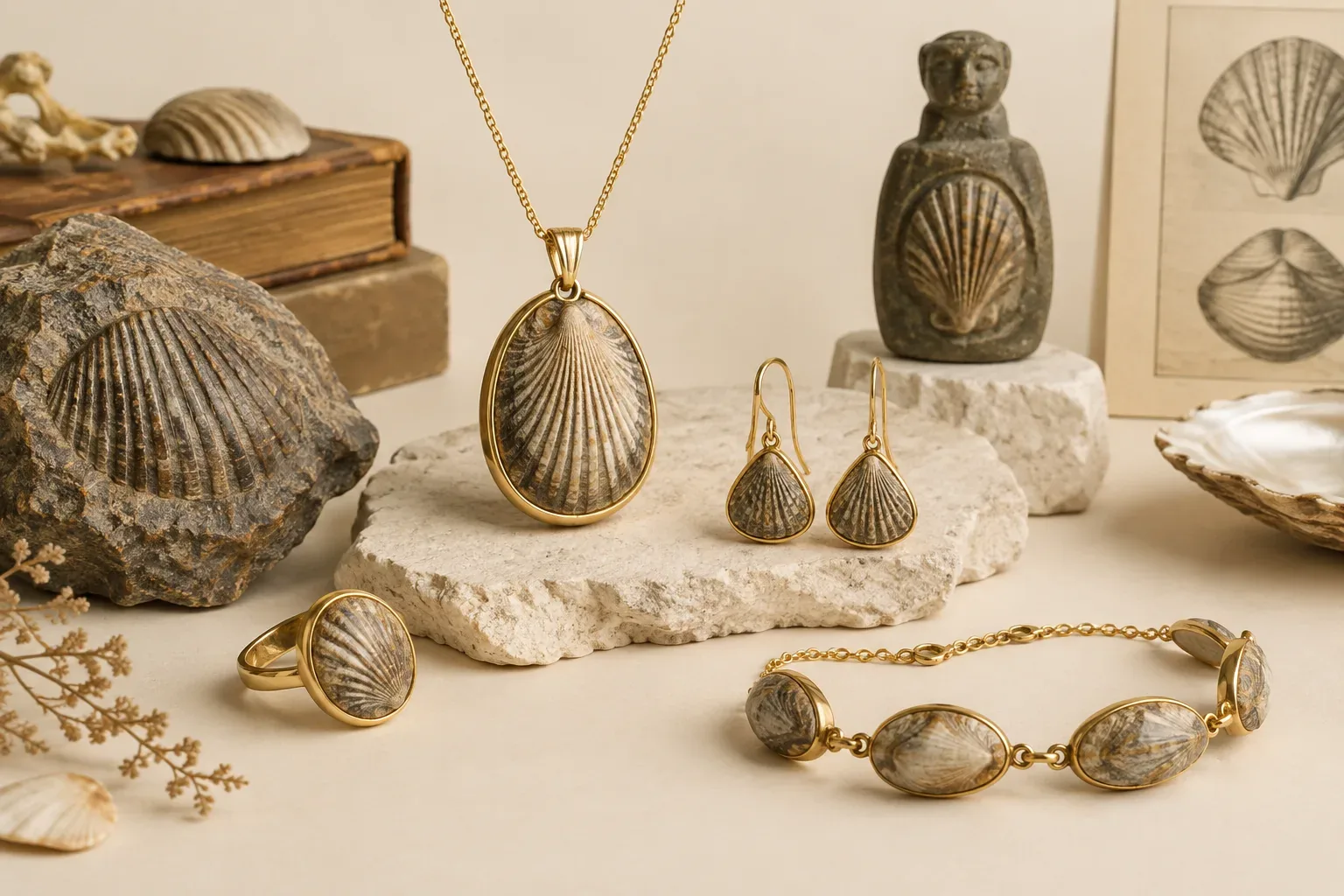
In modern jewellery markets you will encounter bivalve fossils in several forms. Whole fossil shells can be mounted as pendants or brooches and set into metal bezels. Thinly sliced cross-sections are sometimes polished into cabochons and used like other opaque gem materials. Makers also embed smaller fossil fragments in resin to stabilise them and create wearable shapes. Separately, shell motifs—stylised representations of bivalves carved in gemstones, metalwork, or intaglio—appear throughout historical and contemporary pieces; museums note that motif and actual specimen can both circulate as decorative language.
Materials paired with fossil bivalves include silver and gold mounts, oxidised or patinated finishes for a vintage look, and modern bases such as acrylic or resin when the fossil is brittle. When gemstones appear alongside fossils, museum guidance on gem identification is relevant: curators urge buyers to understand the material they are purchasing and to ask about treatments or stabilising methods.
Authenticity, treatments, and imitation — what to ask sellers
Treatments and stabilisation are common with fragile natural specimens. The Federal Trade Commission (FTC) advises that sellers should disclose significant treatments, enhancements, or whether a product is a composite or imitation. Ask sellers directly whether a fossil has been stabilised with resin, dyed, repaired, or assembled from multiple fragments. For fossils presented as cut and polished stones, request information on cutting, backing, or any epoxies used.
Request provenance and documentation when available. Provenance might include the region or formation where the specimen was found, whether it came from a reputable dealer or estate, and any laboratory or conservation reports. A confident seller should be able to describe the fossil’s geological origin in general terms, explain any conservation or stabilisation work done, and confirm whether the piece is natural, treated, or a replica.
Verifying material and condition
Use simple visual checks before purchase: look for signs of modern repair (visible adhesives, uneven seams), consistent surface texture where the fossil meets metal, and suspiciously uniform coloration that might indicate dye. When the seller claims a polished cabochon or slice is an authentic fossil, ask whether it was dyed or impregnated with stabilising resin—both are common and need disclosure under FTC guidance.
For higher-value pieces consider professional verification. Museums and reputable dealers can recommend independent appraisers or laboratories that perform material identification and report on treatments. If a seller resists independent verification or is vague about treatments and origin, treat that as a red flag.
Ethical and cultural considerations when buying or gifting
Respect local laws and collecting ethics. Fossils are subject to national and regional heritage laws in many countries; responsible dealers will avoid offering material that was removed illegally from protected sites. If provenance is unclear or the seller cannot provide a credible history, consider choosing a piece with transparent sourcing or a contemporary design inspired by bivalves rather than an unproven fossil specimen.
When gifting, be mindful of the recipient’s values. Someone with an interest in palaeontology, marine science, or natural history may appreciate authentic specimens and documentation, while someone who prefers symbolic meaning may value a stylised shell design or a sustainably produced modern piece. Pairing the gift with context—such as a note about where the fossil came from or why the motif appealed to you—makes the gesture more respectful and meaningful.
Practical care and maintenance
Fossils are mineralised organic material and can be more brittle or porous than traditional gemstones. Avoid exposure to household chemicals, perfumes, and prolonged immersion in water. Clean gently with a soft, dry cloth; if necessary, use a barely damp cloth and dry immediately. Do not use ultrasonic cleaners, steamers, or harsh abrasives unless a conservator has confirmed the piece is stable for those methods.
Store fossil jewellery separately to prevent abrasion and sudden impacts, and consider keeping fragile pieces in padded boxes or cloth pouches. If a fossil has a visible stabilising resin or adhesive, monitor it for changes (yellowing or softening) and consult a conservator for conservation rather than attempting DIY fixes.
Selection checklist for buyers
Prioritise transparency: Ask about treatments, stabilisation, and provenance. Look for sellers who describe materials and disclose enhancements clearly, in line with consumer guidance from the Federal Trade Commission.
Match piece to purpose: Choose a robustly mounted fossil for everyday wear, a polished slice or resin-stabilised piece for occasional use, or a stylised representation if you value symbolic meaning or conservation-minded production.
Consider documentation and conservation: For higher-value purchases, request or seek independent verification and choose appropriately for the recipient’s interests and ethics.
Further practical resources on this site
If you want to explore how motifs function in cultural and historical jewellery more broadly, see our 'Cultural & Historical Jewelry' category. For gift advice and selecting meaningful pieces, consult our practical gift guide on choosing meaningful jewelry. If you want a different kind of sentimental object, our history of lockets explains how portrait and memory jewellery have been used. Finally, our guide on researching jewelry symbols will help you verify the history and meaning of motifs you encounter.
Frequently asked questions
How can I tell if a bivalve fossil in jewellery is real?
Ask the seller about provenance, treatments, and stabilisation. Look for visible repairs, adhesives, or uneven seams. Request written disclosure of any dyes or resin impregnation; for higher-value items, seek independent verification from a qualified appraiser or laboratory.
Are fossilised shells treated differently from gemstones?
Yes. Fossils are often stabilised with resins or adhesives because they can be porous or fragile; such treatments should be disclosed. Gemstone guidance on identification helps, but fossils may require different conservation approaches, so ask specifically about stabilisation and care.
Can I wear fossil jewellery every day?
That depends on how the piece is mounted and whether the fossil was stabilised. Robust metal mounts and properly stabilised pieces are more suitable for frequent wear. Fragile, untreated specimens are best reserved for occasional wear and extra-care storage.
Is buying fossil jewellery ethical?
Ethical considerations depend on provenance and local laws. Reputable sellers will avoid offering fossils removed illegally from protected sites and should provide credible sourcing. If provenance is unclear, consider choosing a modern design inspired by shells or a piece with transparent sourcing.
What should I ask a seller before I buy?
Ask about geographic origin, whether the fossil was stabilised or treated, any adhesives or resin used, and whether the seller can provide documentation of provenance or independent verification. Also ask about returns, repairs, and recommended care.
Sources and further reading
- Bedazzled: A History of Jewellery — Victoria and Albert Museum
- An A-Z of Gemstones — Victoria and Albert Museum
- Buying Gemstones, Diamonds, and Pearls — Federal Trade Commission