Meaning at a glance
There is little direct historical evidence that any pre-modern culture used foraminifera specifically as a jewelry motif; instead, natural-history materials such as shells and fossils entered jewelry in different eras (notably Victorian natural-history fashions), and contemporary foraminifera jewelry is a modern, personal-symbolism choice. Choose pieces with transparent identification and sourcing, respect scientific and cultural contexts, and follow consumer-disclosure guidance when buying or gifting.
Quick answer
Documentary sources do not show a long, continuous cultural tradition of using foraminifera as a distinct symbolic motif in jewelry. Historical use of shells, fossils, and natural-history specimens in personal ornamentation does occur in documented museum collections and jewelry histories, and modern makers now foreground microscopic foraminifera shapes or fossil-bearing stones as aesthetic or personal symbols. If you want foraminifera jewelry, treat its meaning as contemporary and individual; verify material, disclosure, and provenance when buying or gifting.
What the historical evidence actually shows
The recorded history of jewelry repeatedly shows fashions changing with social contexts and new materials, rather than a stable, universal symbolism attached to a single microscopic organism. The Victoria and Albert Museum describes jewelry history as shaped by changing tastes, technologies, and access to materials, and it documents periods when natural specimens and fossil materials entered decorative use rather than naming foraminifera specifically.
In particular, museum material and curatorial interpretation link the 19th century’s enthusiasm for natural history with increased use of shells, minerals, and fossils in personal ornament. That period’s collectors, scientific societies, and popular naturalists put plants, shells, and fossil fragments into lockets, brooches, and mounted objects as curiosities and mementos. These documented shifts in jewellery and material use are described by the Victoria and Albert Museum as part of the changing social context of adornment.
Beyond these general patterns, there is no authoritative published record in the approved museum literature that identifies a named ancient culture or ritual tradition that carved or stylized foraminifera as an independent emblem in the way that, for example, some plants or religious symbols were adopted and named.
Separating documented historical meanings from modern interpretation
Documented historical meanings attached to shells and fossils in jewelry tend to be practical or sentimental rather than metaphysical. Museums and curators show that such elements were often chosen as mementos, souvenirs of travel, signs of scientific interest, or fashionable novelties tied to the era’s fascination with natural history. These are social and material contexts recorded in collections and exhibitions, not universal symbolic systems.
Modern makers and wearers, however, frequently project contemporary ideas onto microscopic or fossil motifs. Foraminifera-themed pieces today are often framed by makers or buyers as symbols of deep time, marine ecology, scientific curiosity, or personal connection to the sea. Those are valid personal meanings but they are modern interpretations rather than documented, culture-wide historical meanings. Treat contemporary attributions as individual or local cultural readings rather than universal facts.
How foraminifera and related motifs appear in jewelry today
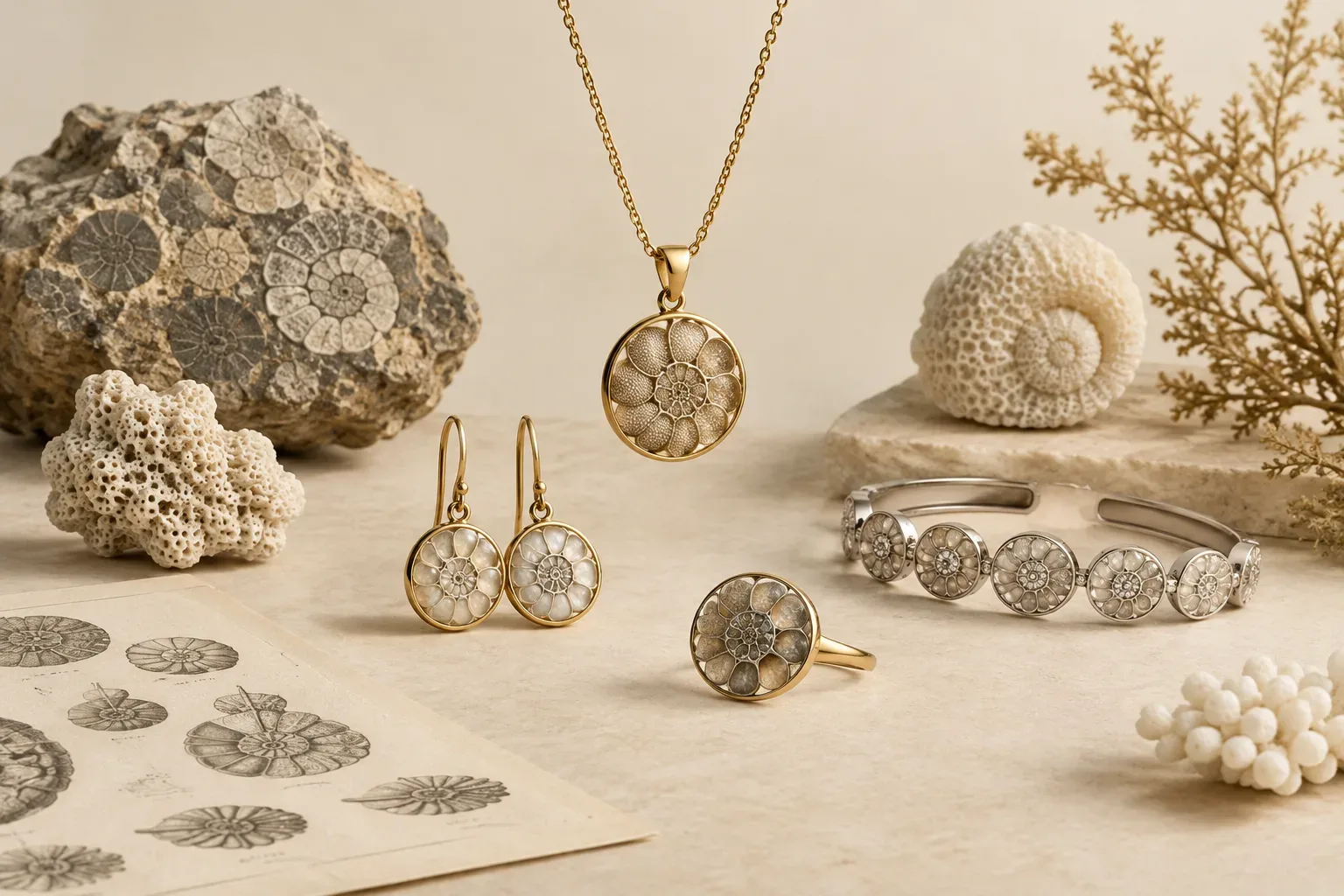
Contemporary jewelry makers use a few practical routes to make foraminifera visible or suggestive in wearable pieces. One method is to set or polish fossiliferous limestone, chalk, or other rocks that contain visible microfossils so that the patterns of tiny shells are exposed as cabochons or in flat insets. Another approach is to reproduce the microscopic forms as engraved or cast motifs in metal, to laser-etch images onto metal or stone, or to embed photographed or scanned images in resin.
Gemstones and fossil-bearing materials used this way are handled under the same identification and description frameworks as any other gem or ornamental material. The Victoria and Albert Museum’s guidance on gemstones explains how gem types and historical contexts matter for identification and interpretation, and museum practice shows that collectors and curators document the material itself separately from the motif applied to it.
Because many modern makers also use composite techniques—resin casting, printed imagery, stabilized fossils, or assembled components—buyers should expect a range of materials and techniques. Some pieces will be authentic polished fossil stone; others will be scientific illustration mounted in a setting; still others will be wholly symbolic metalwork inspired by the shapes of foraminifera.
Material authenticity, disclosure, and treatments
When a piece is sold as containing a fossil or a particular gemstone, sellers are legally and ethically expected to disclose treatments, enhancements, or imitations. Consumer guidance from the U.S. Federal Trade Commission explains that material-treatment and imitation disclosure are part of responsible selling practices. Ask sellers whether a fossil-bearing cabochon is natural, stabilized, dyed, or a cast reproduction and whether any gemstone components have been treated.
A transparent seller will describe the base material, any stabilization or resin treatments applied to fragile fossils, and whether an image is an original fossil or a reproduction. If provenance or scientific relevance matters to you or the recipient, request provenance documentation or a clear statement describing how the piece was made.
Choosing and gifting with respect
If you are choosing or gifting foraminifera-themed jewelry, begin by considering the recipient’s interests. A scientist, teacher, or natural-history enthusiast may value an accurate specimen or documentation, while someone attracted to marine life might prefer a stylized piece that captures the form without claiming scientific authenticity.
Respect scientific and cultural contexts by avoiding claims of universal symbolism. Do not attach invented ancient meanings to a piece and present them as historical fact. If you wish to ascribe a particular meaning when gifting—such as ‘a reminder of patience and deep time’—present that as your personal or the gift-giver’s intent rather than an unbroken cultural tradition.
Prioritize reputable sellers and clear descriptions. Ask whether the fossil material was ethically collected and whether stabilizing treatments were applied. Where price, durability, or wearability is a concern, discuss alternatives such as cast or engraved metal motifs that reproduce foraminifera forms without relying on fragile fossil material.
Care, wear, and long-term preservation
Fossil-bearing stones and delicate inlays may be more fragile than common gem materials. Clean pieces gently with a soft cloth and mild soap and avoid ultrasonic cleaners or harsh chemical treatments unless a qualified conservator or jeweler recommends them. Store fossil or resin pieces away from direct sunlight to reduce the risk of fading or heat damage.
For pieces incorporating mixed media—metal settings with fossil insets, resin, or printed imagery—follow the care guidance for the most delicate component. If a piece has been stabilized with resin or adhesive, ask the maker for cleaning and repair recommendations and keep documentation in case future conservation is needed.
Final practical checklist
Before buying or gifting, verify the seller’s description of materials and treatments, request provenance or process details if scientific authenticity matters, and decide whether the recipient prefers accurate specimens or stylized motifs. Treat the piece’s meaning as a personal or contemporary statement rather than a recovered ancient symbol, and follow basic care guidelines to preserve delicate fossil elements.
When in doubt, choose clear communication and ethical sourcing: those practices protect both the wearer’s expectations and the scientific or natural specimens involved.
Frequently asked questions
Were foraminifera used as jewelry motifs in ancient cultures?
There is no documented evidence in the approved museum literature that ancient cultures deliberately used foraminifera as a named, standalone motif. Museums record the use of shells, fossils, and natural curiosities in jewelry at certain times—especially during the 19th-century interest in natural history—but specific references to foraminifera as a cultural emblem are not supported by the cited sources.
How can I tell if a jewelry piece actually contains fossilized foraminifera?
Ask the seller for a clear description of the material and any scientific or provenance documentation. Request whether the stone was stabilized or treated, whether the image is an original fossil fragment or a reproduction, and any lab or curatorial notes if available. Honest sellers should disclose treatments or imitations in line with FTC guidance.
Is it respectful to gift foraminifera jewelry with a special meaning attached?
Yes, provided you present the meaning as your personal intent rather than as an asserted historical fact. Explain why the motif matters to you or the recipient, and avoid inventing ancient explanations. If the piece involves scientifically collected material, choose ethically sourced items and transparent makers.
What should I know about caring for fossil or resin insets in jewelry?
Clean fossil-bearing or resin components gently with a soft cloth and mild soap. Avoid ultrasonic cleaners, high heat, or strong solvents unless a conservator or jeweler confirms they are safe. Store the piece protected from direct sunlight and extreme humidity.
Where can I learn more about the historical use of natural specimens in jewelry?
Museum collections and exhibitions that document changing jewellery fashions provide the best evidence-based context. The Victoria and Albert Museum’s resources on jewellery history and gemstones are recommended starting points for understanding how natural materials entered decorative use.
Sources and further reading
- Bedazzled: A History of Jewellery — Victoria and Albert Museum
- An A-Z of Gemstones — Victoria and Albert Museum
- Buying Gemstones, Diamonds, and Pearls — Federal Trade Commission