Meaning at a glance
Explain the documented history and changing contexts of the bivalve fossil motif, separate cultural or religious evidence from later popular interpretations, and give practical guidance for choosing and wearing the motif in modern jewelry.
Quick answer
The bivalve fossil jewelry meaning is best understood as a motif with shifting contexts rather than a single, universal symbolism: museum histories show that natural forms like shells and fossils have been used as decorative, status, and sentimental elements across many periods, while modern wearers often layer personal meanings such as connection to the sea, deep time, or environmental concern. This article explains what is documented in museum surveys, distinguishes established historical usage from contemporary personal interpretation, describes how the motif appears in jewelry, and offers practical, respectful guidance for choosing and gifting bivalve fossil pieces.
What the historical record shows
Surveys of jewellery history compiled by major museums, notably the Victoria and Albert Museum, show that artisans have long borrowed shapes and materials from nature and that those natural motifs have meant different things in different cultures and periods. The V&A’s overview of jewellery’s history emphasizes changing social contexts: ornament could signal status, indicate affiliation, carry sentimental value, or simply follow aesthetic fashions. Museum accounts therefore frame natural motifs as polyvalent—useful for decoration, identity, or memory—rather than ascribing a single, unchanging religious or symbolic meaning.
When we look specifically for documented uses of fossils or shell forms, museum collections and exhibitions commonly record objects made from or depicting shells, mother-of-pearl, and other marine materials across periods that include antiquity, medieval and Renaissance Europe, and the modern era. The V&A’s resources on gemstones and materials also discuss how naturally occurring materials have been identified and prized in jewellery, which helps explain why jewelers worked with fossilized shells and related materials when they were available and fashionable.
Which cultures and periods used natural motifs (including shells and fossils)?
Museum histories such as those presented by the Victoria and Albert Museum trace the use of natural motifs broadly across time and place. Artisans in the Mediterranean world, medieval and Renaissance Europe, and later European fashionable periods repeatedly adopted marine forms and other organic shapes in jewellery. The specific meaning assigned to those motifs changed by time, region, and social class: a shell or fossil might be a luxury material in one context, a sentimental memento in another, or a fashion motif in a third.
Importantly, the V&A’s history-oriented treatments do not support any single universal interpretation for a bivalve fossil motif across all these cultures. Where museum documentation exists, it tends to record form, material, and context (for example, whether an object was a high-status pendant or a popular keepsake) rather than a single cross-cultural symbolic definition.
Documented historical meanings versus modern personal interpretations
Documented historical meanings recorded in museum surveys tend to be specific to context: a material could indicate wealth when it was rare, signal trade connections when exotic shell types appeared in a local market, or act as sentimental jewelry when incorporated into mourning or memory objects. The V&A emphasizes social context and change over time rather than fixed symbolism, so the historically documented evidence supports a contextual, not universal, reading of any natural motif.
Modern wearers and designers often layer new meanings onto bivalve fossils that are not directly documented in older museum records. Contemporary interpretations commonly include ideas of deep time, fossil as tangible evidence of Earth’s history, personal attachment to the coast, or environmental awareness and conservation. These modern meanings are personal and cultural interpretations rather than claims grounded in the historical museum record; they are valid for wearers today but should be described as contemporary meanings rather than historical fact.
How the bivalve fossil motif appears in jewelry
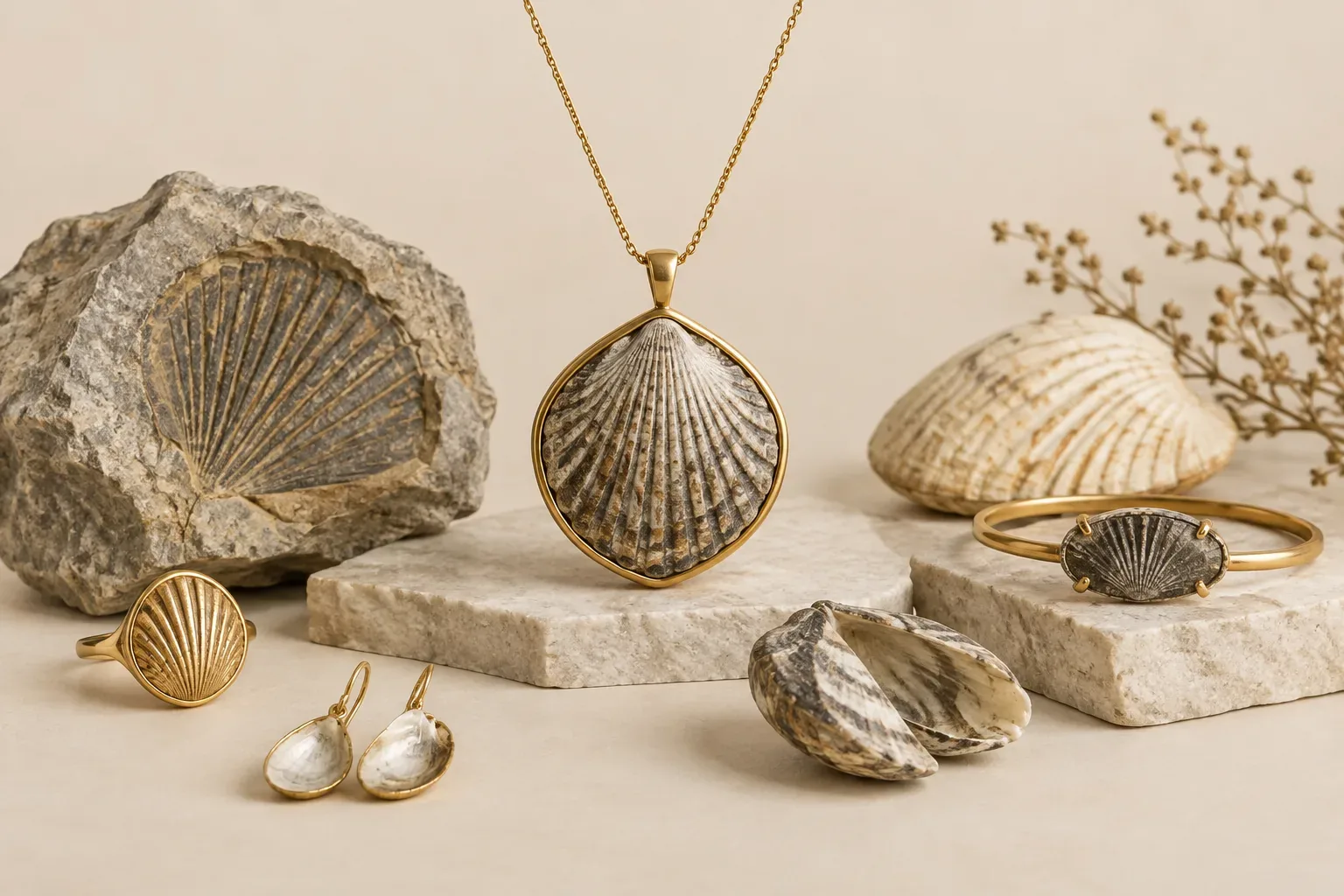
Jewellers use the bivalve fossil motif in several ways. Designers may set whole fossil specimens or polished sections as cabochons and pendants, carve fossil outlines into metalwork as silhouettes or charms, or reproduce the shape in cast metal, enamel, or cut gemstones. Fossilized shell material can also be worked into beads or inlays and can be combined with other materials such as silver, gold, or contemporary resins.
Materials related to bivalve fossils appear in different guises in jewellery. Mother-of-pearl and pearl are related marine-derived materials that have long been used in ornament; the Victoria and Albert Museum’s A–Z of Gemstones explains how such materials are identified and placed in historical context. In some cases, fossilized shells can resemble or be mistaken for other polished organic or inorganic materials, so proper identification is important for collectors and buyers.
Recognizing treatments, imitations, and disclosure practices
When buying bivalve fossil jewelry or jewelry that mimics fossil forms, be aware of treatments and imitations and insist on clear disclosure. The U.S. Federal Trade Commission’s guidance on buying gemstones, diamonds, and pearls emphasizes that sellers should disclose treatments, enhancements, and imitations that materially affect value or use. Ask sellers whether a fossilized piece is natural, stabilized, dyed, resin-impregnated, or a cast reproduction, and request documentation or clear labeling when available.
If a piece is described as 'fossil' because it carries a fossil motif rather than being made from actual fossil material, that should be explicit. Responsible sellers and reputable dealers will provide honest provenance and treatment information. This transparency helps you assess value, decide how to care for the piece, and ensure the item matches the symbolic or aesthetic intent you have in mind for gifting or personal wear.
Practical, respectful selection and gifting guidance
Decide whether you want genuine fossil material, a representation of a bivalve shape, or a modern reinterpretation. Genuine fossil specimens set in jewellery provide a tactile connection to deep time but may be more fragile or require special care. Reproductions and cast motifs are often more durable and less expensive and can be appropriate where symbolic shape matters more than the original material.
Ask questions about provenance and treatment before you buy. Confirm whether the piece is made from naturally fossilized shell or from related marine materials such as mother-of-pearl, and ask the seller to explain any stabilization or enhancements. Use the FTC’s buying guidance as a baseline for what sellers should disclose about treatments, imitations, and origin.
Respect cultural context when gifting. Because natural motifs have meant different things across cultures and eras, choose wording that makes your intent clear. If you are giving a fossilized piece to signal an interest in geology or conservation, say so. If you are gifting in a cultural or religious context where certain symbols may have specific meanings, take time to research or ask about those meanings—see our internal guide 'How to Research the Meaning of a Jewelry Symbol' for a research framework.
Consider durability and lifestyle. If the recipient leads an active life, prefer robust settings and treated or synthetic representations that can handle daily wear. For special-occasion or display pieces, genuine fossils set in fine metal can be a meaningful heirloom choice.
Care, conservation, and display
Fossilized materials can be sensitive to acids, extreme heat, or ultrasonic cleaners, depending on their composition and any stabilizing treatments they have undergone. When in doubt, clean fossil jewelry gently with a soft cloth and mild soapy water and avoid harsh chemicals or mechanical cleaning methods. Request care instructions from the seller and consider periodic professional checks for settings and stabilizing adhesives.
For display or long-term storage, keep fossil jewelry away from direct sunlight and high humidity if possible. Proper storage will help preserve both the fossil material and any metalwork or settings. If a piece has historical provenance or significant monetary value, consider professional conservation advice before undertaking any cleaning or restoration.
Closing perspective
The bivalve fossil jewelry meaning is not a fixed historical fact but a layered set of possibilities. Museum histories led by institutions such as the Victoria and Albert Museum show that natural forms have been repeatedly adapted in jewelry for decorative, social, and sentimental ends. Modern wearers add contemporary interpretations—personal, environmental, or geological—that are meaningful in today’s contexts. For collectors and gifters, the best practice is to treat historical records and modern interpretations separately, confirm material and treatment disclosures per the Federal Trade Commission’s guidance, and choose a piece that suits the wearer’s values, lifestyle, and the meaning you intend to convey.
Frequently asked questions
Is there a single historical meaning for bivalve fossil motifs in jewelry?
No. Museum histories such as those by the Victoria and Albert Museum show that natural motifs have carried different meanings depending on context, period, and location rather than a single universal symbolism. Modern wearers often add contemporary personal meanings that should be distinguished from documented historical uses.
How can I tell if a piece of jewelry is made from a real bivalve fossil?
Ask the seller for provenance and treatment information. Reputable dealers should disclose whether a piece is genuine fossil material, stabilized or treated, a polished fragment, or a cast reproduction. Use identification guides such as the Victoria and Albert Museum’s materials overview to compare characteristics, and request photographs or a certificate when in doubt.
Are fossil materials treated or enhanced, and will sellers disclose that?
Yes—fossils and other organic materials are sometimes stabilized, dyed, or set in resins for durability and appearance. The U.S. Federal Trade Commission advises that sellers disclose treatments and imitations that affect value or use, so ask explicitly about any stabilization, adhesives, dyes, or resin impregnation before purchase.
Is fossil jewelry appropriate to wear in all cultural contexts?
Because meanings of symbols can vary by culture and setting, consider the local or recipient’s cultural perspectives before gifting or wearing a piece in a culturally sensitive environment. If in doubt about cultural significance, research the symbol or consult knowledgeable sources; our guide 'How to Research the Meaning of a Jewelry Symbol' can help.
How should I care for fossil jewellery?
Clean gently with a soft cloth and mild soapy water and avoid harsh chemicals, ultrasonic cleaners, or extreme heat. Confirm any special care requirements with the seller, particularly if the piece has stabilizing treatments or fragile settings. For valuable or antique pieces, consider professional conservation advice.
Sources and further reading
- Bedazzled: A History of Jewellery — Victoria and Albert Museum
- An A-Z of Gemstones — Victoria and Albert Museum
- Buying Gemstones, Diamonds, and Pearls — Federal Trade Commission