Meaning at a glance
Explain the documented history and changing contexts of the gastropod fossil motif, separate cultural or religious evidence from later popular interpretations, and give practical guidance for choosing and wearing the motif in modern jewelry.
Short answer
Documented museum literature does not show a single, continuous symbolic tradition for gastropod fossil jewelry across distinct historical cultures; instead, major museum treatments of jewellery history stress that motifs and materials change meaning with time and social context, and modern symbolic readings of gastropod fossils in jewelry are largely contemporary personal or aesthetic interpretations rather than universally attested historic beliefs (Victoria and Albert Museum).
What we can say about natural history and the motif
At a basic level, a gastropod fossil is the preserved remnant of a shelled mollusc (a gastropod). As a material in decorative objects or jewelry, fossilized shells are tangible evidence of deep time and of organic forms that are both ornamental and durable. Major museum overviews of jewellery emphasize that artists and makers have long drawn on natural materials—shells, stones, and other organic items—as sources of pattern and meaning, even when the specific symbolic meaning varies by time and place (Victoria and Albert Museum).
Because museum literature treats materials and motifs within shifting social contexts rather than as fixed universal symbols, the presence of a fossil within a piece of jewelry should be read first as a material choice that may carry later symbolic layers, rather than as proof of a particular ancient belief tied to the motif itself (Victoria and Albert Museum).
Historical evidence and cultural specificity
Surveying the museum and curatorial literature shows two important points. First, broad histories of jewellery document changing uses of natural motifs across periods—what a motif meant in one era often changed in another. Second, the literature does not offer extensive, clearly documented examples that identify a single, recurring symbolic meaning for gastropod fossils across multiple named cultures. For these reasons, it is more accurate to locate gastropod fossil jewelry within the larger history of natural-material ornamentation than to assert a single cross-cultural symbolism (Victoria and Albert Museum).
If you are researching a specific cultural context, look for primary archaeological reports, museum object records, or curatorial notes that name the site, date, and function of the object. General surveys of jewellery history are useful for understanding how motifs wax and wane in popularity, but they do not replace culture- or period-specific scholarship when you need precise attribution (Victoria and Albert Museum).
Documented historical meanings versus modern interpretations
Documented historical meanings are those that can be tied to written records, ritual contexts, or curator-verified object catalogues that name a belief or function. Major museum treatments caution historians and readers to avoid projecting modern meanings onto objects without supporting evidence. In the case of gastropod fossil jewelry, the museum literature does not present a body of confirmed ritual or religious meanings that is traceable to named historical cultures (Victoria and Albert Museum).
Modern interpretations—by contrast—are commonly aesthetic or personal. Contemporary wearers and designers may ascribe meanings such as endurance, deep time, connection to the sea, or transformation. These are valid personal symbols, but they should be distinguished from claims of antique ritual usage. When buying or displaying a piece, label modern symbolic meanings as contemporary associations unless you have direct curatorial or archaeological evidence to say otherwise.
How the gastropod fossil motif appears in jewelry today
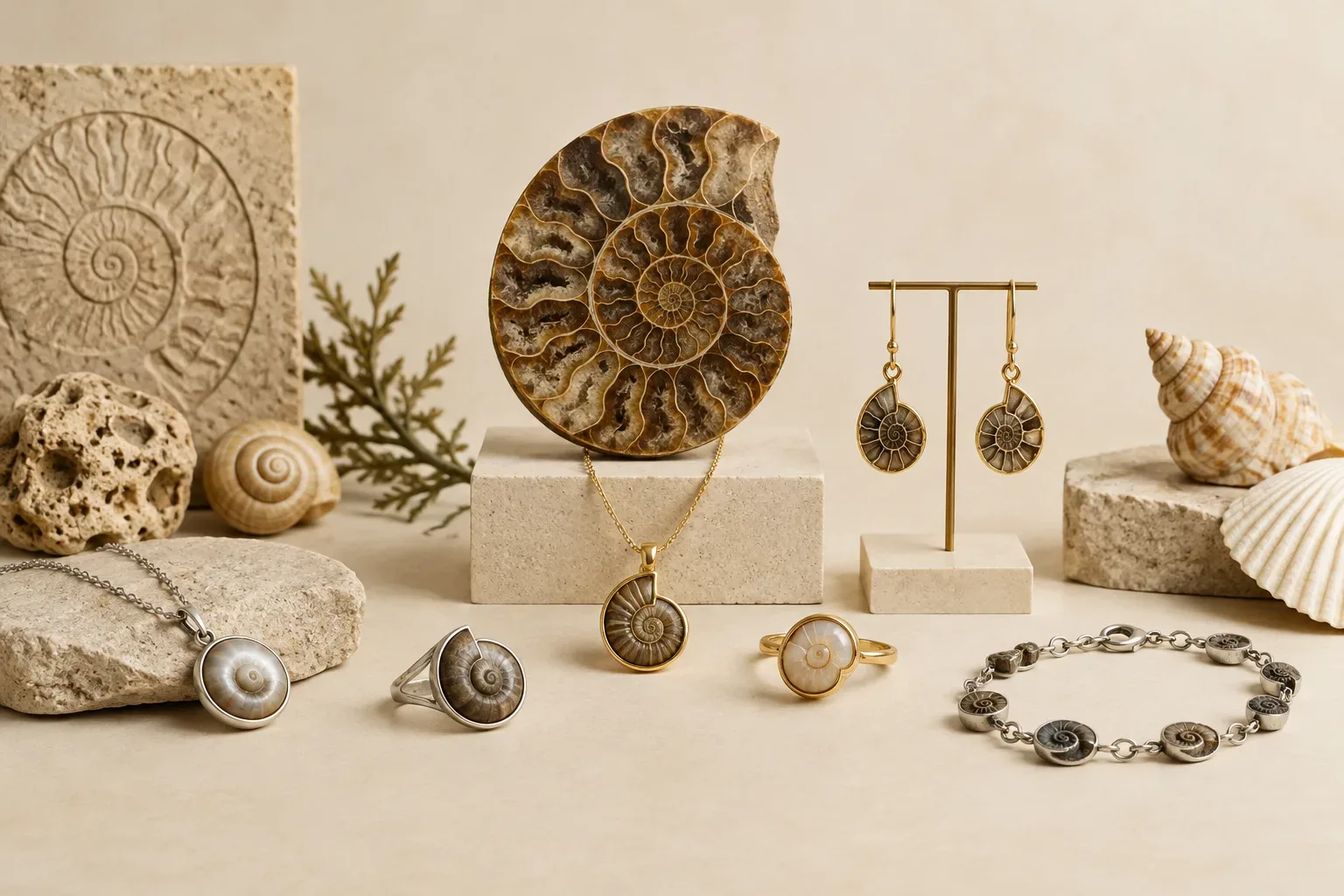
In contemporary jewellery the gastropod fossil motif most often appears as a visible shell surface incorporated for its texture, spiral form, or fossil patterning. Designers may use whole fossil fragments, polished fossil slabs, or fossil-bearing matrices set into metalwork. The motif can also be engraved, reproduced as a pendant shape, or worked into inlay designs.
Museums' guides to materials underline that makers select materials both for their visual qualities and for cultural resonance; whether makers present a fossil as a decorative texture, as a focal stone, or as an emblem will shape how viewers interpret the piece (Victoria and Albert Museum).
Practical and respectful selection and gifting guidance
Choose provenance and transparency. Ask sellers for provenance information and, when applicable, documentation about any stabilization, treatment, or imitation processes. The Federal Trade Commission recommends that consumers ask about treatments, enhancements, and whether a material is a natural specimen, a treated natural specimen, or a synthetic imitation (Federal Trade Commission).
Match symbolism to the recipient. If you want the piece to carry a particular meaning—such as resilience or connection to nature—present that as your contemporary, personal reading of the motif. If the piece is an archaeological or museum-quality object, avoid claiming an ancient or religious meaning unless the seller provides clear, documented evidence.
Respect cultural contexts. If a piece is described as coming from a named culture or archaeological site, request written provenance and any curator or dealer notes that explain historical function. Avoid buying items marketed with grandiose, unverifiable claims about ancient sacred use.
Consider wearability and care. Fossil materials vary in hardness and porosity. Ask about mounting methods and whether the fossil has been stabilized for wear. For delicate fossil components, recommend limited everyday exposure to water, chemicals, and abrasion; consult a jeweller experienced with organic or fossil materials for cleaning and repairs.
Budget and ethics. If you prefer ethically sourced or conservation-friendly materials, ask whether fossils were legally collected and whether their collection meets local regulations. Where possible, prefer pieces made from responsibly sourced materials or contemporary reproductions that avoid damaging paleontological sites.
Conservation, care, and authentication basics
Authentication of fossil-bearing jewellery requires both gemological and, in some cases, paleontological expertise. Dealers should be prepared to say how a fossil was identified and whether any stabilization or adhesive has been used. The FTC's consumer guidance on buying gemstones emphasizes disclosure of treatments and imitations; apply the same standards when assessing fossils in jewellery (Federal Trade Commission).
For care, keep fossil elements away from harsh cleaners and ultrasonic machines unless a specialist has confirmed they are safe. Store fossil jewelry away from high humidity and temperature swings and use padded storage to prevent abrasion. For high-value or museum-quality objects, seek professional conservation advice before any cleaning or alteration.
Putting it together: communicating meaning honestly
When you give, sell, or exhibit gastropod fossil jewelry, be explicit about what is documented and what is interpretive. Label objects with provenance, date (if known), and any curator-supplied information first, and then add an interpretive line explaining modern symbolism if you wish. That approach honors both responsible scholarship and the contemporary emotional value that people attach to natural objects.
If you are researching further, use museum catalogues and curator notes as starting points and seek primary archaeological or conservation reports for stronger historic claims. General museum histories remain valuable for context, but they do not replace object-level evidence when you need culture-specific meaning (Victoria and Albert Museum).
Frequently asked questions
Do gastropod fossils have a single historical meaning across cultures?
No. Major museum studies of jewellery emphasize that motifs and meanings shift across times and places; there is not a single documented, cross-cultural symbolic meaning for gastropod fossils in the museum literature, so modern symbolic readings are usually contemporary interpretations (Victoria and Albert Museum).
How can I verify the authenticity of a fossil in a piece of jewelry?
Ask the seller for provenance and any identification documentation. For material treatments, enhancements, or imitations, follow the Federal Trade Commission's guidance and request written disclosure about treatments and whether the fossil is natural, stabilized, or a synthetic reproduction (Federal Trade Commission).
Are fossil materials durable enough for everyday wear?
Durability varies by the type of fossil and any stabilization applied. Because fossilized material can be porous or fragile, confirm with the seller or a jeweller how the piece has been prepared for wear and whether it requires special care or limited exposure to water and chemicals.
Is it respectful to wear or gift jewelry with fossil motifs?
Yes, provided you are transparent about the object's provenance and avoid attributing undocumented sacred meanings to it. If the item is described as coming from a named culture or archeological site, request documentation and respect any cultural sensitivities related to that source.
What should I ask a dealer before buying gastropod fossil jewelry?
Request provenance, any conservation or stabilization records, clear statements about treatments or imitations, and details about legal collection. If the piece is billed as historically significant, ask for curator or archaeological references that support those claims.
Sources and further reading
- Bedazzled: A History of Jewellery — Victoria and Albert Museum
- An A-Z of Gemstones — Victoria and Albert Museum
- Buying Gemstones, Diamonds, and Pearls — Federal Trade Commission