Meaning at a glance
This goniatite jewelry buying guide explains what is documented about fossil and natural-motif jewelry history from museum sources, separates historical evidence from modern interpretations, and gives practical advice for authenticating, selecting, and caring for goniatite jewelry while noting relevant treatment and disclosure standards.
What the historical evidence shows (and what it doesn’t)
Institutional studies of jewelry history emphasise that people have used natural objects—minerals, shells, teeth and other organic and fossil materials—in personal adornment for millennia. The Victoria and Albert Museum presents this long arc of changing materials and social meanings in their surveys of jewellery history, showing how communities select objects from nature to make items that signal identity and value.
That institutional perspective helps explain why fossils sometimes appear in jewellery, but the Victoria and Albert Museum does not treat every fossil type as equally documented in the archaeological record. For goniatites specifically—ammonoid fossils with coiled shells—museum summaries and broad surveys describe the general practice of working natural forms into jewellery rather than listing continuous cultural uses of one fossil across all periods. In short: the documented historical pattern is the use of natural and fossil materials, and the V&A provides context for that broad practice, but direct, precisely dated cultural attributions for goniatite-specific jewellery are not established in the general V&A overviews.
Separating documented historical meanings from modern interpretations
When a motif or material appears in historical pieces, museums record the object’s provenance, date, and context. The historical meanings attached to objects are therefore those that can be supported by context, inscriptions, or contemporary accounts. The V&A emphasises this approach in its discussions of jewellery as changing social material: documented meanings come from contextual evidence rather than later retrospection.
Modern uses of goniatite motifs or fossil-inlay jewellery are frequently personal, aesthetic, or ecological statements. These contemporary meanings—for example, using a fossil to signal interest in natural history or to express a personal link to deep time—are modern interpretations and should not be presented as universal or historically continuous. Treat modern symbolic attributions as contemporary taste or personal intent unless a piece comes with reliable provenance tying that meaning to a specific historical community.
How the goniatite motif and fossil material appear in jewellery
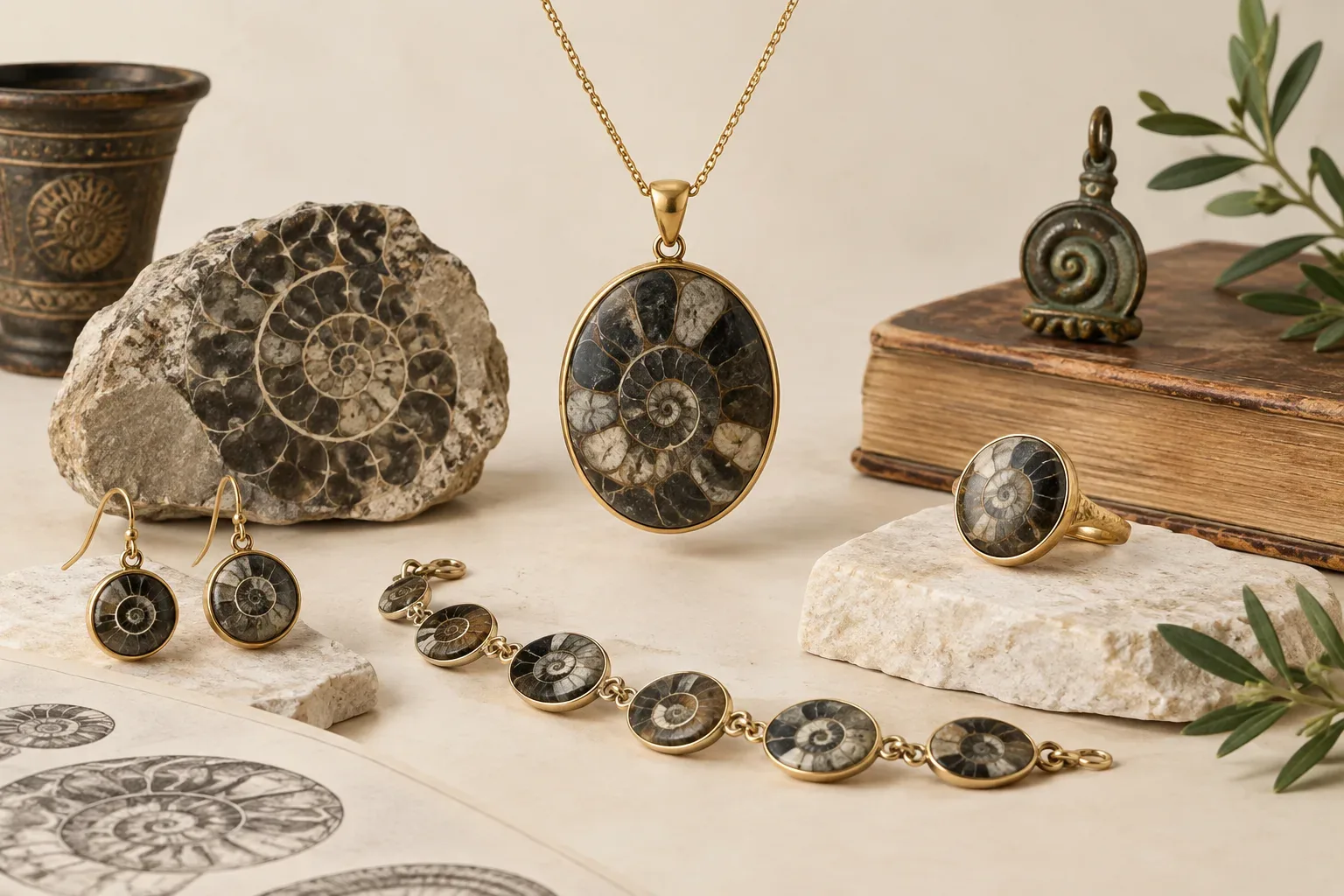
Goniatite material in contemporary jewellery usually appears as polished specimens set as cabochons, used in bezel settings, inlays, or as small, tumbled decorative elements. Craftspeople may leave natural septa and suture patterns visible or polish the surface to highlight internal structure. Because a goniatite is a fossilized shell rather than a crystalline gemstone, it is worked differently from transparent gems: lapidary techniques for fossils focus on stabilisation, cutting, and polishing rather than faceting.
Designs using fossil motifs can range from literal mounts of a whole or partial fossil to stylised reproductions cast in metal. Museum coverage of gemstones and materials explains how different materials require different handling and presentation, and the same principles apply to fossil-based jewellery: the visual effect—matte fossil surface or high polish—will guide how a piece is set and worn.
Authenticity: visual checks and when to seek testing
Start with clear, close images or in-person inspection. Genuine goniatite specimens show natural growth lines, septal sutures, and internal chambering where visible; these features have organic irregularity that is difficult to mimic perfectly. Colour treatment, unnatural uniformity, or a very glossy, plastic-like surface can be signs of stabilising resins, dyes, or complete reproduction.
Because surface treatments, resins and composites are common with fossils intended for jewellery, ask for seller disclosure and provenance documentation. For high-value pieces or important purchases, ask for independent testing from a geologist, palaeontologist or an accredited gem lab familiar with fossils. The Victoria and Albert Museum’s guidance on materials and the FTC’s consumer guidance on gemstones both underline the value of provenance and expert identification when material authenticity is important.
Treatment, imitation, and required disclosures
Treatments and stabilising processes are common for fossils that are fragile or porous. Sellers may consolidate specimens with resins, fill fractures, or enhance colour to improve durability and appearance. The Federal Trade Commission’s consumer guidance on buying gemstones and pearls sets a clear principle: sellers should disclose material treatments and any imitations or assembled constructions so buyers can make informed choices.
Ask sellers to specify whether a piece is untreated fossil material, stabilised with resin, dyed, reconstructed, or a cast reproduction. If a fossil has been assembled from fragments, that should be disclosed. A reputable seller will be able to explain what was done, why, and how it affects appearance and wearability.
Selection: matching material, setting, and intended use
Choose a setting that protects the fossil. Because many fossils are less hard than gemstones like quartz or sapphire, bezel settings, closed-back mounts, or protective frames reduce contact and abrasion. Consider how often the wearer will expose the piece to water, knocks, or chemicals; if frequent wear is expected, select pieces that are stabilised and set to minimise impact.
For aesthetics and longevity, check whether the fossil has been treated to resist moisture and oils. A heavily polished piece may show wear differently from a matte one. Use the V&A’s discussions of jewellery materials as a reminder that design and function have always been linked: choose form to suit life.
Care and maintenance
Clean gently and avoid harsh chemicals or ultrasonic cleaners. Many fossil specimens respond poorly to solvents, strong detergents, or ultrasonic vibration; a soft cloth and mild, pH-neutral soap with quick rinsing is the safest start for routine cleaning. Avoid soaking stabilised fossils for long periods as some consolidants can soften.
Store fossil jewellery separately from harder gemstones and metals to prevent scratching. If a piece has been stabilised with resin, periodic checks by a conservator or jeweller can detect softening, yellowing, or loosening joins. When travelling, carry fossil pieces in protective, cushioned cases to reduce mechanical shock.
Respectful selection and gifting guidance
Consider the recipient’s relationship to natural history and cultural contexts. Some people value fossil jewellery for its scientific resonance, while others may prefer pieces that emphasise design rather than specimen identity. When gifting, ask about allergies to metal or sensitivity to the idea of wearing fossils and be transparent about treatment and provenance.
If a piece is labelled by region or geological formation, check that the seller’s claims align with documented provenance and that local collecting laws and ethical considerations were respected. Present a fossil piece with information about its material and care so the recipient understands both its origin and the attention it needs.
When to seek expertise or certification
For high-value purchases, historical specimens, or pieces marketed with cultural or scientific significance, request independent assessment. A museum curator, accredited gemological laboratory, or a professional palaeontologist can provide confirmation of identification, treatment history, and relative rarity. Sellers who resist providing provenance or third-party reports should be treated with caution.
The V&A’s approaches to provenance and the FTC’s consumer advice both underscore that consumers benefit from documentation and informed sellers. Certification is not always necessary for casual, inexpensive pieces, but it is prudent for important acquisitions.
Final considerations
A goniatite jewelry buying guide grounded in museum practice and consumer-protection advice emphasises provenance, disclosure, and respectful use. Use visual inspection and seller questions to screen for authenticity and treatments, choose protective settings for everyday wear, and treat modern meanings as contemporary choices rather than historical prescriptions.
When in doubt, consult experts and prioritise sellers who disclose treatments and provenance openly. Doing so protects both your investment and the cultural and scientific value of the specimens you choose to wear.
Frequently asked questions
How can I tell if a goniatite in jewellery is genuine?
Look for natural growth lines, irregular septal suture patterns and internal chambering visible on the surface; ask the seller for provenance and treatment disclosure. For important purchases, obtain independent testing from a geologist, palaeontologist, or an accredited lab.
Are goniatite fossils treated or stabilised before being set in jewellery?
Many fossils are consolidated with resins, repaired, or filled to improve durability and appearance. The Federal Trade Commission advises that sellers disclose treatments and any imitations or assembled constructions so buyers can make informed decisions.
Can I wear goniatite jewellery every day?
It depends on the fossil’s hardness and whether it has been stabilised and properly set. Choose protective settings like bezels for frequent wear and avoid exposure to harsh chemicals, ultrasonic cleaners, or prolonged soaking.
What should I ask the seller before buying a fossil-based piece?
Ask for clear provenance, a description of any treatments or stabilisation, whether the specimen is whole or assembled, and any documentation or lab reports. A reputable seller will provide transparent answers.
Is it culturally sensitive to buy or wear fossil jewellery?
Fossil jewellery is not universally problematic, but treat claims of cultural or scientific significance with care. Verify provenance, respect local collecting laws, and be transparent with recipients about the piece’s origin and treatment.
Sources and further reading
- Bedazzled: A History of Jewellery — Victoria and Albert Museum
- An A-Z of Gemstones — Victoria and Albert Museum
- Buying Gemstones, Diamonds, and Pearls — Federal Trade Commission