Meaning at a glance
Documented historical evidence tying sea urchin fossils to a single, long‑standing symbolic meaning in jewelry is limited; museum histories show natural motifs recur across periods but do not establish universal symbolic use for fossil echinoids. Modern symbolic meanings are mostly personal or local, and anyone choosing or gifting sea urchin fossil jewelry should verify authenticity, ask about sourcing and treatments, and respect local community meanings.
Short answer
Briefly: the documented history and changing contexts of the sea urchin fossil motif are limited and patchy. Major museum surveys of jewellery history note that natural forms are frequently used as motifs, but they do not establish a continuous, cross‑cultural symbolic role for fossilized sea urchins. Many associations you will see today — protection, seaside memory, or connection to “deep time” — are modern personal or commercial interpretations rather than well‑documented ancient meanings. This guide explains what is documented, separates historical evidence from modern interpretation, shows how sea urchin fossils are used in jewelry, and gives practical guidance for choosing and wearing pieces responsibly.
What the historical record actually shows
When you look for firm, archaeological or museum evidence that sea urchin fossils carried a consistent symbolic meaning across multiple societies, the record is sparse. Surveys of jewelry history such as the Victoria and Albert Museum’s public resources emphasize that nature and natural materials have long inspired decorative motifs, from florals to shells, and that meanings attached to natural imagery change with fashion, technology, and social context. The V&A’s work on jewellery history explains changing social uses of motifs and materials rather than documenting a single, persistent religious or symbolic role for specific fossils.
That means you should be cautious about claims that a sea urchin fossil—sometimes called an echinoid or 'sea biscuit' in popular listings—was a universal talisman in ancient Egypt, classical Greece, or another named culture unless an explicit archaeological source is cited. The broad museum literature on jewellery and gemstones records many local and period‑specific uses of natural motifs, but it does not provide a clear, widely accepted lineage for sea urchin fossils as a symbolic motif across classical or prehistoric periods.
Documented historical meanings versus modern interpretations
Documented historical meanings: museum scholarship (for example, surveys and catalogues produced by institutions such as the Victoria and Albert Museum) tends to record meanings that are explicitly attested in texts, inscriptions, or well‑catalogued archaeological finds. For most fossil specimens used decoratively, the surviving records do not commonly attribute a consistent religious or protective function in multiple ancient traditions. Where natural items figure in jewelry history, museums document their use in contexts like status display, commemoration, or fashion, varying by period and region.
Modern personal and commercial interpretations: in contrast, many contemporary sellers, designers, and wearers attach modern symbolic language to sea urchin fossils. Common modern associations include seaside memory, endurance and resilience (because fossils are ancient), a sense of connection to geological time, and an aesthetic appreciation for their radial patterns. These are valid as personal meanings but should not be presented as continuous or universal historical facts without specific archaeological evidence.
How the motif and the fossil appear in jewellery
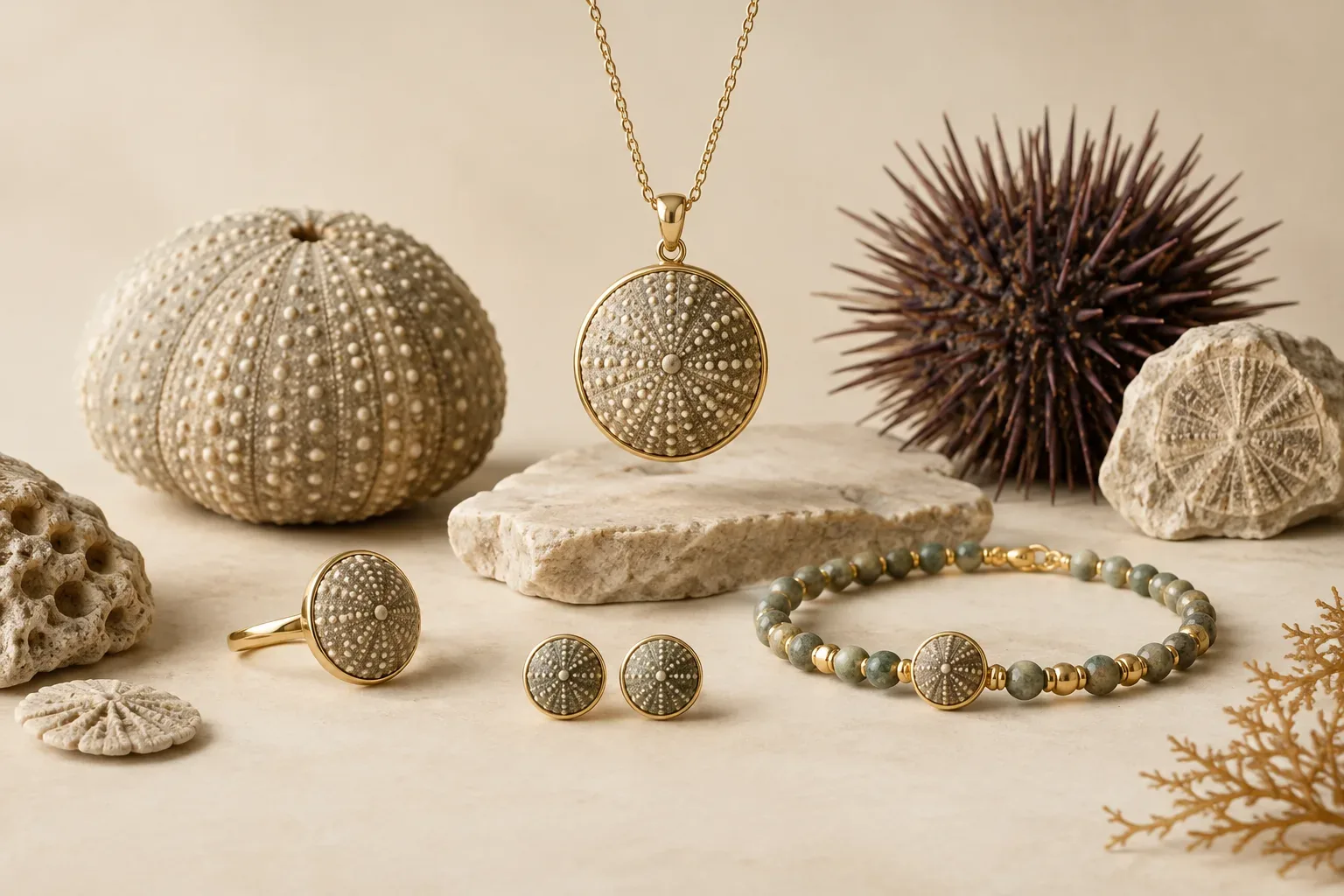
In practice, sea urchin fossils appear in jewelry through several familiar approaches used for natural materials. Some makers use whole or partial fossil specimens as pendants or focal pieces, stabilizing and setting them into metal bezels or frames. Others use polished cross‑sections or fragments set as cabochons, and some designers incorporate fossil imagery in cast metal or engraved forms that reproduce the radial pattern rather than using an actual fossil.
More generally, treatments applied to gemstones and natural materials—polish, stabilization (consolidation with resins), or mounting in precious metals—are described in museum and trade guidance on gemstones and jewelry. The Victoria and Albert Museum’s A‑Z of Gemstones outlines how different materials have been prepared and presented historically and in modern craft, and it is a useful reference for understanding how a fossil might be displayed or modified for use in jewelry.
Practical guidance for selecting, buying, and gifting sea urchin fossil jewellery
Ask about authenticity and disclosure. The Federal Trade Commission’s guidance for buying gemstones urges buyers to seek clear disclosure about treatments, imitations, and the nature of the material. Ask the seller whether the piece contains an actual fossil echinoid, whether it has been stabilized or dyed, and whether any components are synthetic or reconstructed.
Check condition and mounting. Fossils can be fragile or porous; reputable sellers should disclose repairs, resin stabilization, or drilling for suspension. Consider the durability of the mounting and whether the setting protects the specimen from knocks, moisture, or cleaning solvents.
Consider provenance and ethical sourcing. For some buyers, the geographic origin of a fossil and the circumstances of its collection matter. Ask whether the fossil was collected legally and whether its removal harmed a protected site. Museums and ethical dealers will share provenance details when available.
Respect cultural meanings. If a seller or community attributes a particular meaning or sacred status to certain marine fossils, treat that attribution with respect. When gifting, ask the recipient about their preferences and whether they appreciate symbolic language; if in doubt, choose neutral wording that emphasizes aesthetic or geological interest rather than claiming an ancient protective function.
Price and value expectations. Fossil specimens set as jewelry vary widely in price depending on rarity, aesthetic quality, and treatment. Use basic gemstone buying principles—ask for documentation, compare similar pieces, and, where appropriate, request a simple written statement about materials—to make an informed purchase. The FTC’s consumer guidance on buying gemstones is a useful procedural reference for disclosure and treatment questions.
Care and respectful wear
Treat fossilized specimens as both jewelry and small museum objects: avoid harsh chemicals, ultrasonic cleaners, and long‑term exposure to water or extreme humidity. Clean gently with a soft brush and mild soapy water only if you know the piece has not been stabilized with materials that could be damaged by moisture. For delicate or valuable pieces, consult a professional conservator or jeweller familiar with fossils.
When wearing or discussing fossil jewelry in public, avoid asserting speculative historical claims about ancient religious uses unless you can cite a specific archaeological source. If you are unsure about the cultural provenance or significance of a piece, present it as an object with natural beauty and modern meaning rather than an authenticated ancient talisman.
When to consult an expert
If you want to verify the identity or age of a fossil used in jewelry, seek out a qualified palaeontologist, museum curator, or an experienced gemmologist who works with organic and fossil materials. Museums and academic institutions can sometimes help with identification or can point you to local experts. For questions about legal collecting or protected sites, consult local heritage authorities or museum conservation departments.
Final note
Sea urchin fossil jewelry occupies a space where natural history, craft, and personal meaning meet. Major museum overviews of jewellery history highlight the long habit of drawing motifs and materials from nature, but they do not support blanket statements that fossil echinoids carried a single, universal symbolism across ancient cultures. If you love the look or the modern meanings people attach to these pieces, select and gift them with clear questions about material, provenance, and treatment, and with respect for any community meanings associated with the object. For basic guidance on how materials have been used and disclosed in jewellery, see resources from the Victoria and Albert Museum and the Federal Trade Commission.
Frequently asked questions
Are sea urchin fossils considered gemstones?
Fossils are not gemstones in the traditional mineralogical sense, though they can be used decoratively like gem materials. Museum guidance on gemstones explains how different natural materials have been used and presented in jewellery; whether a fossil is marketed as a gemstone often depends on how it has been prepared, polished, or set rather than strict geological classification.
How can I tell if a sea urchin fossil in jewelry is real?
Ask the seller for provenance and details about treatment or stabilization. For a reliable identification, consult a palaeontologist, museum curator, or an experienced gemmologist who works with organic and fossil materials. The Federal Trade Commission recommends that buyers request clear disclosure about treatments and imitations when buying gemstone or natural material jewellery.
Do any ancient cultures clearly use sea urchin fossils as symbols in jewelry?
Major surveys of jewellery history note widespread use of natural motifs but do not document a continuous, cross‑cultural symbolic role for fossilized sea urchins. If you see a claim that a particular ancient culture used sea urchin fossils with a specified meaning, ask for the archaeological or textual source that supports that claim; museum catalogues and academic publications are appropriate places to verify such assertions.
What should I consider when gifting sea urchin fossil jewellery?
Consider authenticity, condition, disclosure of treatments, and whether the recipient values symbolic claims. Ask the seller for documentation about materials and any stabilization. If a fossil has cultural significance in a particular community, be respectful and, where appropriate, explain the modern or geological meaning rather than asserting an unsupported ancient symbolism.
How should I care for fossil jewellery?
Avoid harsh chemicals, ultrasonic cleaning, and prolonged water exposure. Clean gently with a soft brush and mild soap only after confirming that any stabilizing treatments are water‑safe. For valuable or delicate pieces, seek advice from a conservator or professional jeweller experienced with fossils.
Sources and further reading
- Bedazzled: A History of Jewellery — Victoria and Albert Museum
- An A-Z of Gemstones — Victoria and Albert Museum
- Buying Gemstones, Diamonds, and Pearls — Federal Trade Commission