Meaning at a glance
This guide explains the documented history and shifting contexts of the sand dollar fossil motif, separates museum-supported historical evidence from later popular or personal interpretations, and gives practical guidance for authenticating, selecting, treating, and caring for sand dollar fossil jewelry.
What to expect from this guide
This article summarizes what museum research and consumer protection guidance document about jewellery motifs, materials, and disclosure. It explains how sand dollar fossils and the sand dollar motif appear in jewelry, distinguishes documented historical meanings from modern personal or commercial interpretations, and provides practical advice for authenticating, buying, gifting, and caring for such pieces.
Historical evidence and cultural context
Museum scholarship shows that jewelry motifs and meanings change over time and between cultures rather than remaining fixed. The Victoria and Albert Museum documents how jewel design, materials, and symbolic language have shifted through distinct historical periods and social contexts, and it treats motifs as culturally situated rather than universal.
Specifically documented museum work traces how natural forms—flowers, shells, seeds and other organic shapes—entered decorative arts in different eras as designers responded to changing tastes, scientific interest, and trade in materials. The V&A frames these shifts in relation to identifiable periods such as the Georgian, Victorian, and modern eras and to evolving techniques in carving, setting, and reproduction.
There is no single, universally documented ancient culture that assigned a single fixed meaning to the sand dollar fossil motif across all times and places in the way a museum catalog would treat a historically attested emblem. Instead, the motif's appearance in jewelry is a modern and often regional practice informed by natural history, seaside culture, and personal symbolism.
Documented historical meanings versus modern interpretations
Documented historical meanings: Museum sources emphasize that symbolism attached to motifs frequently emerges in particular times and places and is recorded in period artworks, trade catalogues, or maker's notes. Where natural motifs like shells or fossil forms appear in period jewelry, museums attribute meaning based on contemporary sources and the item's provenance. The V&A's studies caution against assuming a motif carried the same meaning across multiple cultures or centuries.
Modern and popular interpretations: Many of the 'meanings' now associated with sand dollars—such as Christian allegorical stories, beach-life nostalgia, or personal tokens of luck or calm—are modern or local interpretations rather than claims grounded in long-established ritual practice. These contemporary meanings can be meaningful to wearers and gift-givers but are distinct from the museum-documented histories that rely on period evidence.
How the sand dollar motif and fossils appear in jewelry
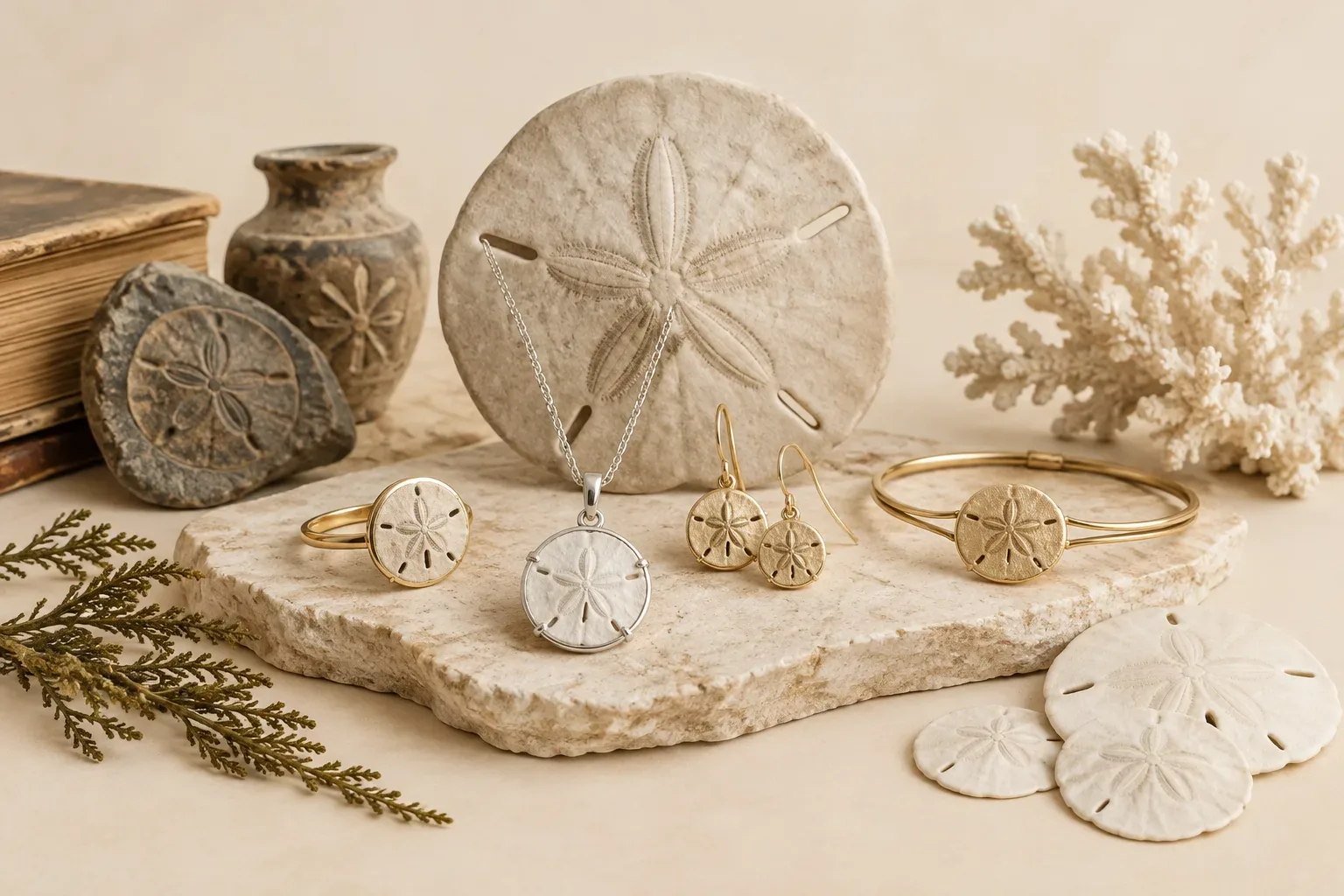
The motif appears in several distinct ways in contemporary jewelry: as a carved or polished actual sand dollar or fossilized echinoid test set into a bezel or resin; as a cast or stamped metal representation in silver or base metal; as an intaglio or cameo-style carving; and as a decorative surface pattern on beads or pendants.
Design and material choices follow standard jewellery practices documented in museum studies: makers select settings and mounts to protect fragile material, and they combine motifs with complementary materials such as silver, gold vermeil, pearls, or other natural elements. The V&A's overview of gemstones and materials explains that museums catalogue both natural items used intact (for example, shells) and objects where the theme is rendered in metal or stone, treating them as different object types with different conservation needs.
Authenticity: how to verify a sand dollar fossil piece
Ask the seller for provenance and a clear description of the material. If a piece is described as an actual fossil sand dollar, request details about where and when it was collected and whether any conservation or repair work was performed.
Examine the surface and weight. Natural tests are typically lightweight, porous, and may show natural weathering; cast metal replicas will be heavier and lack internal crystallization or natural porosity. If a seller offers laboratory or third-party verification (for example, a gemological lab report for associated gemstones or a conservation report), that documentation strengthens the claim.
When in doubt, seek an independent appraisal. Museums and reputable dealers often recommend professional assessment when authenticity affects value or conservation choices. The V&A's work on jewelry history underscores the importance of provenance and maker documentation for interpreting an object's cultural and monetary worth.
Treatments, imitation, and disclosure
Be aware that fossils and shell materials may be stabilized, repaired, dyed, or set in resin to improve durability or appearance. The U.S. Federal Trade Commission requires sellers to disclose treatments, imitations, and material substitutions for gemstones and similar items; this consumer-protection framework is commonly applied by reputable sellers for fossils and organic materials as well. The FTC advises buyers to ask explicitly about any treatments and to retain written descriptions.
Common non-deceptive practices include applying consolidants to fragile fossils, mounting fragments into protective settings, or creating composite pieces where a small natural element is combined with resin or metal. Sellers should disclose such treatments and composites. If disclosure is absent or unclear, treat the claim of authenticity as unresolved until clarified.
Practical care guidance
Handle fossil and shell-based jewelry gently. Because many fossilized echinoid tests and shells are calcareous and more fragile than hard gemstones, avoid abrasion, strong impacts, and prolonged soaking. Store such pieces separately from hard stones and metals to prevent scratching and crushing.
Avoid household chemicals and aggressive cleaning methods. Do not use ultrasonic cleaners or harsh acidic cleaners on fossil or shell materials; ask a conservator or follow the seller's care instructions for safe cleaning methods. For metal settings, standard jewellery cleaning safe for the metal but not the fossil may be appropriate if the fossil can be removed or isolated.
When in doubt about care, consult a professional conservator or the retailer's aftercare guidance. Museum practice emphasizes preserving original surfaces and documented repairs, so conservative cleaning and minimal intervention are widely recommended.
Selecting and gifting sand dollar fossil jewelry respectfully
Consider the recipient's connection to the motif. If the design carries cultural or religious associations for the recipient, discuss those meanings openly so the gift aligns with their values. Remember that modern personal meanings—such as beach memories or spiritual metaphors—are valid for the wearer but are not the same as historically documented symbolism.
Prioritize transparent sellers. Choose dealers who provide clear descriptions, disclose treatments and composites, and offer provenance information or a return policy. For higher-value pieces, look for third-party appraisals and written records.
Think about longevity and wearability. A fragile fossil set in an exposed bezel will need different care and may not suit daily wear; a cast metal sand dollar motif will be more durable. Match the piece to the recipient's lifestyle and communicate care expectations as part of the gift.
Be mindful of conservation and legal issues. Some fossils are collected under regulations or from protected sites; reputable sellers will be able to explain legal and ethical provenance. If in doubt, ask the seller for provenance documentation or choose commercially produced motifs that replicate the look without using vulnerable material.
Final considerations
Museums remind us that meaning in jewelry is historically contingent, and consumer protection agencies emphasize clear disclosure about materials and treatments. Combining those perspectives helps buyers make informed, respectful choices: clarify whether a sand dollar is a natural fossil or a manufactured motif, ask about treatments and provenance, and match the item's durability to intended use.
When sand dollar fossil jewelry is chosen intentionally—with transparent information and appropriate care—it can be a meaningful and beautiful object that reflects both personal taste and responsible collecting.
Frequently asked questions
How can I tell if a sand dollar in jewelry is a real fossil or a replica?
Ask the seller for provenance and for a written description of the material and any treatments. Natural tests tend to be lightweight, porous, and may show weathering, while cast metal replicas are heavier and lack natural porosity. If authenticity matters for value, seek a third-party appraisal or a conservation report.
Should sellers disclose treatments or repairs to fossil jewellery?
Yes. The Federal Trade Commission requires disclosure of treatments, imitations, and material substitutions for gemstones and similar items; reputable sellers apply the same transparency to fossil and organic jewellery, specifying stabilizers, dyes, resin composites, or repairs.
Are sand dollar designs historically religious symbols?
Museum research indicates symbolism varies by time and place and is documented only where contemporary sources support it. Many religious or allegorical meanings attached to sand dollars are modern interpretations rather than long-established historical facts. Treat historical claims critically and consider museum-based evidence when historical meaning is important to you.
How should I care for sand dollar fossil jewellery?
Handle gently, avoid strong impacts and abrasive contact, do not use ultrasonic or harsh chemical cleaners on the fossil parts, and store pieces separately. If cleaning guidance is unclear, consult the seller or a professional conservator for safe cleaning methods.
Is it ethical to buy fossil sand dollar jewellery?
Ethical considerations depend on provenance and local laws where the fossil was collected. Reputable sellers should be able to explain provenance and whether collection complied with regulations. If provenance is unclear or the item appears to come from a protected site, consider choosing commercially produced motifs instead.
Sources and further reading
- Bedazzled: A History of Jewellery — Victoria and Albert Museum
- An A-Z of Gemstones — Victoria and Albert Museum
- Buying Gemstones, Diamonds, and Pearls — Federal Trade Commission