Meaning at a glance
Documented historical evidence for the sand dollar fossil as a fixed symbolic motif is limited; museum research shows that jewelry motifs and meanings shift by time and place, while many popular modern readings are personal or recent adaptations—this guide separates historical documentation (attributed to the Victoria and Albert Museum) from later interpretations, explains how sand dollar motifs and fossil materials appear in jewelry, and gives practical, FTC-aligned advice for selecting, gifting, and caring for such pieces.
What a sand dollar fossil is (natural history in brief)
In natural-history terms, sand dollar fossils are the preserved skeletal tests of flattened echinoids commonly called sand dollars. As fossils, they preserve the five-part petal pattern and the overall disc shape that make the form visually distinctive. Collectors and makers have long appreciated that recognizable shape because it adapts well to carving, insetting, and casting into jewelry forms.
Documented historical evidence and changing contexts
When we ask whether the sand dollar motif had a fixed meaning in the past, the careful way to answer is to look at the history of jewelry as a changing social language. The Victoria and Albert Museum frames jewelry history as socially and materially contingent: motifs, materials and their meanings shift with fashion, technology and social values rather than remaining universal. Where direct documents tie a motif to a single religious or cultural meaning, museums typically rely on dated objects, maker notes or contemporary texts to support that link. For the sand dollar specifically, there is little museum-backed evidence establishing a single symbolic meaning that was widely shared across times or places. That absence of consistent historical documentation is itself important: it means most clear claims that sand dollars
Separating documented historical meanings from modern interpretations
Because comprehensive, museum-supported evidence tying the sand dollar to a single ancient or religious symbol is scarce, many widely circulated meanings belong to modern interpretation, personal symbolism, or regional folklore rather than to a documented historical tradition. For example, some contemporary writers and makers treat the sand dollar as a Christian emblem, associating the five-point petal with the wounds of Christ and the center with the Easter story. Those readings are modern devotional or poetic interpretations and should be presented as such unless the object in question comes with provenance linking it to an explicit historical devotional use.
Museums such as the Victoria and Albert Museum emphasize that jewelry meanings are mutable: a motif that begins as natural-history curiosity might later be read as nationalistic, religious, romantic, or commercial depending on the historical moment and audience. When you encounter statements about the 'meaning' of a sand dollar fossil in jewelry, ask whether the claim is supported by dated provenance, maker records, or contemporaneous accounts (documentary evidence) or whether it is a recent symbolic overlay.
How the sand dollar motif and fossil material appear in jewelry
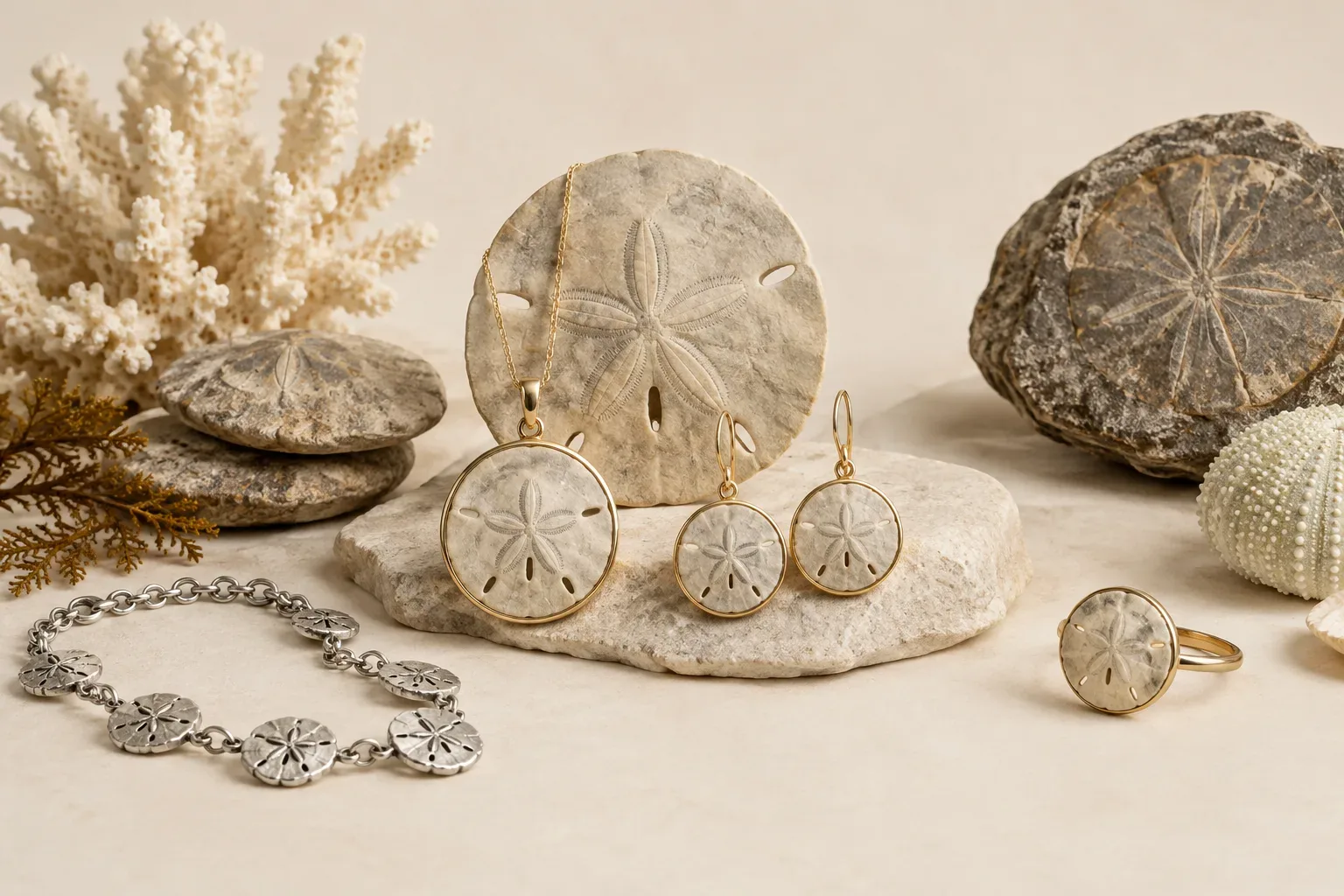
Designers and craftsmen use the sand dollar motif in several distinct ways. Some jewelers set small, polished fossil tests into bezels or pendants, preserving the natural fossil surface. Others reproduce the pattern as a metal form—cut-out discs, stamped or laser-etched plates, and cast charms that echo the petal-like central design. Jewelry makers also translate the motif into stone inlay, shellwork and engraved gemstones where the star pattern is the focal point.
Beyond whole fossils, makers may use fossil fragments, cast replicas in silver or bronze, or stylized silhouettes in gold and inlaid gemstones. When genuine fossil material is not used, makers will often work in materials that mimic the color and texture of fossils; under consumer-protection guidance such treatments and imitations should be disclosed to buyers.
Material considerations and disclosure
When you are assessing sand dollar fossil jewelry, treat the material claim—'fossil', 'natural sand dollar', 'replica'—as central to value and meaning. The Federal Trade Commission's guidance on buying gemstones, diamonds and pearls highlights the importance of clear disclosure of treatments, imitations and the nature of materials in jewelry sales. Although that FTC guidance focuses on gemstones, its core principle applies: ask the seller to state plainly whether a piece uses actual fossil material, stabilized or treated fossil, a cast reproduction, or a shell/stone with a similar look.
If a piece uses a real fossilized test, ask about where it was collected, whether it is a whole test or a composite, and if any adhesives or stabilization methods were used. If the seller cannot answer or refuses to disclose treatments and origins, consider that a potential red flag for provenance and long-term conservation.
Practical and respectful selection or gifting guidance
Decide what matters most for you or your recipient: authenticity of fossil material, historic or artisanal provenance, symbolic reading, aesthetics, or conservation credentials. If authenticity and provenance matter, choose a seller who documents the piece with clear material descriptions and provenance notes. Conservatively value pieces whose makers or sellers disclose any stabilization, repair or treatments.
When gifting a sand dollar fossil piece as a symbolic token, be explicit about the nature of the symbolism you intend. If you present the motif as part of a religious or cultural narrative, clarify whether that association is a modern personal meaning rather than a documented historical connection. This approach honors both the recipient’s beliefs and the object’s material and cultural history.
Consider legal and environmental implications if the fossil originates from protected coasts, private land or areas where collection is restricted. Ask sellers whether the material was collected legally and ethically. If you are concerned about conservation, prioritize pieces made from responsibly sourced fossils, verified reproductions, or artist-made castings that avoid removal of vulnerable specimens from the wild.
Caring for sand dollar fossil jewelry and practical wear notes
Fossil material and delicate shell-like tests can be fragile. When a fossil test is set in a pendant or brooch, treat it as you would other delicate natural materials: avoid prolonged exposure to water and chemicals, and remove the piece during high-impact activities. If a fossil has been stabilized by a maker, follow any specific care instructions provided.
For metal or cast pieces that reproduce the motif, general jewelry care practices apply: protect the metal from harsh chemicals, clean with a soft cloth, and have soldered connections and settings checked periodically. If in doubt about cleaning a piece that combines fossil and metal components, consult a conservator or a reputable jeweler who will respect both material fragility and aesthetic integrity.
Contextual humility: what we can reliably say
The reliable scholarly position is modest: museums that catalogue jewelry stress shifting meanings and the need for provenance when making historical claims. The Victoria and Albert Museum's work on the history of jewelry shows how motifs gain, lose or shift meanings in different periods, and the museum provides a model for assessing claims about symbolic meaning. For the sand dollar motif specifically, the responsible approach is to treat many common symbolic claims as contemporary or personal unless an object carries documented provenance demonstrating historical symbolic use.
Final takeaways
Sand dollar fossil jewelry carries visual and personal resonance, but documented historical meanings are scarce; museums emphasize that jewelry motifs are historically contingent. Treat modern symbolic readings as contemporary or personal unless a piece has provenance tying it to a specific historical context. Choose pieces from sellers who disclose material details, respect conservation and legal collection concerns, and offer clear care instructions so the object can be worn and interpreted responsibly.
Frequently asked questions
Does a sand dollar fossil have a documented historical meaning?
There is no widely documented, single historical meaning for the sand dollar fossil across cultures. Museum research shows that jewelry meanings shift with time and place, so many common symbolic associations are modern interpretations or personal attributions unless a specific object has provenance linking it to a historical tradition.
How can I tell if a sand dollar in jewelry is a real fossil or a replica?
Ask the seller for clear material disclosure. A reputable seller should state whether the piece contains genuine fossil tests, stabilized fossils, shell, carved stone, or cast metal replicas. If the seller cannot provide a transparent description of material and any treatments, treat that as a reason to seek another source.
Are there ethical or legal concerns about buying sand dollar fossils?
Yes. Fossil collection can be subject to local laws and conservation concerns. Ask sellers whether material was legally and ethically collected. If provenance is unclear or the seller cannot confirm legal collection, consider choosing responsibly sourced fossils or artist-made reproductions to avoid supporting the removal of specimens from protected sites.
How should I care for sand dollar fossil jewelry?
Treat fossil-bearing jewelry as you would other fragile natural materials: avoid exposure to water and household chemicals, remove during physical activity, and follow any stabilization or conservation instructions from the maker. For combined fossil-and-metal pieces, consult a conservator or experienced jeweler for cleaning and repair to avoid damaging delicate fossil surfaces.
Can I gift a sand dollar fossil piece with religious symbolism?
You can, but be transparent about the nature of that symbolism. If you intend the piece to carry a religious or cultural meaning, explain whether that reading is a personal or contemporary interpretation rather than something documented historically. Transparency respects both the recipient and the object’s material history.
Sources and further reading
- Bedazzled: A History of Jewellery — Victoria and Albert Museum
- An A-Z of Gemstones — Victoria and Albert Museum
- Buying Gemstones, Diamonds, and Pearls — Federal Trade Commission