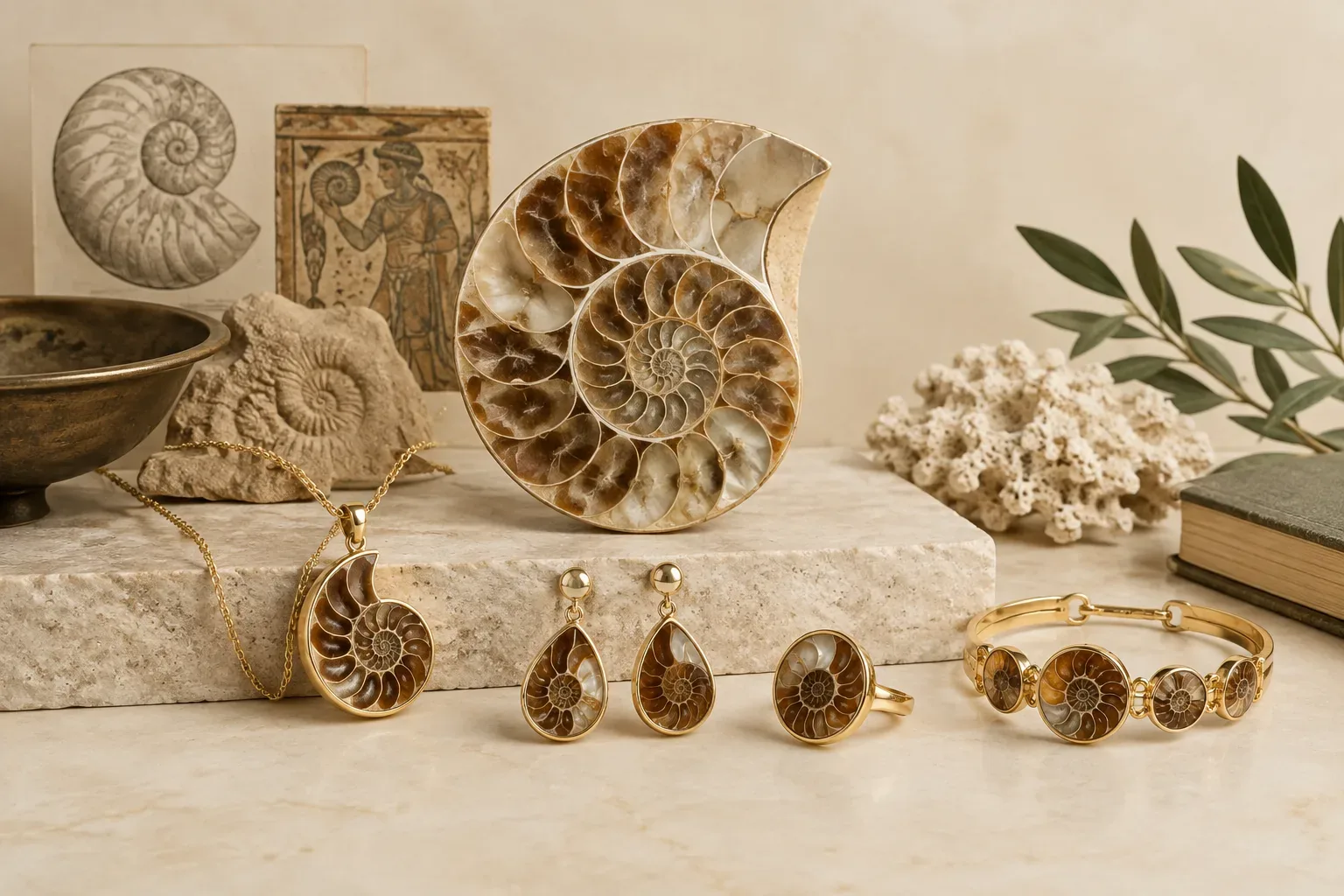
Meaning at a glance
This guide explains the documented history and changing contexts of nautilus and fossil motifs in jewelry, distinguishes historical evidence from modern personal interpretation, and gives practical advice on checking authenticity, understanding common treatments, selecting respectfully, and caring for nautilus fossil jewelry.
What the documented history shows (and what it doesn’t)
Museum research into jewellery history makes two useful points for buyers. The Victoria and Albert Museum’s presentation on jewellery history shows how materials, motifs, and meanings have changed with fashion, technology, and collecting habits rather than remaining fixed across time or cultures. The V&A’s guidance also places natural materials—shells, corals, and other marine objects—within broad long-term patterns of use in decorative arts.
What that means for the nautilus motif specifically is caution: there is no single, well-documented worldwide religious or symbolic meaning for nautilus fossils across all cultures recorded in the V&A overviews. Instead, historic makers and wearers treated marine forms and fossils as fashionable materials, curiosities, or status objects at different times. For example, in the 18th and 19th centuries European tastes included natural curiosities and shell collectables in cabinets and jewellery as part of collecting culture, a trend that museum histories document as changing with scientific interest and display practices.
In sum, the historical record cited by museum sources supports a view of fossil and shell jewellery as shifting in social context: sometimes decorative, sometimes an expression of natural history interests, and sometimes sentimental or fashionable. It does not support claims that a particular, uniform sacred meaning was attached to the nautilus fossil in every culture or period.
Separating documented meanings from modern interpretations
Documented meanings are those you can locate in museum catalogues, period writings, or maker’s provenance. The V&A material on jewellery history is useful here because it shows how Victorian, Georgian, and earlier European jewellery used natural materials within certain social codes. Where the documentation links a motif to a specific meaning, that link is best presented as specific to that culture and period.
Modern personal interpretations—such as viewing the nautilus spiral as a universal symbol of growth, resilience, or spiritual balance—are contemporary layers that many buyers and wearers add to the object. These contemporary meanings are valid at a personal level but should not be presented as documented historical fact. If you are buying for someone who values historical authenticity, make the distinction clear: you can gift a nautilus piece with a modern sentiment while acknowledging the piece’s historical context is more often decorative or a curiosity than sacred.
How the nautilus or fossil motif appears in jewellery
Fossil and shell motifs enter jewellery in two related ways: as whole or partial natural objects used for their shape and texture, and as designs inspired by the shell form reproduced in metal, enamel, or stone. Museum descriptions of jewellery techniques and materials show that makers have long adapted natural items into rings, brooches, cameos, pendants, and inlaid pieces.
In modern jewellery you will commonly see fossil nautilus material polished and sliced into cabochons, thin cross-sections set as pendants or earrings, small whole shells mounted into bezels, fossil fragments inlaid into metal or resin, and nautilus-inspired metalwork and enamelling that echoes the spiral. Some makers also incorporate fossil material into beads or set fossil slices in framed pendants that highlight the internal chambered structure, while others reproduce the spiral in engraved or cast metal without using fossil material at all.
Authenticity, treatments, and seller disclosure
Authenticity for fossil jewellery includes three separate questions: whether the item contains genuine fossil material, whether that material has been materially altered or combined with other substances, and whether the seller is making accurate claims about source and treatment. The Federal Trade Commission emphasises that sellers should clearly disclose treatments, enhancements, and substitutes used in gemstones and similar materials, and that buyers should ask for specific written information if the seller does not volunteer it.
Common alterations and constructions in fossil jewellery include stabilization with resins to reduce fragility, dyeing to enhance color, backing or lamination for thin slices, surface coatings to increase gloss, and composite assembly where a small fossil element is mounted in a larger engineered matrix. There are also items styled to look like fossils that are carved or cast from non-fossil materials. Because these choices affect durability, appearance, and price, ask the seller whether the piece is a natural unaltered fossil, a treated fossil, a composite (describe how), or a fossil-inspired reproduction.
Follow the FTC’s guidance: request written disclosure of any treatments, keep proof of purchase that lists the material and treatments, and confirm return rights before you buy. If a seller is unwilling to answer basic questions about treatment and origin, that is a legitimate red flag.
Practical selection and gifting guidance
Start with your priorities. Decide whether you want a historically authentic fossil specimen, a durable everyday piece, a museum-quality example intended for occasional wear, or a design-forward item that simply evokes the nautilus form. An authentic, untreated fossil slice may be more fragile and better suited to occasional wear, whereas stabilized or backed slices or resin-set pieces can be practical for daily use.
When buying vintage or antique pieces, request provenance and condition information. For newly made work, ask how the maker prepared the fossil, what metal and fastening they used, and whether any adhesives or resins are visible at joins. If you are gifting for cultural or religious reasons, research whether the recipient or their community has particular views about fossils, shells, or animal remains to avoid unintended offence. If the piece has documented historic origin, share that provenance with the recipient as part of the gift narrative.
Price and value depend on size, rarity, finish, mount, and whether the item is treated or composite. Compare similar listings and ask for close-up photos that show the fossil’s internal structure and the join between fossil and setting. Make sure the seller’s return policy and disclosure practices match your expectations before completing a purchase.
Care and maintenance
Treat fossil materials gently. Clean with a soft, dry or slightly damp cloth and avoid harsh chemicals or abrasive cleaners that can damage fossil surfaces or surface coatings. Keep fossil and shell components away from strong household acids, prolonged immersion in water, and extreme heat, which can affect adhesives and coatings.
Store fossil jewellery separately from harder gemstones and metals to avoid scratches, and consider padded compartments or a soft pouch. For pieces with resin stabilization or composite mounts, follow the maker’s specific instructions; if none are given, assume moderate handling and occasional wear rather than heavy daily use. When in doubt about a cleaning or repair, seek a jeweller experienced with organic or fossil materials rather than attempting aggressive treatments yourself.
When to seek an expert or walk away
Seek expert help if the item is high-value, claims to be an important antique, or if you plan to insure the piece. Experts can assess authenticity, identify treatments, and advise on conservation. Walk away or delay a purchase if the seller refuses written disclosure of materials and treatments, if the provenance is implausible, or if the price seems inconsistent with the seller’s claims.
Finally, remember that many purchases of nautilus-inspired jewellery are about personal meaning and aesthetics as much as material authenticity. Be explicit with the seller and the recipient about your priorities: rarity and provenance, everyday durability, or symbolic design interpretation.
Frequently asked questions
How can I tell if a nautilus fossil in jewellery is real?
Ask the seller for a clear description of the material and any treatments, request close-up images that show internal structure, and obtain written disclosure. Genuine fossils typically show natural chambering and growth patterns; sellers should disclose stabilisation, backing, dyeing, or composite construction. If a seller refuses written information, treat that as a red flag.
What common treatments should I expect with fossil jewellery?
Common treatments include resin stabilization to strengthen fragile material, backing or lamination for thin slices, surface coatings to improve gloss, dyeing to alter color, and composite assembly where fossil fragments are set into an engineered matrix. These treatments change durability and value, so ask for and keep written disclosure of any treatment.
Are fossil nautilus pieces suitable for everyday wear?
It depends on construction and treatment. Untreated, thin, or fragile fossils are best for occasional wear. Stabilized, backed, or resin-set pieces are often more durable for regular use. Check the maker’s recommendations and consider the setting and fastenings when deciding whether to wear a particular piece daily.
Do fossils have the same symbolic meaning across cultures?
No. Museum histories show that meanings attached to materials and motifs change over time and between cultures. While modern wearers often assign personal symbolism to the nautilus spiral, that contemporary interpretation should not be assumed to be a historically universal meaning.
What should I ask a seller before buying?
Request written details of the material, treatments, mounting techniques, provenance, and the return policy. Ask for close-up photos that show joins and the fossil’s internal structure. Confirm whether the piece is vintage, repaired, composite, or newly made from fossil material.
Are there legal restrictions on buying fossils?
Laws and regulations about collecting and exporting fossils vary by country and locality. If provenance or legality is important to you, ask the seller for documented provenance and check local regulations where you live or where the fossil was collected.
How should I clean and store fossil jewellery?
Clean gently with a soft cloth and avoid strong chemicals and abrasive cleaners. Store fossil pieces separately from harder gemstones and metals to prevent scratches, and follow any specific instructions the maker provides for stabilized or composite items.
Sources and further reading
- Bedazzled: A History of Jewellery — Victoria and Albert Museum
- An A-Z of Gemstones — Victoria and Albert Museum
- Buying Gemstones, Diamonds, and Pearls — Federal Trade Commission