Meaning at a glance
Dinosaur bone jewelry meaning is a modern cultural phenomenon: there is no longstanding, documented historical symbolism tied to dinosaur bones, and meanings assigned today are personal or tied to scientific and aesthetic interests; this article traces the relevant documentary record, explains how fossil bone is used in jewelry, and offers responsible selection and gifting advice.
Quick answer
The short answer to 'dinosaur bone jewelry meaning' is that any symbolic meaning is modern and individual rather than rooted in an inherited cultural or religious tradition. Museums and jewellery historians show that jewellery acquires new meanings as materials and knowledge change, and fossil bone entered jewellery and the gem trade in relatively recent practice. If you wear or gift dinosaur bone jewellery, its meaning will usually be personal—such as a connection to paleontology, deep time, endurance, or curiosity—rather than a documented ancient symbol.
What the historical evidence shows
The documentary record for jewellery, as summarised by the Victoria and Albert Museum, emphasises that the materials people choose for personal adornment and the meanings attached to them change over time as aesthetic tastes, technologies and scientific knowledge develop. The V&A’s historical surveys focus on how societies repurposed new materials and motifs as they became available and better understood.
There is no reliable historical evidence from archaeologists or from museum catalogues that pre-modern cultures held specific, enduring symbolic meanings for dinosaur bones. Human cultures that used bones in ornaments long predate scientific recognition of dinosaurs, but those historical uses involved animal bone and ivory from species known to people, not fossilized dinosaur remains recognised for their deep-time age. The association of specific prehistoric reptiles with fossil bones and the cultural practice of turning those fossils into jewellery belong to the modern era of collecting and gem commerce rather than to a continuous traditional symbolism.
Separating documented historical meanings from modern interpretations
Documented historical meanings are those recorded in contemporary sources—museum records, inventories, literature, or religious texts—and as the V&A emphasises, historians rely on that documentary evidence. For dinosaur bone, there is no such historical record of long-established symbolic use. In short, there is no documented traditional or religious symbolism for dinosaur bones that predates modern paleontology and the gem market.
Modern interpretations, by contrast, are plentiful and legitimate as personal or contemporary cultural meanings. People may ascribe to dinosaur bone jewellery meanings such as a fascination with natural history, a sense of connection to deep time, resilience because bone survives, or a tribute to scientific discovery. These interpretations are contemporary narratives made by wearers, makers, and marketers, and they are not universal or historically mandated.
How dinosaur bone appears in jewellery
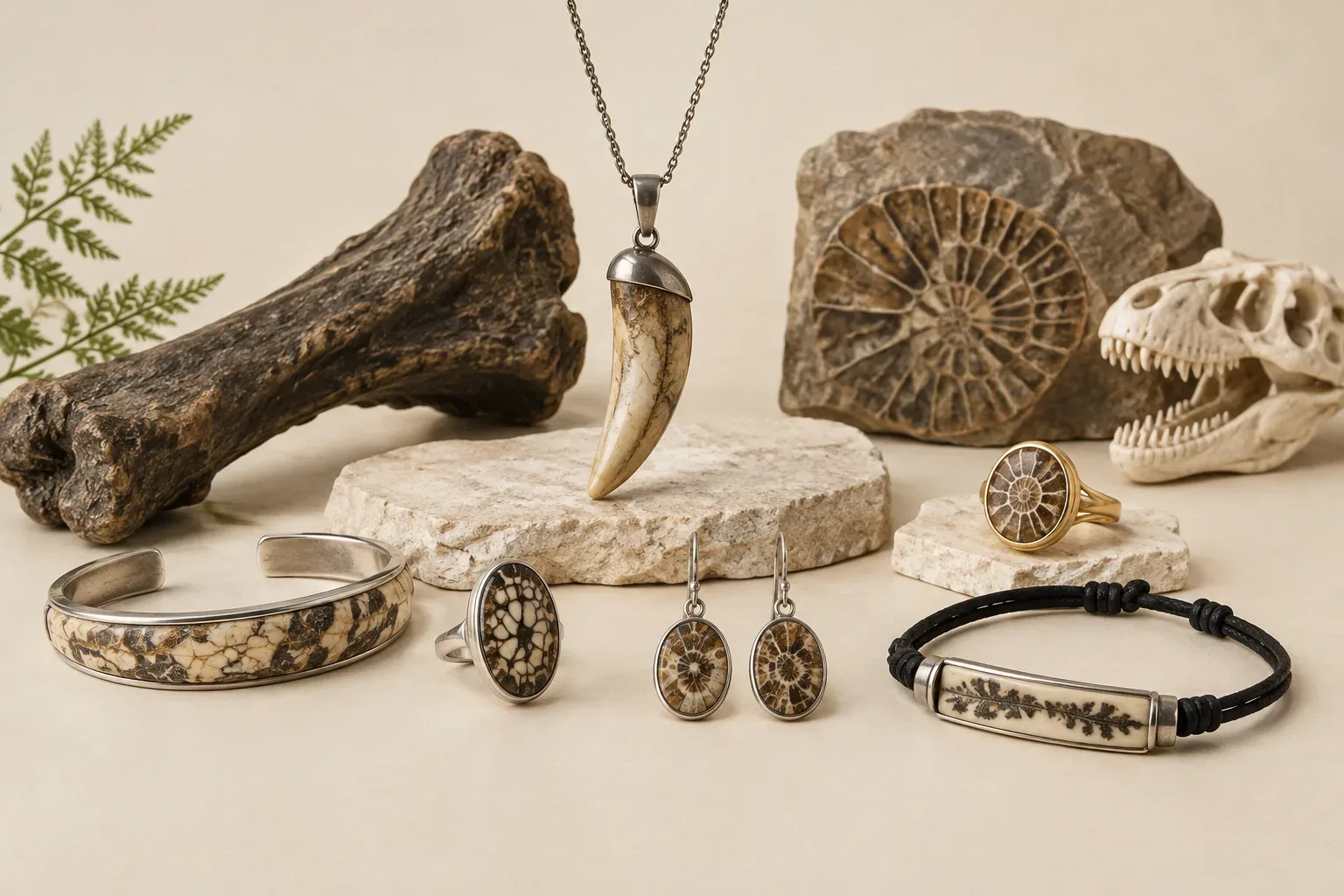
In the modern jewellery market, fossil bone and other fossil materials are treated and presented similarly to other gem and semi‑precious materials. As the Victoria and Albert Museum’s resources on gemstones explain, gem material—whether mineral or organic—is cut, polished and set into familiar jewellery forms. Fossil bone is commonly fashioned as cabochons, beads, inlays, and pendants that are set into rings, necklaces, bracelets and brooches.
Because fossil bone is handled like other gem material in contemporary workshops, buyers should expect it to be available in a range of finishes and settings. Styles vary from distinctly scientific or natural-history inspired mounts—appealing to collectors and museum-enthusiasts—to purely decorative, fashion-led settings. The visual interest often comes from the internal structure and coloration preserved in the fossil rather than a pre-existing cultural symbol.
Material disclosure and authentication: what to ask sellers
The Federal Trade Commission advises that buyers should expect clear disclosure about materials, treatments, and imitations when purchasing gemstones and similar goods. Ask the seller whether the piece is natural fossil bone, whether it has been stabilized or treated, and whether any imitation or composite techniques were used. Honest disclosure is a standard consumer right; reputable dealers provide documentation about treatments, origin and any repairs or reconstructions.
Provenance helps both ethical choice and meaning. If the provenance is documented—where the specimen was found, how and when it entered the trade, and whether it was legally collected—this information contributes to the story you can attach to the object. If a seller cannot or will not supply basic provenance and treatment information, consider buying elsewhere.
Responsible selection and respectful gifting
If you are choosing dinosaur bone jewellery for yourself or as a gift, start with the recipient’s interests. People who work in or enjoy natural history, paleontology, or geology may appreciate the scientific connotations; others may prefer the aesthetic qualities alone. Avoid assuming a particular symbolic or spiritual significance unless you know the recipient wants it.
Consider ethical and legal questions before purchasing. Request clear information about sourcing and whether the material has been collected in accordance with local laws and landowner permissions. Bear in mind that fossil specimens can be culturally sensitive or subject to local heritage protections; when in doubt, ask the seller and, if necessary, consult an institutional or legal authority. Prioritise reputable dealers, museum stores or established artisans who supply documentation and are transparent about treatments and origin.
Care, longevity, and display
Fossil materials are often stable but can be more fragile than many gemstones, depending on their preservation and any treatments they received. Follow general gemstone-care practices: avoid harsh chemicals, store pieces separately to prevent scratches, and clean gently according to the maker’s instructions. When in doubt about cleaning or repair, consult a jeweller experienced with organic or fossilized materials or seek guidance from museum conservation resources.
If a piece is intended as a keepsake or heirloom, include a written note with provenance and care instructions so future owners understand both the object’s material nature and any special handling it requires.
Contextualising meaning in a changing material culture
The Victoria and Albert Museum’s work on jewellery history reminds us that meanings attached to objects evolve: a material that is novel in one era becomes a conventional luxury in another, and new scientific or cultural knowledge can shift public perception. The meaning of dinosaur bone jewellery is therefore best understood as emerging from a modern network of collectors, makers, museums, hobbyists and scientists rather than from an inherited symbolic tradition.
Wearing or gifting dinosaur bone jewellery can be a way to celebrate curiosity about Earth’s past, support skilled makers who work with unusual materials, or simply enjoy an object’s colour and pattern. Because these meanings are contemporary and personal, wearers are free to shape what the piece signifies to them, provided they do so with respect for provenance and legal considerations.
Final thoughts
When people ask about 'dinosaur bone jewelry meaning,' the most accurate answer is that meaning today is created by wearers and makers, moderated by transparent sourcing and informed by the modern history of jewellery materials. Museums such as the Victoria and Albert Museum show how jewellery meanings shift over time, and consumer-protection guidance from agencies like the FTC emphasises clear disclosure about materials and treatments. Choose pieces from transparent sellers, ask about provenance and treatment, and gift with information so the recipient can appreciate the object’s material story as well as its aesthetic.
Frequently asked questions
Is 'dinosaur bone' an ancient symbol with religious meaning?
No; there is no documented historical record of dinosaur bones being used as a religious or traditional symbol in pre-modern cultures. The symbolic meanings you see today are contemporary and personal rather than inherited.
How can I tell if a piece contains real fossil bone?
Ask the seller for provenance and any laboratory or expert reports. Reputable dealers should disclose whether a piece is natural fossil bone, whether it has been stabilised or otherwise treated, and whether parts are composite or imitation.
Are treatments or stabilisation common, and should they be disclosed?
Yes. The Federal Trade Commission recommends clear disclosure of treatments, enhancements and any imitations. Always request written information about treatments before you buy.
Is it appropriate to gift dinosaur bone jewellery?
Gifting is appropriate when the recipient appreciates the material for its aesthetic or scientific connections. Provide provenance and care information with the gift, and avoid implying cultural or spiritual meanings that are not documented unless the recipient specifically values that narrative.
How should I care for fossil bone jewellery?
Treat fossil jewellery gently: avoid harsh chemicals, hard impacts and extreme temperature changes. Clean according to the maker’s instructions and consult a jeweller experienced with fossil or organic materials for repairs.
Where can I learn more about gemstone identification and jewellery history?
Museum resources such as the Victoria and Albert Museum’s guides on jewellery history and gemstones provide useful context about how materials enter fashion and acquire meaning over time.
Sources and further reading
- Bedazzled: A History of Jewellery — Victoria and Albert Museum
- An A-Z of Gemstones — Victoria and Albert Museum
- Buying Gemstones, Diamonds, and Pearls — Federal Trade Commission