Meaning at a glance
This ammonite jewelry buying guide explains what the historical record supports about fossil and gemstone use in jewelry, distinguishes documented cultural evidence from contemporary personal meanings, details how ammonite appears in jewelry, outlines common treatments and disclosure practices, and offers practical selection, gifting, and care advice.
Quick answer
Ammonite jewelry buying guide — concise answer: fossilized spiral shells are used as decorative elements and gemstones in modern jewellery; historical use of fossils and organic gems in personal adornment is documented in museum collections and scholarship, but specific cultural meanings vary and later popular interpretations are not universally supported. When buying, ask sellers about material identification, treatment and provenance; expect common stabilizing treatments and require clear disclosure; choose settings and care routines that protect the fragile fossil material.
What the historical record supports
Museum research and exhibition work show that humans have long worn natural materials, and that changing social contexts affect how jewellery is used and understood. The Victoria and Albert Museum presents jewellery history as a record of evolving tastes, technologies, and social meanings, noting that materials regarded as precious or fashionable have changed across cultures and periods (Victoria and Albert Museum).
The V&A’s resources on gemstones also explain that a wide variety of natural materials — minerals, organic gems, and worked fossils — have been incorporated into personal adornment in different times and places, sometimes for visual effect and sometimes for symbolic reasons (Victoria and Albert Museum). These museum sources document the fact of usage and the changing contexts; they do not support a single, universal symbolic meaning for any motif including fossil shells.
Documented historical meanings versus modern interpretations
Documented historical meanings come from material evidence, maker records, and written accounts preserved and interpreted by museums and scholars. The V&A and other museum collections provide the strongest grounded claims: they show how jewellery materials and motifs were linked to status, trade, technology, and fashion at particular times and places (Victoria and Albert Museum).
Modern personal interpretations — for example, ideas about fossils bringing healing energy, protection, or specific spiritual qualities — are contemporary meanings created by wearers, retailers, or popular culture. These modern meanings are valid as personal or cultural expressions but should not be presented as historical facts unless the provenance and primary evidence support them. The V&A’s approach to jewellery history underscores that meanings shift and are often reinterpreted by subsequent generations (Victoria and Albert Museum).
How the ammonite motif and fossil material appear in jewellery
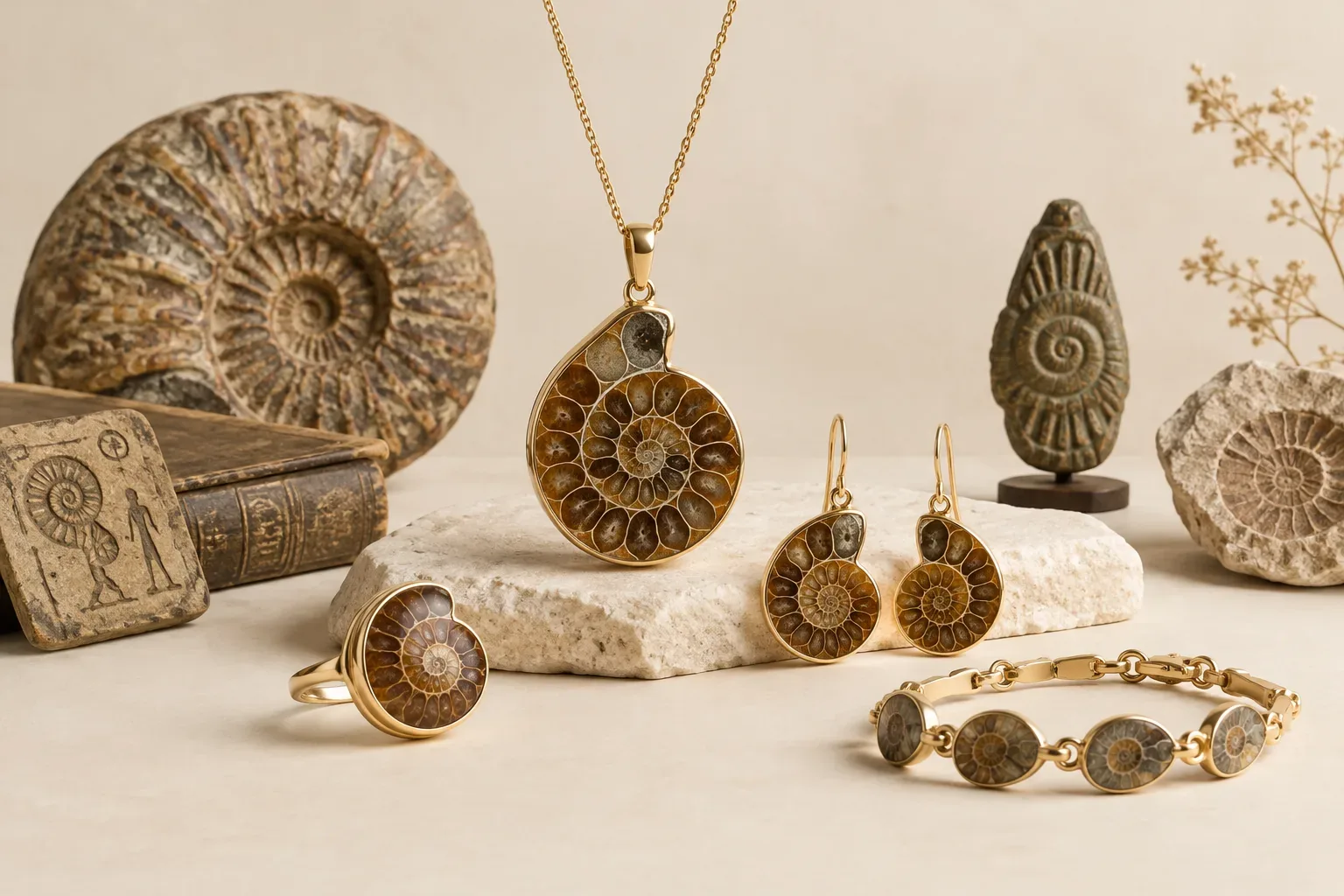
In contemporary jewellery the ammonite motif appears in a few common ways. Craftspeople and designers may set whole polished fossil shells as pendants or brooches, slice and polish cross-sections to display internal structure, or use fossil fragments as inlay. Where the fossil is visually striking, makers often highlight the spiral form as a standalone decorative motif.
Designers also combine fossil material with metals and other gemstones, mounting shells in bezel or prong settings, inlaying shells flush with metal surfaces, or incorporating fossil pieces into mixed-material settings alongside gemstones and pearls. Museum descriptions of gemstone and material use show that creators have long combined different materials to achieve desired visual and social effects, and the same design principles apply when fossil shells are used in jewellery today (Victoria and Albert Museum).
Authenticity, common treatments, and what to ask sellers
Ask sellers directly whether the piece contains a natural fossil shell, a treated fossil, a reconstructed composite, or an imitation cast. The Federal Trade Commission advises buyers to expect honest disclosure about material identity and about any treatments or enhancements that affect value or care needs, and to use written descriptions and return policies when possible (Federal Trade Commission).
Common interventions include stabilizing fragile fossil material with resins or adhesives, backing thin slices with supportive materials, polishing surfaces to bring out internal structure, and applying coatings to enhance luster or color. Sellers should disclose such treatments because they affect durability, care, and value. Unscrupulous imitations may include molded resins or plastics cast to look like fossils; again, disclosure and the seller’s reputation are critical.
When authenticity matters to you, ask for magnified images, description of treatments, and any available provenance. Request a clear returns policy and, for higher-value pieces, consider asking for third-party identification from a reputable gemological or conservation laboratory. The FTC’s consumer guidance on buying gemstones and related materials emphasizes that transparent disclosure and documentation are essential when purchasing treated or unusual materials (Federal Trade Commission).
Selection and gifting guidance — practical and respectful choices
Decide first whether you want a piece for aesthetic reasons, historical interest, or because of a personal meaning attached to fossils. If aesthetics are primary, focus on cut, color, patina, and how the fossil is mounted. If historical or educational interest is central, prefer pieces with clear provenance and vendor notes about where the material was sourced and how it was prepared.
Gifting ammonite jewellery invites sensitivity to recipient beliefs and tastes. Do not assume a receiver shares contemporary spiritual interpretations. If you wish to gift a fossil piece for symbolic reasons, explain the modern meaning you attach to it in a card or conversation rather than implying a universal historical association. For heirloom or significant purchases, insist on documented provenance and full disclosure of treatments, and choose a reputable seller with clear return terms.
Also be mindful of legal and ethical issues. Laws and collecting ethics around fossils vary by jurisdiction. In some places, significant fossils are protected and cannot be legally collected or sold; in others, commercial collection is regulated. If provenance or legality is unclear, ask the seller to clarify source and compliance. Choosing established galleries, museum shops, or reputable dealers reduces risk and supports responsible practices.
Care and maintenance of fossil-based jewellery
Fossil material used in jewellery is often more fragile and porous than common gemstones. To protect such pieces, store them separately to avoid abrasion, keep them away from harsh chemicals and cleaners, and avoid prolonged exposure to high heat or direct sunlight which can affect any resins or coatings.
Clean fossils gently with a soft, dry or slightly damp cloth. Avoid immersion or aggressive mechanical cleaning when the fossil is stabilized with resin or backed with composite materials; those interventions can be damaged by solvents or ultrasonic cleaners. When in doubt, ask the seller or a qualified conservator for cleaning guidance for that specific piece.
For mounted pieces, check settings regularly to ensure thin fossils are supported and secure. If you notice newly loosened fragments, consult a conservator or a jeweller experienced with fossils rather than attempting home repairs that could cause further damage.
Frequently asked questions
How can I tell if an ammonite in jewellery is genuine?
Ask the seller for clear photographs and a description of the material and any treatments. Genuine fossil shells show internal structure and often have natural variation in color and texture; trustworthy sellers will disclose stabilizing or backing treatments. For significant purchases, request third-party identification or a certificate.
What treatments should I expect with fossil jewellery?
Fossils used in jewellery are commonly stabilized with resins, backed for support, polished, or coated to enhance appearance. The Federal Trade Commission advises that sellers must disclose treatments that affect appearance or value, so ask for details before buying (Federal Trade Commission).
Are ammonite pieces fragile?
Fossil material can be more fragile and porous than many gemstones. Thin slices or polished fossils may be supported with backing or set in protective mounts. Store pieces separately, avoid hard knocks, and get professional advice for repairs.
Do ammonite motifs have a single historical meaning?
No. Museum scholarship shows jewellery meanings change over time and between cultures. Documented historical meanings come from context-specific evidence; modern spiritual or healing claims are contemporary interpretations rather than universal historical facts (Victoria and Albert Museum).
Is it ethical to buy fossil jewellery?
Ethical considerations depend on local laws, conservation status, and how the material was sourced. Ask sellers for provenance and compliance information; choose reputable dealers or museum shops when possible to reduce legal and ethical risks.
How should I clean ammonite jewellery?
Clean gently with a soft, dry or slightly damp cloth. Avoid strong chemicals, solvents, or aggressive mechanical cleaning that could damage stabilized or backed fossils. If unsure, consult the seller or a qualified conservator.
Should I ask for a return policy or certificate?
Yes. Request a clear written return policy and, for higher-value purchases, consider third-party identification or a certificate. Documentation helps protect you if the material is misrepresented or if undisclosed treatments are discovered.
Sources and further reading
- Bedazzled: A History of Jewellery — Victoria and Albert Museum
- An A-Z of Gemstones — Victoria and Albert Museum
- Buying Gemstones, Diamonds, and Pearls — Federal Trade Commission