Meaning at a glance
This article explains the documented history and evolving contexts of onyx cuts and settings, separates historically attested uses from modern personal interpretations, describes how onyx appears in jewelry, and gives practical, culturally respectful guidance for selecting and gifting onyx pieces.
What the historical evidence shows
Material, cut, and use of onyx have changed across cultures and periods. The Victoria and Albert Museum describes how gemstones, including banded varieties such as onyx and agate, were worked in the ancient Mediterranean and reused in later European jewellery traditions. The museum’s surveys of jewellery history show continuity in techniques such as carving (intaglio and cameo) and the use of polished, unfaceted surfaces for dark stones in multiple periods.
Museum documentation emphasizes social context: jewellery styles shift with taste, technology and ritual use. For example, carved dark stones appear in engraved signets and as set stones in later European fashions; the same broad material—layered chalcedony—was adapted differently in different eras. Those observations are based on museum study of collections and objects, not on a single universal meaning.
Separating documented history from later or personal meanings
The historical record shows how onyx was cut and used; it does not support a single, unchanging symbolic meaning across time or place. According to the Victoria and Albert Museum, onyx and similar stones were worked in particular ways (for example, carved or polished) and employed in jewellery forms that reflected contemporary tastes and functions. Where modern sources ascribe spiritual or protective powers to onyx, those are contemporary beliefs or personal interpretations rather than universally documented historical functions.
Be explicit about what is documented and what is modern interpretation when you describe a piece. Note, for instance, that a Victorian-era black-set ring in a museum may tell you about mourning dress and aesthetic preference in that period (a documented context), but it does not prove that every wearer across time intended or believed the same symbolic meanings attributed today.
Common cuts and why they matter
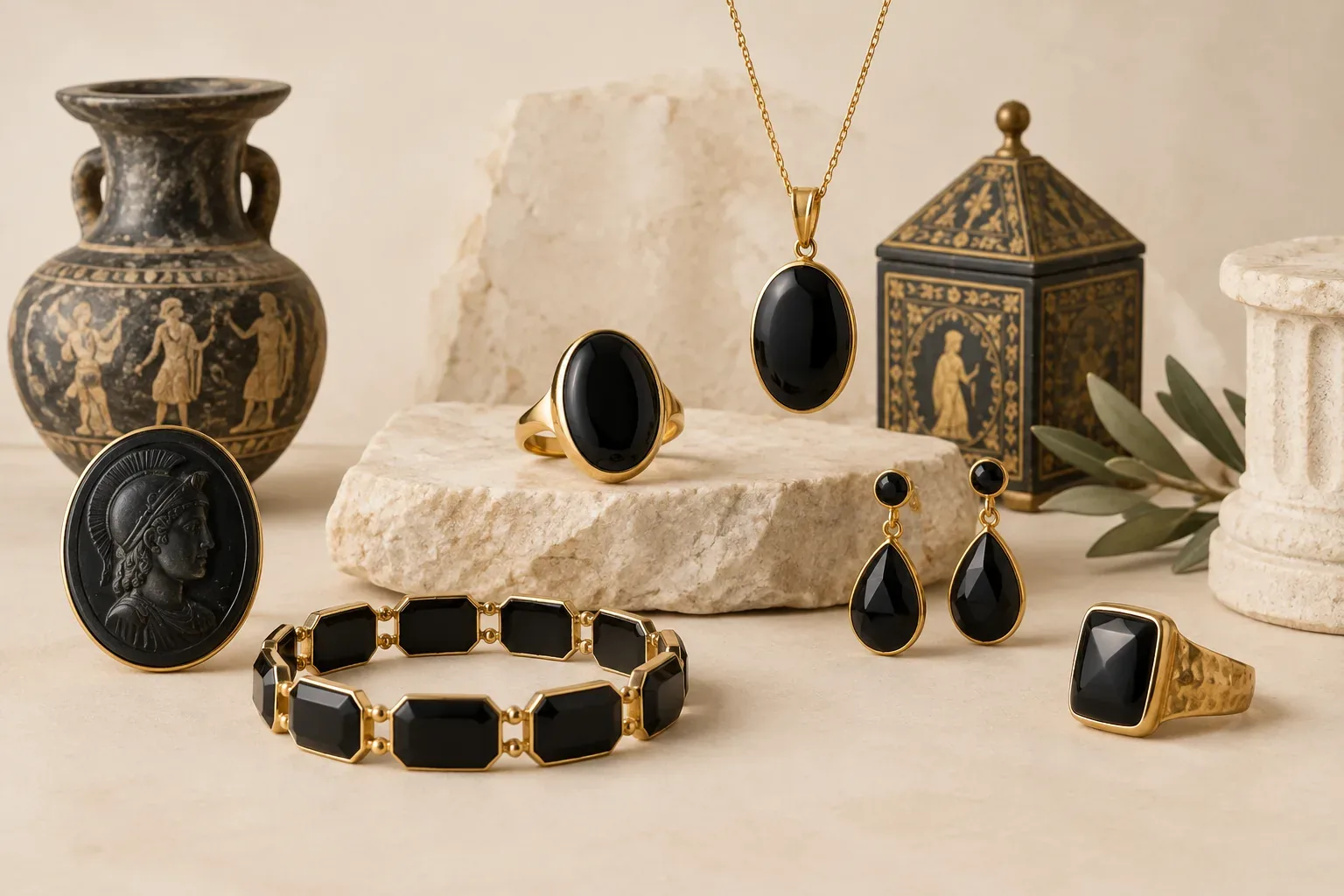
Museum descriptions and gemstone guides highlight a few recurring cuts for onyx that are both traditional and practical. Polished cabochons—smooth, rounded domes—are common because they emphasize the stone’s color and banding and reduce the risk of chipping along facets. Carved techniques such as intaglio (incised design) and cameo (relief carving using layered material) appear where artisans used the banded structure of onyx to create contrast in carved images or portraits.
Faceting is less common but possible; it emphasizes sparkle over a stone’s monochrome look and requires careful planning to avoid showing internal layers awkwardly. The cut you choose affects both appearance and durability: smoother, more protective cuts are generally more forgiving in everyday wear.
Settings that protect beauty and structure
Historical and modern jewellery both use setting choices to protect cut stones. Bezel settings—where a metal rim encircles the stone’s edge—are historically common and remain a sensible choice for onyx because the rim supports and guards the edges of smooth or carved stones. Low-profile settings reduce the likelihood of catching on fabric and protect the stone from impact.
Prong settings expose more of the stone and can look lighter and more modern, but they offer less edge protection, which is a practical consideration for stones that are polished rather than faceted. When selecting a setting, weigh the wearer’s lifestyle, the piece’s intended use, and the stone’s cut: protective mounts suit everyday rings, while more open settings can work for occasional-wear pendants and earrings.
How onyx motifs and traditions appear in jewellery
Onyx appears in jewellery in several recognisable ways: as polished cabochons set in rings or brooches, as carved cameos and intaglios that exploit the stone’s layered colors, in beaded necklaces, and as inlays or pavé-like accents in geometric designs. Museum surveys show these forms across periods—from carved personal seals to 19th- and 20th-century fashion pieces—each reflecting the technical possibilities and aesthetic preferences of the moment.
Motifs—such as portrait cameos, signet surfaces, or geometric Art Deco inlays—use onyx for contrast or tone. The same material can therefore read very differently depending on context: it may signal restraint in formal dress, serve as a durable signet surface, or be used for dramatic high-contrast designs in modern fashion jewellery.
Practical guidance for choosing and gifting onyx jewellery
Match the piece to the recipient’s lifestyle and taste. For everyday rings, prefer protective settings and classic cuts such as cabochons; for occasional pieces, you can select more exposed settings or delicate carving. Consider metal choices and finishes that complement the stone’s tone—black onyx pairs with both yellow and white metals, but the overall design should reflect the wearer’s usual jewellery palette.
Ask the seller about treatments and imitations and request documentation when appropriate. The Federal Trade Commission advises consumers to seek disclosure of treatments, origin claims, and whether a stone is natural, treated, or synthetic. If provenance matters—antique, studio-carved or mass-produced—request clear information and, for valuable purchases, written confirmation of those attributes.
Be culturally respectful. If the piece displays motifs associated with particular religious or cultural traditions, ask about their meaning and suitability before gifting. Museum collections show that similar forms can have very different functions and meanings in their original contexts, so avoid assuming a single meaning for a motif and prefer open conversation about intent and respect.
Care, maintenance and long-term value considerations
Choose settings that make maintenance straightforward: bezels and closed-back settings hide the stone’s undersides but can make routine cleaning easier because fewer edges trap dirt. Confirm whether a stone has been stabilized or dyed and follow care guidance from the seller; treated stones can require different cleaning approaches. When you need authoritative advice about disclosure and material treatment, follow the Federal Trade Commission’s consumer guidance on buying gemstones and asking about treatments.
For long-term value, provenance, maker, and condition matter more than the stone alone. Museum collections and historical studies emphasize the role of craftsmanship and context in how objects are valued over time. If resale or heirloom status is a concern, retain purchase documentation and any lab reports that accompany the item.
Final considerations: blending history and personal meaning
Use documented history as a guide, not a prescription. The Victoria and Albert Museum’s work helps us understand how artisans and wearers used onyx in specific historical contexts, which can inform design choices today. At the same time, modern wearers often assign personal meanings that extend or depart from those historical contexts—those contemporary meanings are valid personal or cultural expressions, but they should be acknowledged as modern interpretations rather than historical facts.
When choosing onyx cuts and settings, combine respect for historical technique and the practical needs of the wearer: select cuts that flatter the stone’s inherent qualities, choose settings that protect it, verify disclosures about treatments or imitations, and be mindful of cultural associations if the motif carries specific communal meaning.
Frequently asked questions
What are the most durable settings for onyx?
Bezel and low-profile settings are generally the most protective for onyx because they encircle and support the stone’s edges; choose these for rings or pieces intended for regular wear.
Can onyx be faceted or is it only cut as cabochons?
Onyx can be faceted, but cabochons and carved cuts are more common; cabochons emphasize smooth color and reduce chipping risk while carved cuts exploit banding for cameos and intaglios.
How should I verify whether an onyx is treated or synthetic?
Ask the seller for written disclosure of treatments and origin. The Federal Trade Commission advises consumers to request clear information about whether a stone is natural, treated, or synthetic before purchase.
Are the symbolic meanings often ascribed to onyx historically documented?
Documented museum research shows how onyx was used and fashioned in particular contexts, but many spiritual or protective meanings commonly cited today are modern personal or cultural interpretations rather than universally documented historical facts.
Is onyx appropriate as a gift for someone from a specific cultural or religious background?
Consider the motif and context: similar stone forms have different meanings across traditions. If the motif has an identifiable cultural or religious association, ask or research its significance and be respectful when gifting.
How should I care for onyx jewellery?
Care depends on treatments and setting; ask the seller for specific cleaning instructions. Generally, avoid harsh chemicals and sudden impacts, and store pieces to prevent scratches and knocks.
Sources and further reading
- Bedazzled: A History of Jewellery — Victoria and Albert Museum
- An A-Z of Gemstones — Victoria and Albert Museum
- Buying Gemstones, Diamonds, and Pearls — Federal Trade Commission