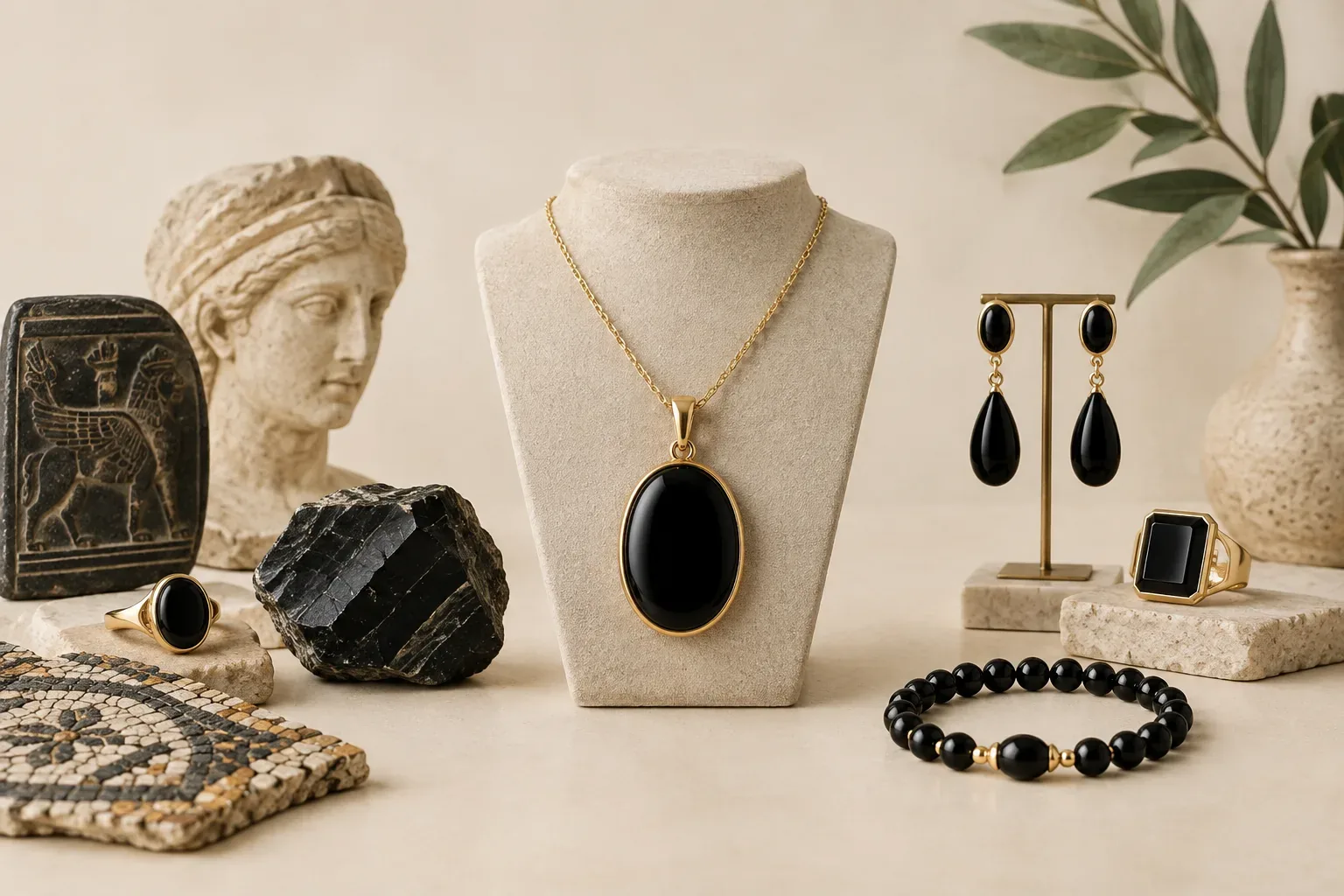
Meaning at a glance
Document the historical uses and changing contexts of onyx and related motifs using museum evidence, separate documented cultural or religious uses from modern personal meanings, and give practical, disclosure-aware guidance for evaluating, buying, and gifting onyx jewelry.
What onyx is — a brief, evidence-based definition
Onyx is a variety of chalcedony, the microcrystalline form of quartz. Its most familiar commercial appearance is banded or uniformly black chalcedony used in beads, inlay, and carving. The Victoria and Albert Museum describes gemstones and traditional working methods in ways that help place stones like onyx in jewellery-making and collecting contexts rather than in purely metaphysical terms.
Documented historical evidence and changing contexts
Museum scholarship shows that gemstones and motifs have moved through different social roles rather than carrying a single, unchanging meaning. The Victoria and Albert Museum’s materials on jewelry history explain how gemstones have been used for status, identity, ornament and technical display across periods, and how tastes and meanings shift with social norms and technology.
For example, carved stone techniques such as intaglio and cameo appear in Classical antiquity and reappear in later revivals; the same material could be used for personal seals, amulets, or purely decorative jewels in different centuries. The V&A’s overview of gemstones and its exhibition materials place these technical and stylistic shifts in particular social contexts rather than as fixed, universal meanings.
Because the V&A frames jewellery as a constantly changing social practice, evidence for particular religious or cultural uses of onyx must be tied to specific periods and sources. Where museums document a use—such as gemstones appearing in Roman cameos, or particular forms in Victorian jewellery—that documentation is about how people in those times used materials, not about a timeless property of the stone itself.
Historical meanings versus modern personal interpretations
Museum documentation records how people used and valued gemstones at particular times. Those documented uses—status symbols, seals, mourning emblems, fashion accessories—are specific to their cultures and eras, as emphasised by the Victoria and Albert Museum’s histories. Where the V&A documents a function or style, that is a historical claim tied to the named period.
Modern meanings people attach to onyx—such as notions of protection, grounding, or personal symbolism—are contemporary personal or marketed interpretations. They are valid as personal beliefs but are not the same as historically documented uses. When you evaluate an onyx jewel for purchase or as a gift, treat historical evidence and modern symbolism separately: the first is verifiable in museum and historical records; the second is subjective and varies by the wearer.
How onyx and related motifs appear in jewelry
Onyx appears in a variety of forms in jewellery: carved cameos and intaglios, signet-style stones set into rings, beads and rosary strands, flat inlays in men’s and women’s accessories, and as polished cabochons in brooches and pendants. The Victoria and Albert Museum’s resources on jewellery history and gemstones describe these technical uses and how artisans have worked stones into decorative and functional objects.
Motifs carved into onyx can include portraits, classical figures, geometric patterns and floral designs, and in some periods stones were used for mourning jewellery or as signets. The same shape — a carved oval cameo, for example — might have served as a personal seal in one era and as sentimental portrait jewellery in another; museum evidence places each use in its historical context.
Quality and value factors to evaluate
Start with the stone: inspect color and banding. For many buyers, high-quality black onyx will show an even, deep tone with a smooth, glossy polish; for banded varieties, crisp, regular bands with good contrast and a clean surface add value. Look for chips, hairline fractures, or areas where the polish is worn, as these reduce both aesthetic appeal and durability.
Assess workmanship: how well is the stone cut, carved or set? Symmetry, even polish on a cabochon, fine detail in carving, and secure, professional mounting in metal all add to market value. A large, well-carved piece from a skilled lapidary will usually command a higher price than a similar-sized, roughly finished stone.
Consider treatments and imitations: sellers often dye chalcedony to deepen colour or use composites and assembled stones to produce larger pieces. The Federal Trade Commission advises buyers that treatments and imitations exist and that sellers should disclose material treatments and enhancements. Ask directly about dyeing, heating, stabilization or assembled stones, and expect truthful disclosure.
Factor in context: provenance, age, and maker can shift value. A signed or documented historical piece, or a work by a recognized designer or house, will typically be priced higher than an anonymous modern mass-produced item. Museum writing on jewellery history highlights how social context, not just material, shapes value over time.
Practical buying steps and questions to ask
When inspecting onyx jewellery in person or online, ask for clear photos of the unmounted stone and the finished piece, including close-ups of any carved detail, edges and the back. Check that the setting is secure and that prongs or bezels fully protect the stone edges.
Ask the seller whether the stone has been dyed, heat-treated or otherwise altered, and request any available documentation or a written statement. The Federal Trade Commission recommends that consumers expect honest disclosure about treatments and imitations; insist on that disclosure before purchase.
Request information about return policies, appraisals and any lab certificates if the item is being sold at a significant premium. For vintage and antique pieces, provenance and maker marks can justify higher value but verify claims and, where possible, consult a reputable appraiser or a museum reference.
Examine how the piece fits your wear plans: lighter, finely carved onyx is appropriate for delicate pendants and brooches, while solid, larger stones work for rings and men’s signet-style jewellery. Consider daily wear versus occasional wear—how the setting protects the stone matters for longevity.
Selection and gifting guidance
Match the piece to the recipient’s style and lifestyle. For a daily-wear ring, prioritise secure settings and an unbroken surface over elaborate but fragile carving. For a sentimental or display piece, a historic or finely carved cameo may be appropriate even if it requires more careful handling.
Respect cultural and historical meanings. If you choose onyx because of a specific cultural motif or historical form, make sure you understand the documented meaning as presented by museum or scholarly sources rather than relying on popular generalisations. The Victoria and Albert Museum’s resources are a good starting point for contextual research.
Be transparent when giving a historically styled or vintage onyx piece as a gift. If an item is a reproduction, a dyed modern stone, or a true antique, say so—honest context respects both the recipient and the object’s history. If the meaning you attach is personal, make that clear to the recipient so the gift’s story is sincere rather than presented as a necessarily ancient or universal truth.
Care and long-term considerations
Treat onyx jewellery as you would other delicate carved or polished gemstones: avoid hard knocks, store pieces separately to prevent abrasion, and clean gently with a soft cloth and mild soap and water when needed. Avoid harsh chemicals and ultrasonic cleaners if the stone has been treated or if the carving and setting are fragile.
For valued or historic pieces, consider professional conservation advice rather than attempting repair yourself. Museum practice, as reflected in institutions such as the V&A, emphasises careful handling and documentation, so preserve receipts, provenance notes and any conservation records with the item.
Final thoughts
Onyx quality and value come from a combination of material attributes, craftsmanship and context. Use museum resources to understand historical uses and social context, and use consumer-protection guidance to insist on disclosure of treatments and imitations. Separate documented historical meanings from personal or modern symbolism, and choose pieces that match the recipient’s style and intended use.
Frequently asked questions
How can I tell if a black onyx has been dyed?
Ask the seller directly and request a written disclosure. Dyed chalcedony often shows uneven colour at drill holes, facet edges or where polish is worn. The Federal Trade Commission advises that sellers must disclose treatments and enhancements, so insist on clarity before purchase.
Are there common imitations of onyx I should watch for?
Yes. Glass, plastic, assembled composites, and other dyed chalcedony can be offered as onyx. Ask for clear photos or an in-person inspection, and request disclosure of any assembled components. For higher-value purchases, consider a professional appraisal or lab report.
Does historical provenance affect onyx value?
Provenance, maker attribution, and age can increase value, particularly for museum-quality or signed pieces. Museum scholarship demonstrates that context influences value; confirm provenance with documentation and, when necessary, independent appraisal.
How should I care for onyx jewellery?
Clean gently with a soft cloth and mild soap and water, avoid harsh chemicals and ultrasonic cleaners, and store pieces separately to prevent abrasion. For historic or fragile items, seek professional conservation advice rather than attempting aggressive cleaning or repair.
What practical questions should I ask a seller before buying?
Request information on treatments (dyed, heated, stabilized), any lab reports or appraisals, the return policy, and clear images of the stone and setting. The FTC recommends that consumers expect honest disclosure about treatments and imitations.
Sources and further reading
- Bedazzled: A History of Jewellery — Victoria and Albert Museum
- An A-Z of Gemstones — Victoria and Albert Museum
- Buying Gemstones, Diamonds, and Pearls — Federal Trade Commission