Meaning at a glance
Explain the documented history and changing contexts of the jade treatments and imitations motif, separate cultural or religious evidence from later popular interpretations, and give practical guidance for choosing and wearing the motif in modern jewelry.
What the historical record shows (and which cultures appear in that record)
Museum collections and interpretive material document that jade has long been used in many places and contexts. The Victoria and Albert Museum presents jade within a broad global history of jewelry, noting carved and polished jade objects in East Asian, Mesoamerican, and Pacific contexts among others. Those collections show jade appearing as personal ornament, ritual objects, and status markers rather than as a single, uniform symbol.
Because jade occurs across different cultures and periods, its meanings and uses were local and varied. The Victoria and Albert Museum’s writing about gemstones and jewelry traces these changes in social and material context rather than offering one fixed symbolism for all jade objects. When you read museum descriptions or provenance notes, they document specific uses—such as personal adornment, ritual objects, or trade goods—for particular places and times rather than a universal meaning.
Separate documented historical meanings from modern interpretations
Documented historical meanings come from archaeology, museum catalogs, and contemporaneous records that place particular objects in a social or ritual context. The Victoria and Albert Museum’s accounts emphasize that historical meanings for jade are local: a carved form or color can have a specific association in one culture and a different one elsewhere. Those documented associations are the safer basis for understanding a historic piece.
Modern personal or popular interpretations—for example, claims that any jade pendant guarantees health, luck, or spiritual protection—are contemporary layers of meaning that may draw on but do not replace the original context. These modern attributions are often shaped by fashion, tourism, or personal belief. Treat them as individual or cultural preferences rather than universal facts, and distinguish them clearly from what museums record about an object’s historic function or meaning.
How jade appears in jewelry and decorative objects
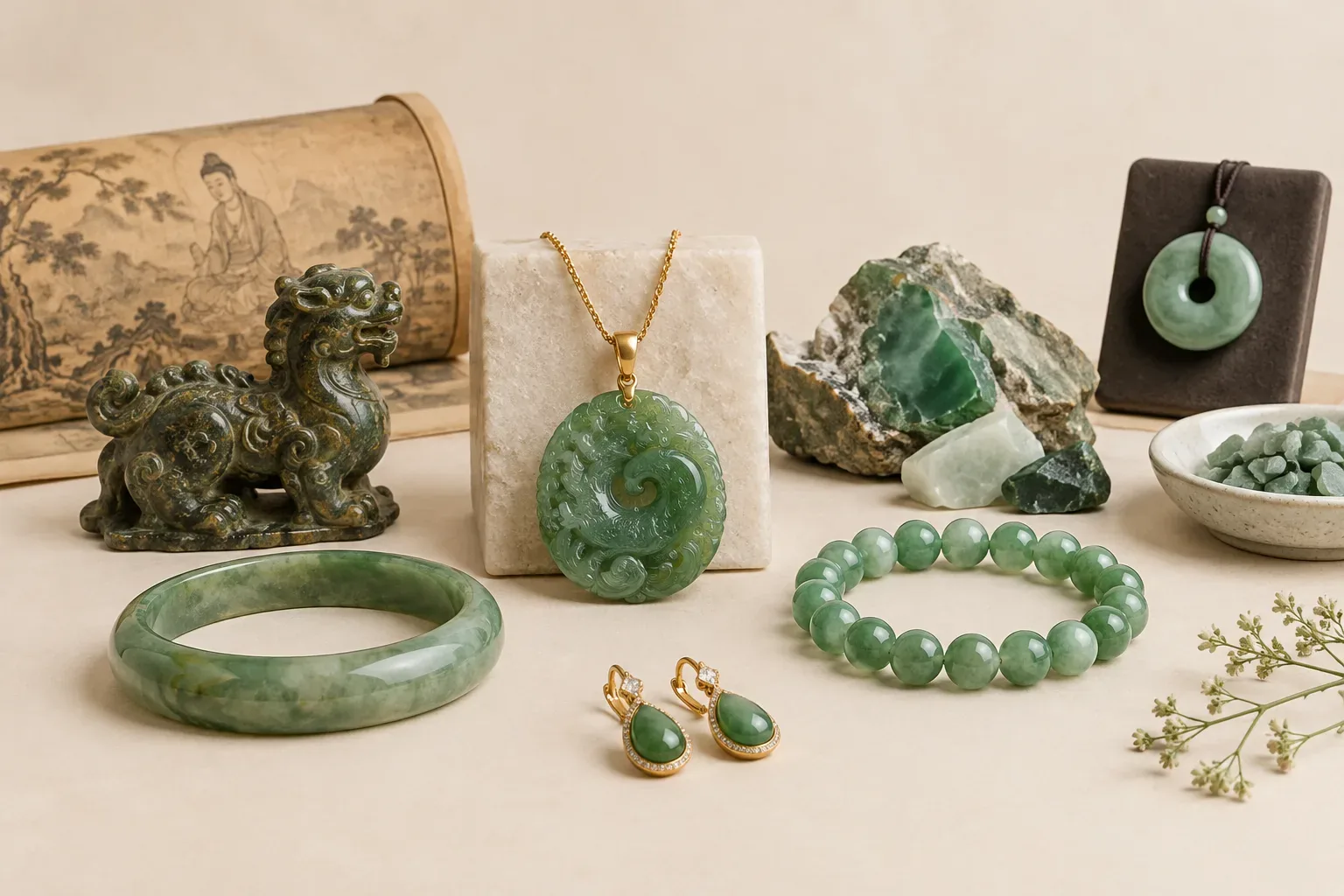
Jade is used in many forms of jewelry: carved pendants, bangles, beads, inlays, cameo-style carvings, and cabochons set into metal. Museum collections described by the Victoria and Albert Museum show both standalone jade pieces—such as carved amulets or bangles—and mixed-material objects where jade is set into gold, silver, or other mounting materials. These forms reflect local carving traditions, available lapidary techniques, and changing fashions.
In addition to historic carved objects, modern jewelers use jade in contemporary settings and design languages. Some jewelers favor the raw, touchable qualities of a bangle; others contrast polished jade with modern metalwork. Whether you encounter a museum piece, an antique pendant, or a new design, recognizing the object’s form helps you judge both its cultural lineage and its likely treatment history.
What 'treatment' and 'imitation' mean for buyers
Treatments and imitations are different things. A treatment alters a natural stone to improve its color, clarity, or durability; an imitation is a non‑jade material made to look like jade. The Federal Trade Commission’s consumer guidance about buying gemstones stresses that sellers should disclose material treatments and whether an item is an imitation or simulant. That guidance is about clear, truthful disclosure to help consumers make informed choices.
Because jade in the market today may be natural and untreated, treated, or a simulant, your questions and expectations should reflect that variety. A treated piece can still be beautiful and appropriate as a gift; an imitation can be an affordable, ethical choice if disclosed honestly. What matters is transparent information about what you are buying.
Practical selection and gifting guidance
Start by asking the seller for a plain answer about three points: whether the item is natural jade (and which species if known), whether it has been treated or stabilized, and whether it is a simulant or an imitation. Request written confirmation of those answers or a gemological report for pieces of higher value. The Federal Trade Commission recommends that consumers require disclosure about treatments and imitations; written documentation reduces ambiguity.
If you care about cultural sensitivity, ask about provenance. Museum notes compiled by the Victoria and Albert Museum show that particular shapes, motifs, and colors can have local meanings; a respectful buyer will learn whether a form is a generic ornamental style or has specific cultural significance, and avoid presenting a culturally specific ritual object as a casual fashion item. When gifting to someone from the culture that uses a given jade motif, consider asking if the recipient would prefer a secular design or a piece with particular traditional formality.
For care and longevity, know how the piece was treated. Some treatments change how a stone responds to heat, chemicals, or ultrasonic cleaning. When in doubt, ask the seller for care recommendations in writing and follow conservative cleaning methods recommended by reputable museums and jewelers. Finally, buy from reputable dealers with clear return policies and positive documentation practices; good dealers will welcome questions rather than avoid them.
Short buyer’s checklist
Before you pay, confirm whether the stone is natural jade (and whether it’s nephrite or jadeite if that matters to you), whether it has undergone any treatment, and whether it is an imitation. Request written disclosure or a lab report for high-value items, check the seller’s reputation and return policy, and be sensitive to cultural meanings when the design has identifiable traditional significance. These steps follow the practical consumer guidance set out by the Federal Trade Commission and the contextual practices documented in museum collections.
Final note on value and meaning
Value and meaning are not the same. Museums such as the Victoria and Albert Museum document how jade’s social and symbolic importance has changed across time and place, which helps explain why some pieces are prized for historical or cultural reasons while others are valued for colour and workmanship. Treatments and imitations influence market value and care requirements, but a treated or imitation piece can have personal or aesthetic value if its origins are disclosed and the buyer understands what they are receiving.
Frequently asked questions
What specific questions should I ask when buying jade?
Ask whether the stone is natural jade and which species if known, whether it has been treated or stabilized, and whether it is an imitation or simulant. Request written disclosure and, for higher-value purchases, an independent laboratory report. The Federal Trade Commission advises consumers to require clear disclosure about treatments and imitations before buying.
How can I tell if jade is real from a photo or market stall?
Photographs are often misleading; small details like translucency, surface texture, and carving style matter and are hard to judge from images. Ask the seller for documentation and a close-up image or video, and insist on honest answers about treatments and whether the item is a simulant. For valuable purchases, rely on a reputable dealer and professional testing rather than a photograph alone.
Are treated jades worth buying?
Treated jades can be attractive and durable; they are a valid choice if the treatment is disclosed. Treatments affect market value and care recommendations, so evaluate whether the treatment meets your expectations for longevity and appearance before you buy. Clear disclosure allows you to decide whether a treated piece is right for you.
Should I get a lab report for jade?
For high-value items or when provenance and treatment status are important to you, a gemological report from a reputable laboratory provides reliable information about species and treatments. The Federal Trade Commission’s consumer guidance supports obtaining documentation where material disclosures affect value and use.
Is it culturally insensitive to wear jade motifs from another tradition?
Context matters. Museum documentation, such as that published by the Victoria and Albert Museum, shows jade motifs have specific meanings in particular cultures. If a piece is obviously a ritual object or uses a culturally specific symbol, ask about its provenance and consider whether a secular or locally produced design would be more appropriate when gifting outside that culture.
Sources and further reading
- Bedazzled: A History of Jewellery — Victoria and Albert Museum
- An A-Z of Gemstones — Victoria and Albert Museum
- Buying Gemstones, Diamonds, and Pearls — Federal Trade Commission